Clear Sky Science · en
Consolidation and surface protection of granite using modified polysiloxane oligomers for cultural heritage restoration
Why saving stone monuments matters
Across the world, temples, cliff carvings, and stone statues carry stories from earlier civilizations. In China’s Fujian Province, many of these treasures are carved from granite, a rock usually thought of as tough and permanent. Yet acid rain, humidity, and pollution slowly eat away at their surfaces, causing flaking, fading, and loss of detail. This study explores new protective treatments designed to strengthen weakened granite from the inside while gently shielding its surface, aiming to keep these cultural landmarks standing and legible for generations.
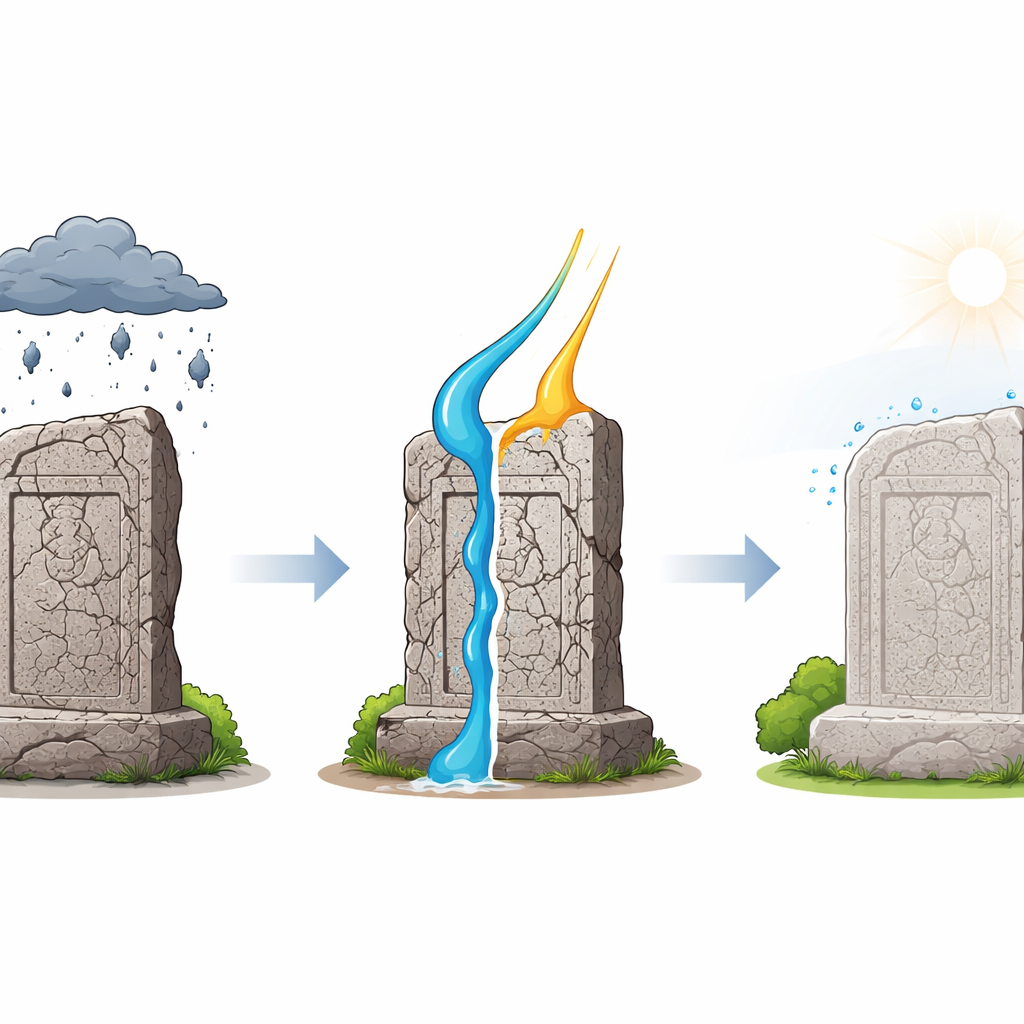
How granite relics are under attack
Granite in Fujian faces a harsh combination of high humidity, heavy rainfall, and frequent acid deposition. Over time, rain and airborne pollutants seep into tiny pores and cracks in the stone. Chemical reactions dissolve minerals, while physical stresses from wetting, drying, and freeze–thaw cycles break grains apart. The result is a surface that turns powdery, patterns that blur, and pieces that chip away. Conservators need treatments that can reach deep into this damaged network, glue loose grains back together, repel water, and still allow the stone to “breathe” so moisture does not become trapped inside.
A new blend of stone-strengthening liquids
The researchers tested a family of materials called modified polysiloxane oligomers, mixed with a gentle solvent known as D40. Polysiloxanes are silicon-based molecules that can seep into stone pores, then form a thin, almost invisible network that binds mineral grains together and repels water. Four mixtures were prepared with different polysiloxane concentrations, labelled A (30%), B (25%), C (20%), and D (15%). These were compared with a widely used commercial product, S-130. Granite blocks from a Fujian quarry were first artificially weathered with acid to mimic real relics, then coated with the test solutions and examined using a wide range of measurements, from hardness and ultrasonic sound speed to color, gloss, water uptake, and microscopic imaging.
What the tests revealed about strength and protection
Each mixture showed its own strengths. Solution A, with the highest polysiloxane content, penetrated deeply and built a strong internal framework. Tests of hardness and sound speed through the stone showed that A greatly improved internal cohesion, making the once-loose, weathered granite denser and more solid. Under the microscope, pores and tiny cracks were partly filled without forming a thick crust at the surface, which is important for keeping the stone’s natural look and allowing vapor to escape. Solution D, with lower polysiloxane content and higher solvent content, flowed more easily into fine spaces and spread smoothly across the surface. It delivered excellent water repellency: treated stones absorbed significantly less water than untreated samples and even less than those coated with S-130, all while keeping color changes small enough to remain barely noticeable to the naked eye.
Standing up to harsh weather in the lab
To mimic decades of outdoor exposure in a short time, the team subjected treated and untreated stones to intense “artificial aging” cycles. These included ultraviolet light, hot-and-humid conditions, acid and alkali baths, salt crystallization, and repeated freeze–thaw. Untreated granite and the commercial product both showed cracking, surface roughening, and loss of mineral particles under these stresses. By contrast, the new polysiloxane mixtures, especially D, held up remarkably well. Surfaces stayed smoother, the mottled mineral pattern remained recognizable, and microscopic images showed fewer new cracks and less mineral loss. Measures of hardness, internal sound speed, and water repellency declined only slightly from their post-treatment values, indicating that the protective network survived under punishing conditions.
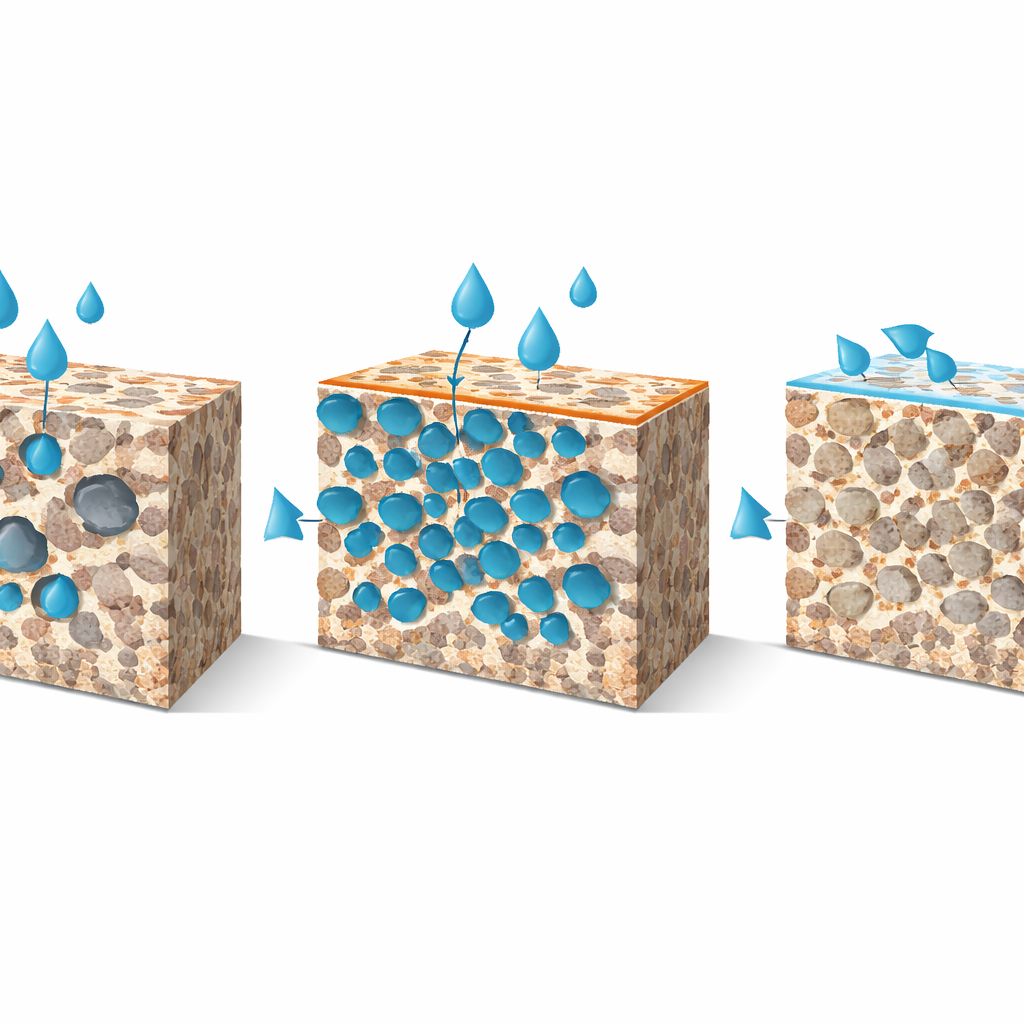
A practical recipe for preserving granite heritage
Putting these results together, the authors propose a simple two-step strategy for real-world use. First, apply solution A several times to deeply reinforce weakened granite, turning its loose inner structure into a stronger, more continuous skeleton. After this cures, apply solution D as a thin surface coat to create a durable, water-repellent skin that still lets water vapor escape and barely alters the stone’s appearance. Laboratory tests suggest that this combination can both stabilize the interior and shield the exterior of granite relics in Fujian’s demanding climate. The authors stress, however, that these are early-stage findings: long-term trials on less critical monuments are needed to confirm that the treatments behave safely and predictably outdoors. If those tests succeed, this approach could become a powerful tool for keeping carved granite heritage clear, legible, and structurally sound far into the future.
Citation: Liu, Y., Ke, Y., Wang, Y. et al. Consolidation and surface protection of granite using modified polysiloxane oligomers for cultural heritage restoration. Sci Rep 16, 8295 (2026). https://doi.org/10.1038/s41598-026-38623-3
Keywords: granite conservation, cultural heritage, stone protection, water-repellent coatings, polysiloxane treatments