Clear Sky Science · en
Parameters optimization of photovoltaic systems using modified quantum inspired particle swarm method
Why smarter solar panels matter
Solar power is often praised as clean and abundant, but getting the most electricity out of a solar panel is a harder problem than it looks. Inside each panel, tiny electrical effects determine how much power is produced under different conditions of sunlight and temperature. Manufacturers do not provide all the hidden details of these inner workings, so engineers have to estimate them from measurements. This paper introduces a new way to do that estimation more accurately and efficiently, which can ultimately help design better solar systems and predict their performance more reliably.
Hidden knobs inside a solar panel
A solar cell can be described using simple electrical building blocks: current sources, diodes, and resistors. Engineers group these into models with one, two, or three diodes to capture different loss mechanisms inside the cell, such as charge recombination or leakage paths. Each model has several unknown "knobs" – parameters like internal currents, resistances, and quality factors – that control the shape of the current–voltage curve, the basic fingerprint of a solar device. Matching this curve to real measurements with high precision is crucial for tasks like forecasting energy yield, designing controllers, and diagnosing faults in photovoltaic systems.

Why traditional methods fall short
Many existing methods try to tune these hidden knobs by minimizing the difference between measured and modeled current–voltage curves. Classical approaches, whether formula-based or numerical, can be fast but often rely on simplifying assumptions, such as ignoring some resistances, which limits accuracy. More recent “metaheuristic” methods, inspired by nature or physics, search broadly through possible parameter combinations and can tackle the strong nonlinearity of solar models. However, they can still get stuck in local dead ends, converge too early to mediocre solutions, or demand heavy computation. A popular technique called quantum-behaved particle swarm optimization (QPSO) is faster than many rivals, but in complex solar models with many parameters it can become inaccurate and computationally costly.
A more disciplined digital swarm
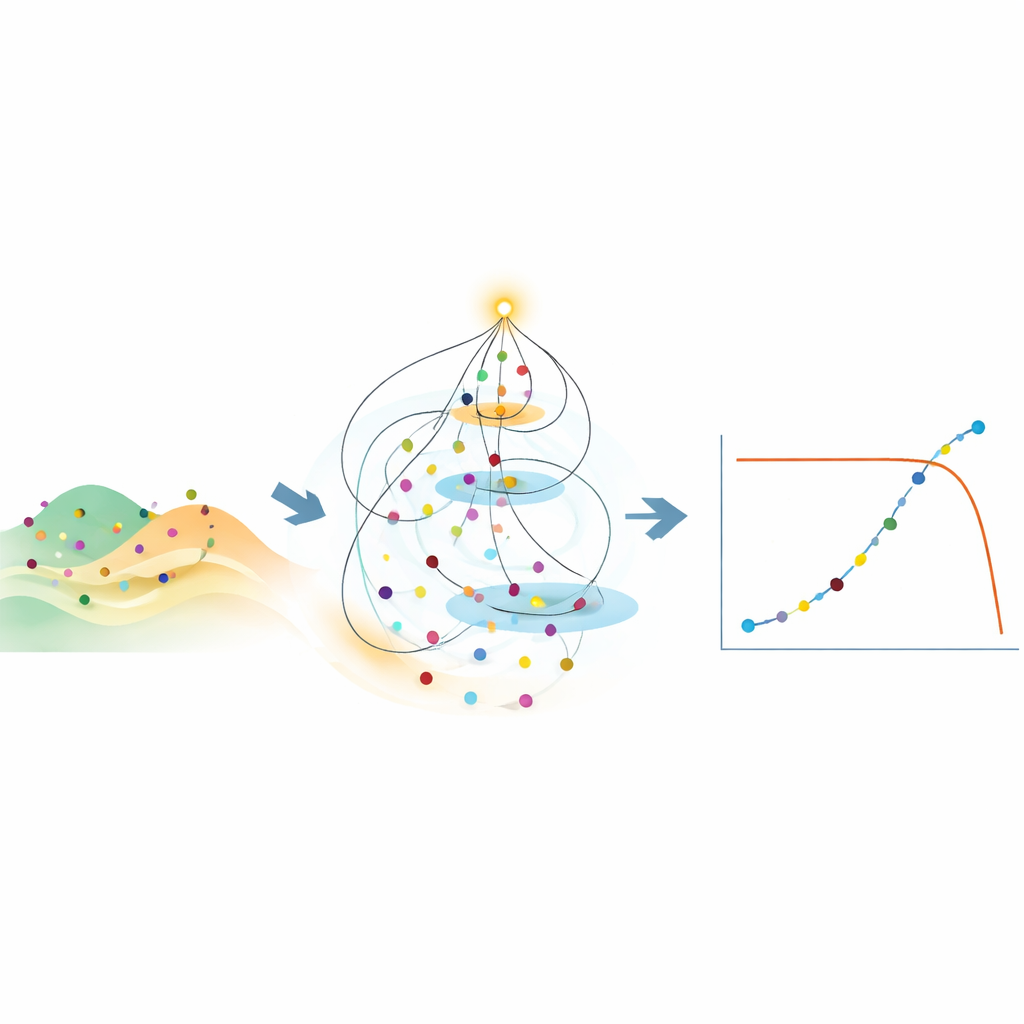
The authors propose a refined variant called the Modified Quantum-inspired Particle Swarm method (MQPSO). Imagine a swarm of candidate solutions, each representing one guess for all the hidden solar parameters, moving through a landscape where height corresponds to error. MQPSO improves how this swarm explores and settles. It starts with a Latin Hypercube sampling scheme that spreads initial guesses evenly across the search space, avoiding early crowding. An adaptive control factor steers the swarm to roam widely at first and then zoom in more carefully later. An elitism reinjection step regularly identifies the best and worst candidates, nudging the worst ones toward the elite without copying them outright, which both accelerates progress and preserves diversity.
Zooming in on the fine details
Beyond these steps, MQPSO adds a dual-attractor mechanism: instead of each particle being pulled only toward its own best position and the overall best of the group, every parameter dimension is influenced by an intermediate point that blends personal and global experience, plus a collective mean of the best solutions. Random directions keep the swarm from freezing prematurely. Once the global best candidate is found by this quantum-inspired dance, a local search technique (Nelder–Mead) performs a final fine-tuning in its neighborhood, squeezing out remaining error. Together, these changes are designed to balance exploration of new regions with exploitation of promising ones, especially in high-dimensional and highly curved error landscapes.
What the tests reveal in practice
To evaluate MQPSO, the researchers applied it to three standard solar cell models (single-, dual-, and three-diode) and to two commercial photovoltaic modules. They compared its performance against standard QPSO and several other modern optimization methods, running each algorithm 30 times on the same datasets. Accuracy was measured using root mean square error, which directly reflects the typical size of the mismatch between measured and modeled current values. Across all cases, MQPSO produced smaller and more consistent errors, with average error reductions of roughly 25% for the simplest cell model, nearly 60% for the dual-diode model, and about 15% for the three-diode model when compared with standard QPSO. Statistical tests confirmed that these improvements were not due to chance.
What this means for future solar power
For non-specialists, the bottom line is that this new algorithm offers a sharper way to “read” what is happening inside a solar panel from the outside measurements alone. By extracting model parameters more accurately, engineers can build digital twins of solar devices that behave much closer to reality. That, in turn, helps improve system design, control, and fault detection, contributing to more reliable and efficient solar installations. While the method still has limitations – including computational cost and sensitivity to measurement quality – it marks a significant step toward smarter, more robust tools for optimizing solar energy systems.
Citation: Rehman, Z.U., Rehman, O.U., Munshi, A. et al. Parameters optimization of photovoltaic systems using modified quantum inspired particle swarm method. Sci Rep 16, 7864 (2026). https://doi.org/10.1038/s41598-026-38620-6
Keywords: solar photovoltaics, parameter estimation, swarm optimization, metaheuristic algorithms, renewable energy modeling