Clear Sky Science · en
Enhancing photothermal therapy effectiveness via tartrazine-induced optical clearing of biological tissues
Making Light-Based Cancer Treatments Work Better
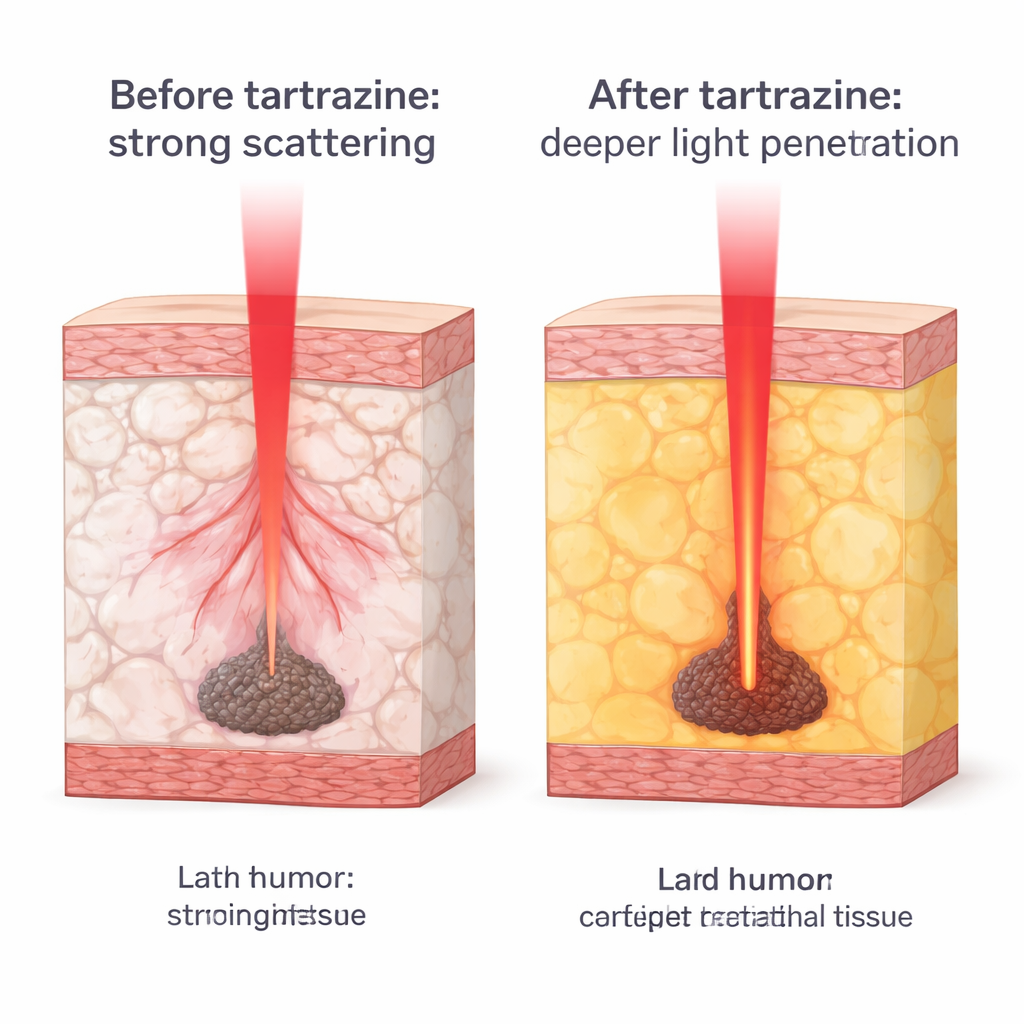
Doctors are increasingly using light to heat and destroy tumors deep inside the body, a strategy known as photothermal therapy. But there is a major obstacle: our tissues scatter light, so only a fraction of the energy actually reaches the target, while healthy areas can be overheated. This study explores an unexpected helper—a common yellow food dye called tartrazine—that can temporarily make tissues more transparent to treatment light and, in turn, make cancer-heating therapies safer and more effective.
A Food Dye with a Hidden Talent
Tartrazine is widely used to color foods and drinks and has a well-documented safety record at dietary doses. The researchers build on recent physics work showing that when tartrazine is dissolved in water, it changes how light travels through that liquid at the near-infrared wavelengths typically used in medical treatments. Instead of ripping apart or dehydrating tissue like many traditional “clearing agents,” tartrazine subtly adjusts how light bends in the watery spaces between fats and proteins. By making the optical properties of these components more similar, the dye reduces the amount of light that gets bounced around and scattered.
Turning Cloudy Tissue into a Clearer Window
To test this idea, the team first created controlled “tissue phantoms”—gel blocks containing tiny plastic beads that mimic how real tissues scatter light. Using computer simulations and experiments, they showed that adding tartrazine can cut scattering by up to about two-thirds, especially in samples filled with larger, densely packed particles, which resemble real biological structures. At carefully chosen concentrations, tartrazine increased how much treatment light passed through these phantoms without making them too opaque from the dye’s own color. The sweet spot was around 0.3–0.5 moles per liter of dye, where the balance between less scattering and extra absorption was most favorable.
From Model Gels to Real Animal Tissue
The researchers then moved from artificial gels to slices of chicken muscle, a closer stand-in for living tissue. After soaking the samples in tartrazine, they measured how much visible and near-infrared light could pass through. The treated tissues became noticeably more transparent, allowing up to about 1.7 times more light through at certain wavelengths. Importantly, this clearing was reversible: when tartrazine-soaked tissues were placed back in plain water, they gradually returned to their original, more opaque state. Image tests showed that fine patterns placed behind the treated tissue appeared sharper and with higher contrast, demonstrating that light was traveling straighter instead of being scattered in all directions.
Delivering More Heat Where It Counts
Better light penetration only matters if it leads to better treatment. To check this, the team built a realistic tumor model using 3D-printed scaffolds seeded with human glioblastoma (brain cancer) cells, then placed tartrazine-treated or untreated “tissue” layers between a near-infrared laser and the tumor models. With tartrazine in the path, more laser energy reached the tumor region, raising temperatures by up to about 10 degrees Celsius compared to untreated setups. This higher, more uniform heating tipped the balance from modest effects to strong tumor cell killing. In tartrazine-treated conditions, even intermediate laser powers triggered clear increases in cancer cell death, a rise in programmed cell suicide (apoptosis), and a surge in damaging reactive oxygen molecules, all hallmarks of effective photothermal therapy.
Why This Matters for Future Treatments
Overall, the study suggests that temporarily “clearing” tissue with a food-safe dye could help light-based cancer treatments reach deeper targets using either lower laser powers, shorter treatment times, or both. Because tartrazine acts mainly by gently tuning how light moves through tissue—rather than by chemically damaging it—its effects are reversible and potentially safer than many existing clearing chemicals. While further animal and safety studies are needed, this work points to a simple, low-cost way to turn the body from a light-scattering obstacle into a more cooperative partner, making photothermal therapy more precise and less harmful to surrounding healthy tissue.
Citation: Minopoli, A., Evangelista, D., Marras, M. et al. Enhancing photothermal therapy effectiveness via tartrazine-induced optical clearing of biological tissues. Sci Rep 16, 7553 (2026). https://doi.org/10.1038/s41598-026-38616-2
Keywords: photothermal therapy, tartrazine, optical clearing, light-based cancer treatment, tissue transparency