Clear Sky Science · en
External validation of the PREVENT risk score: performance and clinical utility in an Iranian population
Why this heart risk study matters
Heart attacks and strokes are among the leading causes of death worldwide, and countries in the Middle East are hit especially hard. Doctors increasingly rely on computer-based “risk scores” to decide who needs early treatment, but many of these tools were built using data from Western populations. This study asks a simple but vital question: does a widely promoted new American risk score, called PREVENT, actually work for people living in Tehran, Iran—and if not, can it be tuned to do so?
Checking if a foreign tool fits local lives
The researchers used data from the long-running Tehran Lipid and Glucose Study, which has followed thousands of city residents for more than two decades. From this project, they focused on 5,799 adults aged 30 to 79 who did not have cardiovascular disease at the start. For each person, they calculated the PREVENT score, which combines information such as age, blood pressure, cholesterol, kidney function, diabetes, smoking, and use of blood pressure or cholesterol medicines to estimate the chance of a heart attack or stroke over 10 years. They then watched who actually went on to have these events and compared real-world outcomes with what the score had predicted.

How well the score separated higher and lower risk
One key test of any prediction tool is how well it distinguishes between people who will and will not develop disease. In this Iranian population, PREVENT performed strongly for women and reasonably well for men. Over a median of 13 years of follow-up, the model’s ability to rank people from lower to higher risk was described as excellent in women and acceptable in men. This means that, in general, women who later had a heart attack or stroke tended to have higher PREVENT scores than women who stayed healthy, and the same held true—though less strongly—for men.
Fixing a hidden bias in men’s risk
Although the ranking was good, the raw numbers told a more nuanced story. PREVENT tended to underestimate the absolute risk of heart attack and stroke in Iranian men, predicting that, on average, men’s 10-year risk was about 4 percent when the true risk was closer to 8 percent. For women, the predicted and observed risks matched much better. To address this gap, the team performed a “recalibration,” adjusting the baseline level of risk in the equations without changing which factors they included or how strongly those factors were weighted. After this adjustment, predicted risk rose in both sexes, especially men, better reflecting the true rate of cardiovascular events seen in Tehran.
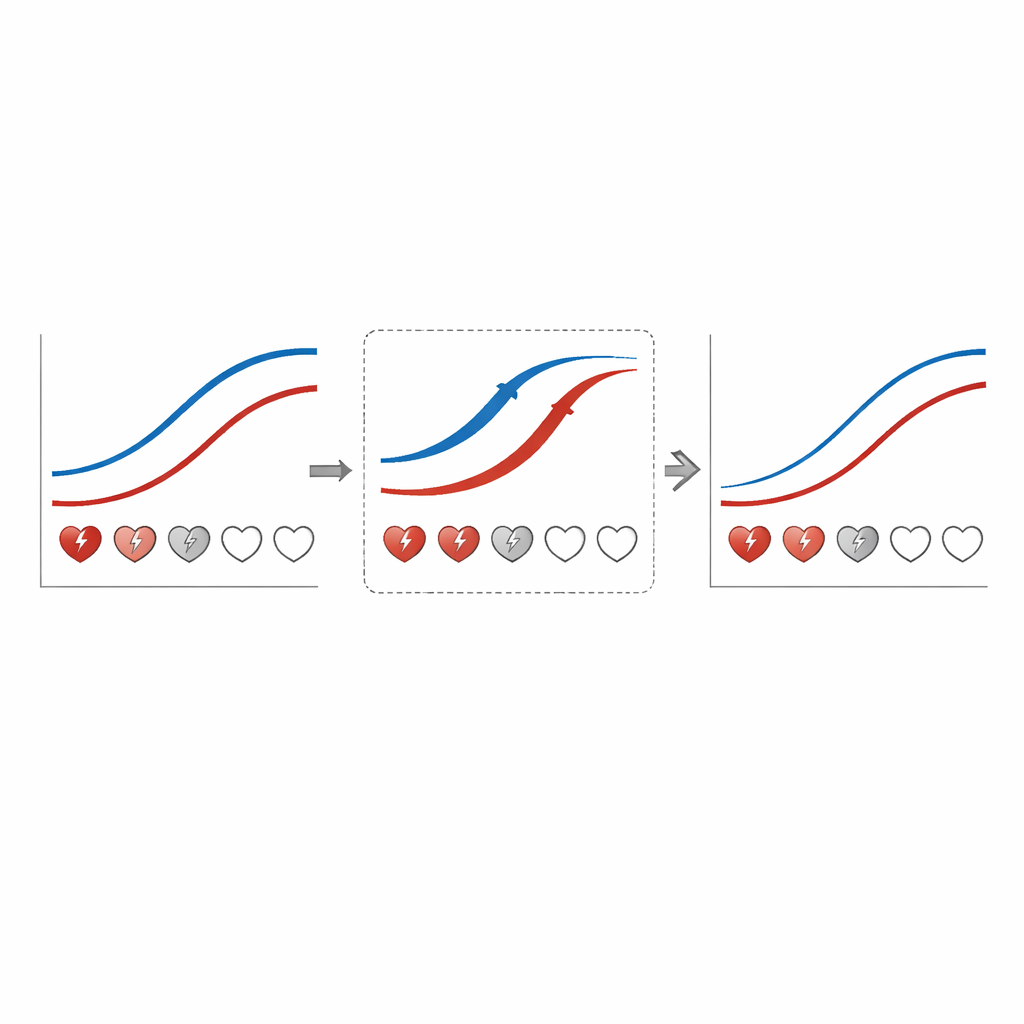
What recalibration means for real-world care
Recalibrating the score changed how many people were classified as “high risk,” the group most likely to be offered intensive lifestyle counseling or medicines such as statins. Using a 5 percent 10-year risk cut-off, the original PREVENT model flagged about one in six women and one in four men as high risk. After recalibration, these proportions climbed to about one in three women and nearly one in two men. Sensitivity—the share of people who actually had heart attacks or strokes and were correctly flagged—rose markedly, while specificity—the share of healthy people not flagged—fell somewhat. Decision-curve analyses, which balance the benefits of catching more high-risk individuals against the harms of unnecessary treatment, suggested that the recalibrated model offered a small but meaningful gain in clinical usefulness, particularly at the moderate risk levels where doctors most often debate whether to start medication.
Placing PREVENT among other risk tools
The study also compared PREVENT’s performance in Tehran with earlier evaluations of older tools such as the Framingham Risk Score and the pooled cohort equations. Overall, PREVENT’s ability to separate higher- from lower-risk individuals was similar or slightly better, and it had a more balanced trade-off between missing true cases and over-treating low-risk people once recalibrated. Importantly, PREVENT starts estimating risk from age 30, includes kidney function and current treatment status, and does not rely on race categories—features that are particularly relevant in a diverse, relatively young, and rapidly changing urban population like Tehran’s.
What this means for people and policy
For non-specialists, the takeaway is that off-the-shelf heart risk calculators developed in one country cannot simply be plugged into another and expected to work perfectly. In this large Iranian study, the PREVENT score proved to be a promising foundation but needed local tuning to avoid underestimating men’s risk. After recalibration, it offered reliable guidance for identifying adults at higher chance of heart attack or stroke over the next decade, especially women, and could help doctors focus preventive efforts where they matter most. The authors conclude that adapting such tools to local data—rather than building entirely new ones from scratch—may be an efficient way for countries in the Middle East and similar regions to improve early detection and prevention of cardiovascular disease.
Citation: Hasanpour, A., Asgari, S., Khalili, D. et al. External validation of the PREVENT risk score: performance and clinical utility in an Iranian population. Sci Rep 16, 9187 (2026). https://doi.org/10.1038/s41598-026-38614-4
Keywords: cardiovascular risk prediction, heart attack and stroke, PREVENT score, Iranian population, risk calculator recalibration