Clear Sky Science · en
Miniaturized dual-band MIMO antenna with high gain and isolation for mm-wave applications
Why tiny antennas matter for future phones
To deliver the super‑fast downloads and smooth streaming promised by 5G and beyond, our devices must talk over very high‑frequency “millimeter‑wave” signals. These signals can carry huge amounts of data but fade quickly and are easily blocked by walls, hands, or even rain. This paper describes a tiny new antenna module, small enough to fit inside compact gadgets, that helps phones and other devices keep strong, reliable 5G connections at these demanding frequencies.
Squeezing more performance into less space
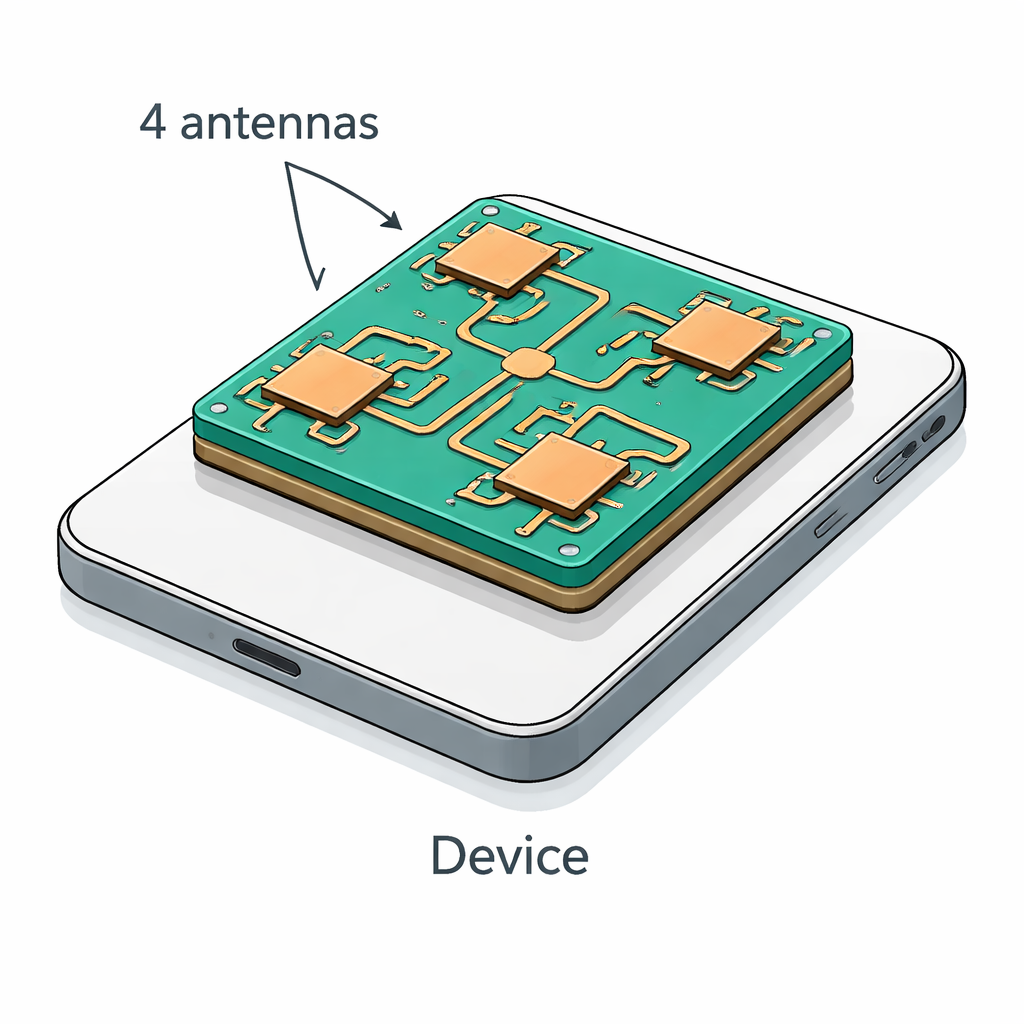
The researchers set out to design an antenna system that is both powerful and extremely compact. Their finished module measures just 15 by 15 millimeters and less than a millimeter thick—roughly the footprint of a fingernail—yet it contains four separate antennas that can work together. The design targets two key 5G “mm‑wave” bands around 30 and 38 gigahertz, which are part of the so‑called FR2 range used for multi‑gigabit links. Despite its size, the module achieves strong signal amplification (gains of about 8 dB) and keeps unwanted interaction between the four antennas very low, which is crucial when several are packed so closely together.
Many ears listening at once
Using several antennas in one device—known as multiple‑input multiple‑output, or MIMO—lets a phone act like it has many “ears” and “mouths” for radio waves. This boosts data rates and makes links more reliable in cluttered real‑world environments. However, when antennas sit near each other, they can interfere, muddying the signal instead of improving it. The team’s layout places four identical antennas at the corners of a square board made from a low‑loss circuit material. Careful spacing, combined with a smart shape for each antenna, keeps signal leakage between them more than 25 decibels below the main signal, meaning each element largely hears its own channel without being overwhelmed by its neighbors.
Shaping currents to cover two key bands
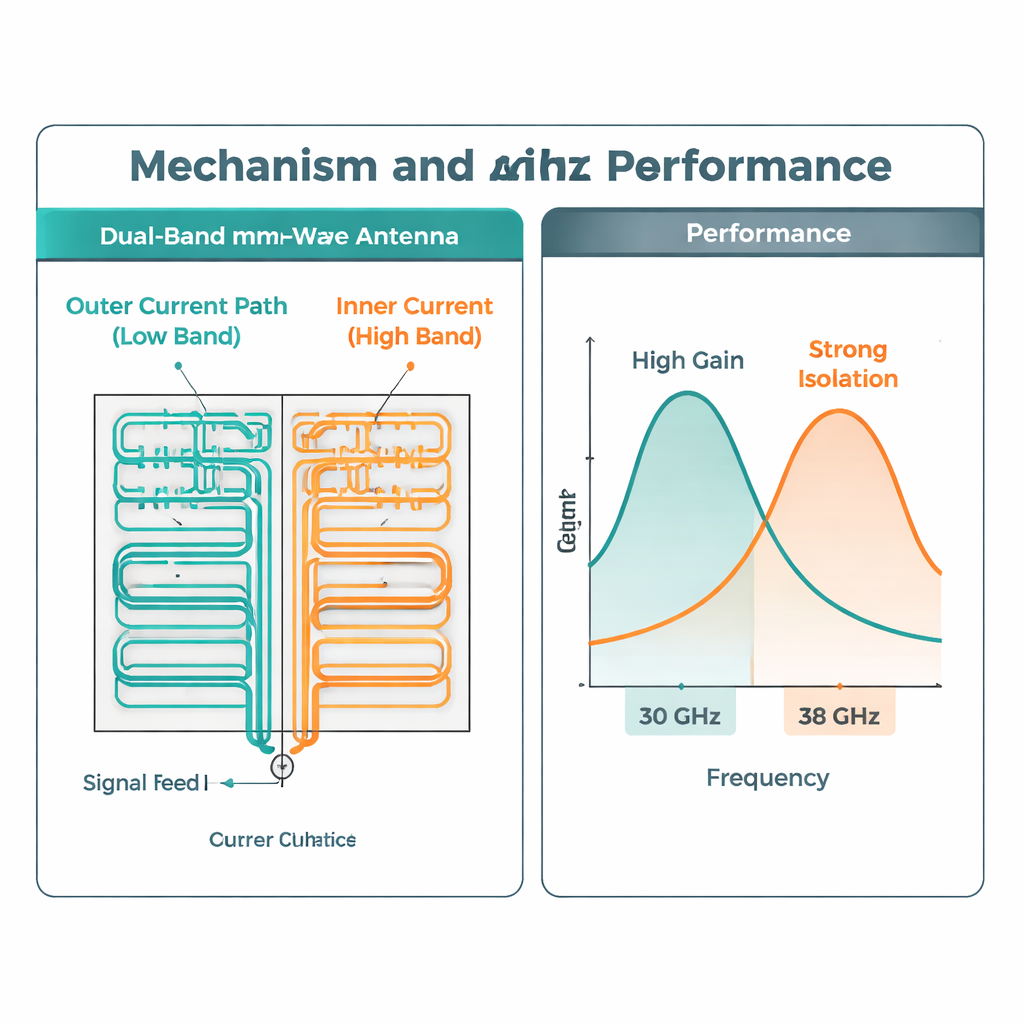
Each antenna is built as a flat copper pattern with slots and nested strips that guide electrical currents along different paths. At the lower 30‑gigahertz band, the current flows along a longer route around the outer parts of the pattern, acting like a slightly longer “radio wire” tuned to that frequency. At the higher 38‑gigahertz band, the current prefers a shorter loop created by inner slots and strips. By adjusting a few critical lengths in this maze‑like geometry, the designers can place the two operating bands precisely where 5G systems need them, without resorting to bulky add‑on structures that would increase cost and size.
From simulation to real‑world tests
To confirm that the idea works outside the computer, the team built a prototype on a standard circuit board and measured it with precision lab equipment. The measured results closely matched the simulations: the antennas showed strong response in the intended bands, remained well matched to typical radio hardware, and retained high isolation between ports. When evaluated with standard MIMO metrics, the module showed extremely low similarity between the signals received by different antennas, nearly ideal diversity gain around 10 decibels, and only a small loss in the theoretical data‑carrying capacity of the wireless channel. In practical terms, this means the module can support multiple high‑rate data streams without tripping over itself.
What this means for everyday wireless devices
For non‑specialists, the key message is that this work packs a powerful, two‑band, four‑antenna 5G front end into a space about the size of a coin, while keeping the antennas from interfering with one another. Such a module could be built into smartphones, small base stations, or vehicle‑mounted units to deliver faster and more reliable connections in crowded cities or inside buildings. By combining small size, high gain, and robust multi‑antenna behavior, the design points toward future 5G and even 6G devices that can move huge amounts of data without needing bulky hardware.
Citation: Gayathri, R., Kavitha, K., Rajesh Kumar, D. et al. Miniaturized dual-band MIMO antenna with high gain and isolation for mm-wave applications. Sci Rep 16, 7402 (2026). https://doi.org/10.1038/s41598-026-38609-1
Keywords: 5G millimeter-wave, MIMO antenna, compact antenna design, dual-band wireless, high-gain arrays