Clear Sky Science · en
Tailoring combined impact loading using gradient foam composite projectiles with variable fragment shapes
Why safer blast tests matter
Explosions from bombs, missiles, or improvised devices don’t just send out a pressure wave of hot gas. They also hurl shards of metal at high speed. Together, this blast-and-fragment duo can tear through buildings, vehicles, and protective walls far more severely than either effect alone. Yet recreating such complex threats in the lab is dangerous, expensive, and often hard to control. This study introduces a safer, tunable way to imitate these harsh conditions using specially designed “foam bullets” that carry metal pieces inside them, offering engineers a new tool for designing better armor and protective structures.
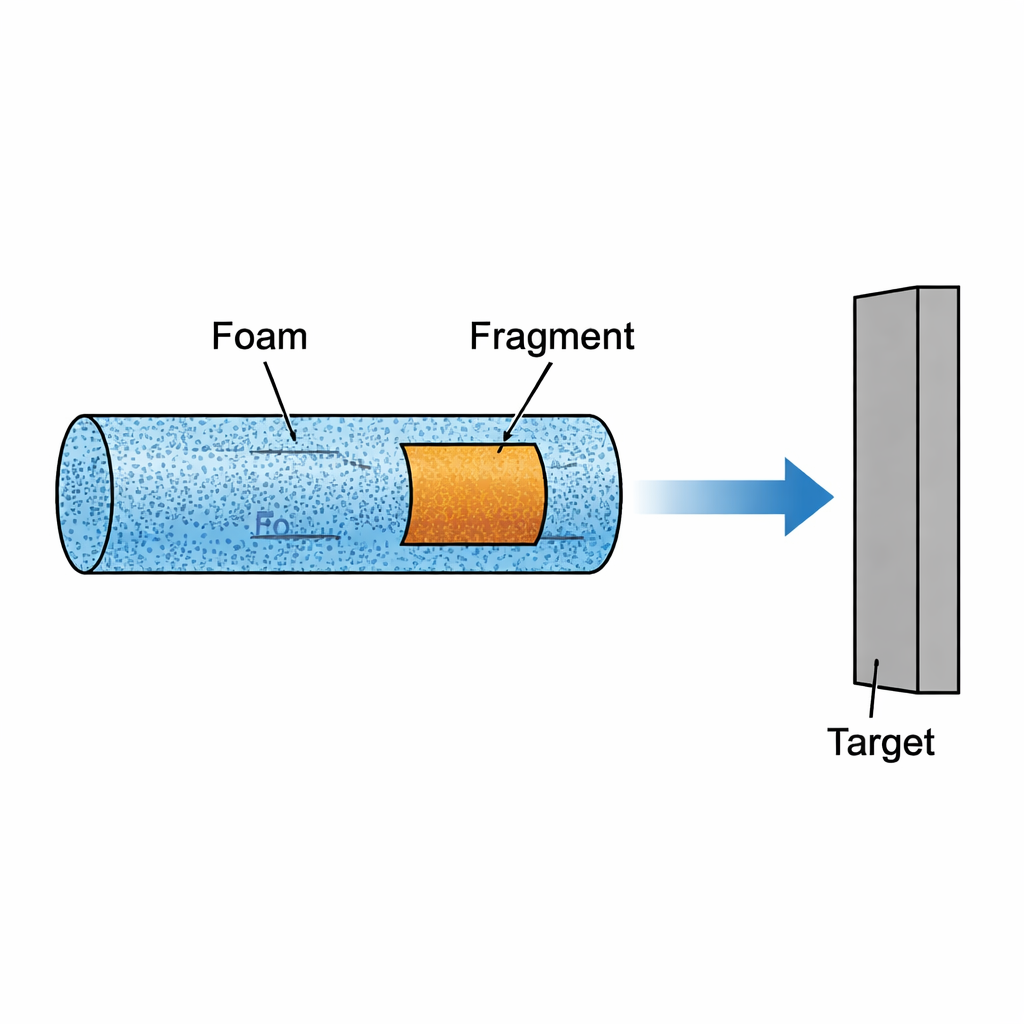
Turning foam bullets into lab-made blasts
The researchers build on an idea that a fast-moving block of metal foam can mimic the pressure pulse of an explosion when it hits a plate. Metal foam is like a solid sponge of aluminum: light, crushable, and able to soak up energy. By firing such a foam projectile at a steel plate, the impact generates a short, intense pressure surge similar to a shock wave. Inside this foam, the team embeds a solid metal fragment that stands in for the shrapnel produced by a real casing. By carefully choosing the foam’s density, the fragment’s shape, and how deeply it sits inside the foam, they can control when the “shock” and “fragment” reach the target and how strongly they act together.
Shaping the hidden shrapnel
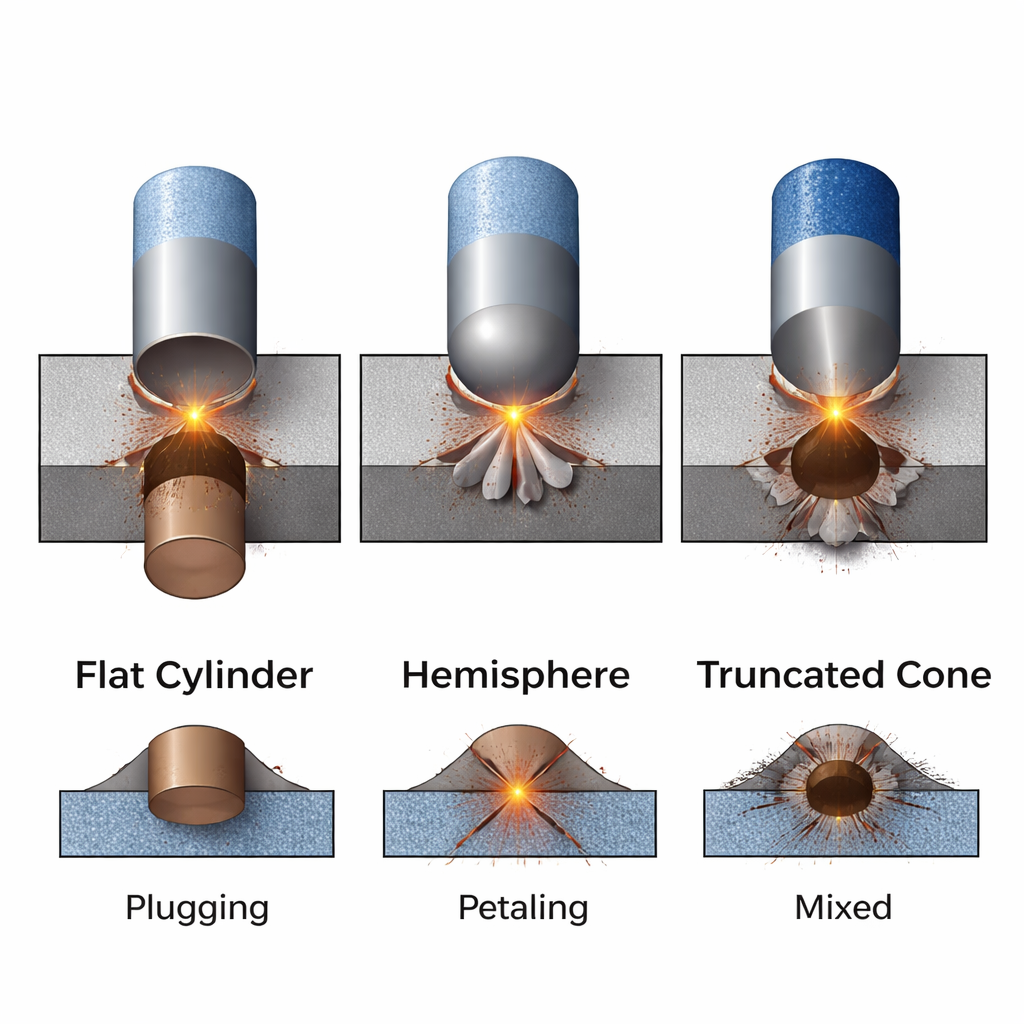
Real explosions throw off irregular chunks of metal, but most lab studies simplify them as blunt cylinders. Here, the authors compare three simple shapes for the embedded piece: a flat-ended cylinder, a round hemisphere, and a truncated cone (a cone with its tip cut off). All are made to have the same mass and are fired at the same speed, so any differences come from shape alone. Using detailed computer simulations, checked against experimental data, they track how fast each fragment slows down, how much it bends or pierces the steel plate, and what kind of cracks or holes form.
How shape changes damage
The simulations reveal that the shape of the metal piece plays a surprisingly strong role in how the plate fails. Flat-ended cylindrical fragments spread the load over a larger area, sending stress waves more widely through the plate. This causes a “plug” of metal to be sheared out and leads to large overall bending, but the fragment itself slows down more and ends with the lowest leftover speed. Hemispherical fragments, with their small initial contact area, focus the force into a tiny spot. They punch through quickly, creating petal-like tears around the hole and keeping a higher residual velocity, but they allow less of a combined effect between the foam-driven shock and the fragment. The truncated cone lands in between, causing a mix of shearing and tearing and a moderate level of overall damage.
Stacking foam to tune the hit
Beyond fragment shape, the researchers also tailor the foam itself. They divide the foam into three layers along its length and vary how dense each layer is, creating a “gradient” from heavy to light or vice versa. A denser front layer behaves like a stiffer cushion: it delivers a sharper, higher first push to the plate but for a shorter time. A lighter front layer softens this initial strike, spreading the energy over a longer period. By comparing different gradients, with and without embedded fragments, the study shows that these layered foams can be used to sculpt the time history of the contact force—how strong the impact is at each instant—and to adjust how much of the fragment’s energy is lost before it exits the plate.
What this means for real-world protection
In simple terms, the work shows that both the nose shape of a hidden metal piece and the way foam density is arranged in front of it can be used like knobs to dial in different kinds of blast-and-fragment threats in the lab. Flat noses and dense front foam make the plate work harder and absorb more energy, while sharp or rounded shapes and lighter foam push toward quicker perforation. This tunable “foam bullet” concept offers a safer, repeatable way to explore how walls, panels, and armor behave under realistic combined loading, guiding future designs that better protect people and critical infrastructure from explosions.
Citation: Jiang, P., Wu, C., Wang, X. et al. Tailoring combined impact loading using gradient foam composite projectiles with variable fragment shapes. Sci Rep 16, 7226 (2026). https://doi.org/10.1038/s41598-026-38606-4
Keywords: blast protection, metal foam, composite projectiles, fragment impact, protective structures