Clear Sky Science · en
BERT based sentiment analysis of consumer hesitancy toward solar energy adoption
Why People Still Hesitate About Solar Power
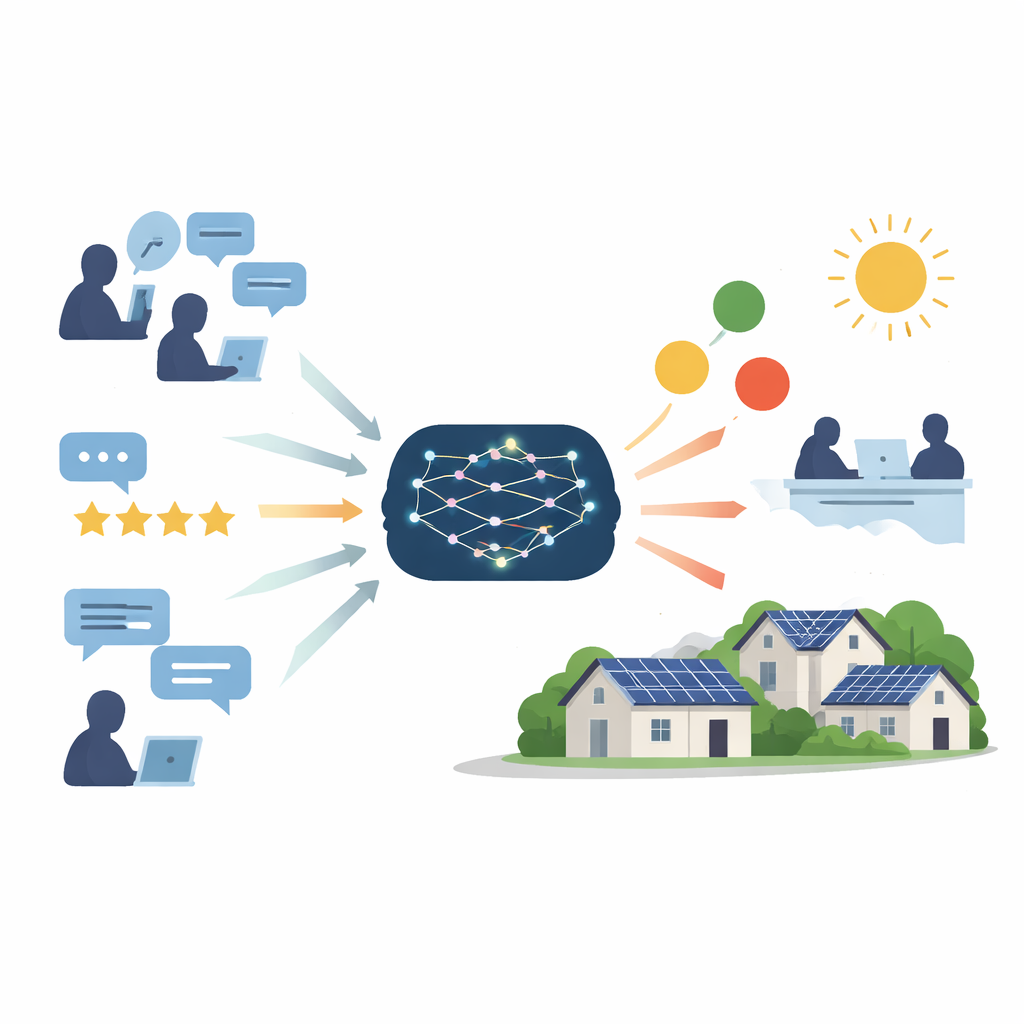
Solar panels promise clean, homegrown electricity, yet many households remain unsure about putting them on their roofs. This study digs into what everyday people are really saying online about solar energy—across social media, reviews, and public forums—and uses a modern language AI system to read the mood. By turning thousands of comments into a clear picture of worries and hopes, the work shows where cost, trust, and confusion are holding solar power back, and how smarter analysis can help policymakers and companies respond.
Listening to Online Voices at Scale
Instead of relying on slow surveys or small focus groups, the researchers collected some 50,000 public posts and reviews mentioning solar adoption, then filtered this down to 22,000 clearly positive or negative items. These came from platforms such as short messages, threaded discussions, consumer review sites, and open web pages. By drawing on many sources rather than a single site, the study reduces the risk of over-listening to one type of user or region. Careful preprocessing—removing duplicates, stripping out usernames and links, standardizing wording, and grouping key phrases like “solar energy” or “solar cost”—turned this noisy stream into a cleaner, more comparable dataset while protecting user privacy.
How an AI Learns the Tone of Solar Talk
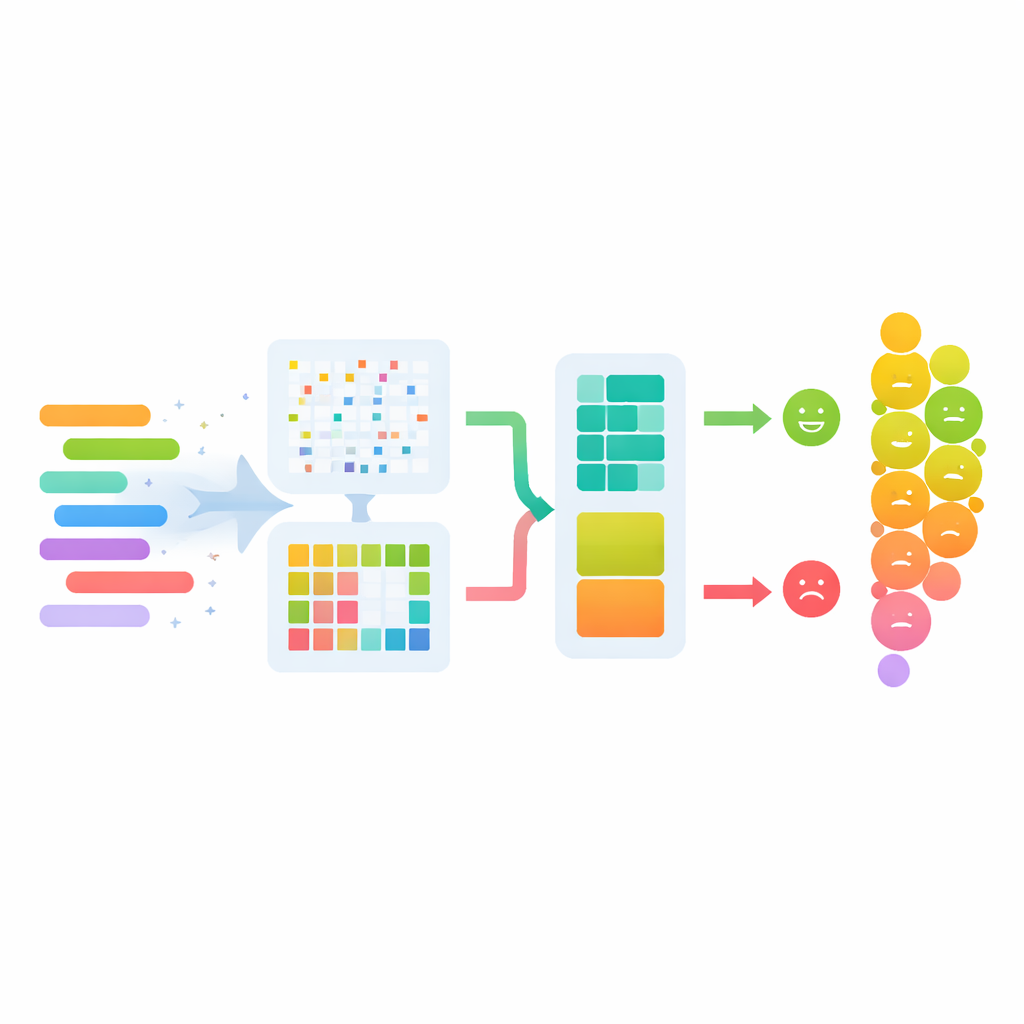
To read sentiment in this text, the team built a hybrid model that combines two complementary ways of representing language. One, called TF–IDF, measures how distinctive a word or phrase is in the corpus, elevating terms that strongly signal important themes such as “cost,” “reliability,” “policy,” or “payback.” The other comes from BERT, a modern transformer-based language model that represents each sentence in a high-dimensional space, capturing nuance, irony, and context that simple word counts miss. By concatenating these two views into a single feature vector and training a classifier on labeled examples, the system learns both which words matter and how they are used in real sentences about solar power.
Checking Accuracy and Making Results Actionable
The hybrid approach is not just clever on paper; it performs solidly in practice. On held-out test data that the model never saw during training, it achieves an F1-score of 0.82, with balanced precision and recall for both positive and negative sentiment and an overall accuracy of 0.84. Additional checks—such as receiver operating characteristic curves, precision–recall curves, and calibration plots—show that the predicted probabilities match real outcomes well, meaning the model knows when it is confident and when it is uncertain. The authors then go a step further, using cumulative gain charts, lift curves, and “Top-K” accuracy to show that if a policymaker can examine only a small fraction of posts, focusing on the model’s highest-confidence predictions surfaces far more relevant, decision-worthy comments than random sampling would.
What People Worry About Most
Once the system reliably separates positive from negative discussion, the researchers look inside the negative camp to see what themes dominate. They find that over 40% of negative sentiment centers on money—upfront installation costs, doubts about payback time, and fears of hidden fees. Roughly a quarter of negative comments highlight worries about reliability: Will the panels work in bad weather, will maintenance be a headache, and can people trust installers and equipment? Nearly one in five negative posts reflects environmental skepticism, such as concerns about panel manufacturing, recycling, or whether solar really reduces emissions once the full life cycle is considered. Policy confusion and frustration also surface, but somewhat less strongly than these core barriers.
Turning Insights into Better Solar Adoption
For a non-specialist reader, the main outcome is straightforward: by listening carefully to large-scale online conversations with an AI tuned to the solar domain, it becomes possible to quantify what is holding people back. Cost emerges as the biggest hurdle, followed by trust in performance and lingering doubts about environmental benefits. Because the model can highlight the most confident, informative cases and visualize trends over time, it gives policymakers, installers, and advocates a practical dashboard of public concerns. That, in turn, can guide targeted incentives, clearer communication about savings and reliability, and better answers to environmental questions—steps that could help more households feel ready to make the leap to solar power.
Citation: Jabbar, A., Yuan, J., Al-Shamasneh, A.R. et al. BERT based sentiment analysis of consumer hesitancy toward solar energy adoption. Sci Rep 16, 8397 (2026). https://doi.org/10.1038/s41598-026-38604-6
Keywords: solar energy adoption, consumer sentiment, renewable energy hesitancy, AI text analysis, BERT model