Clear Sky Science · en
A large tyrannosaurid from the Late Cretaceous (Campanian) of North America
Why this ancient leg bone matters
Most people know Tyrannosaurus rex as the king of the dinosaurs, but how did such a giant predator evolve in the first place? This study looks at a single, unusually large leg bone dug up in New Mexico and shows that giant “T. rex–like” tyrannosaurs were stalking North America millions of years earlier than we thought. That one bone not only reveals a predator nearly as massive as a city bus, it also reshapes ideas about where and how the most famous dinosaur lineage arose.
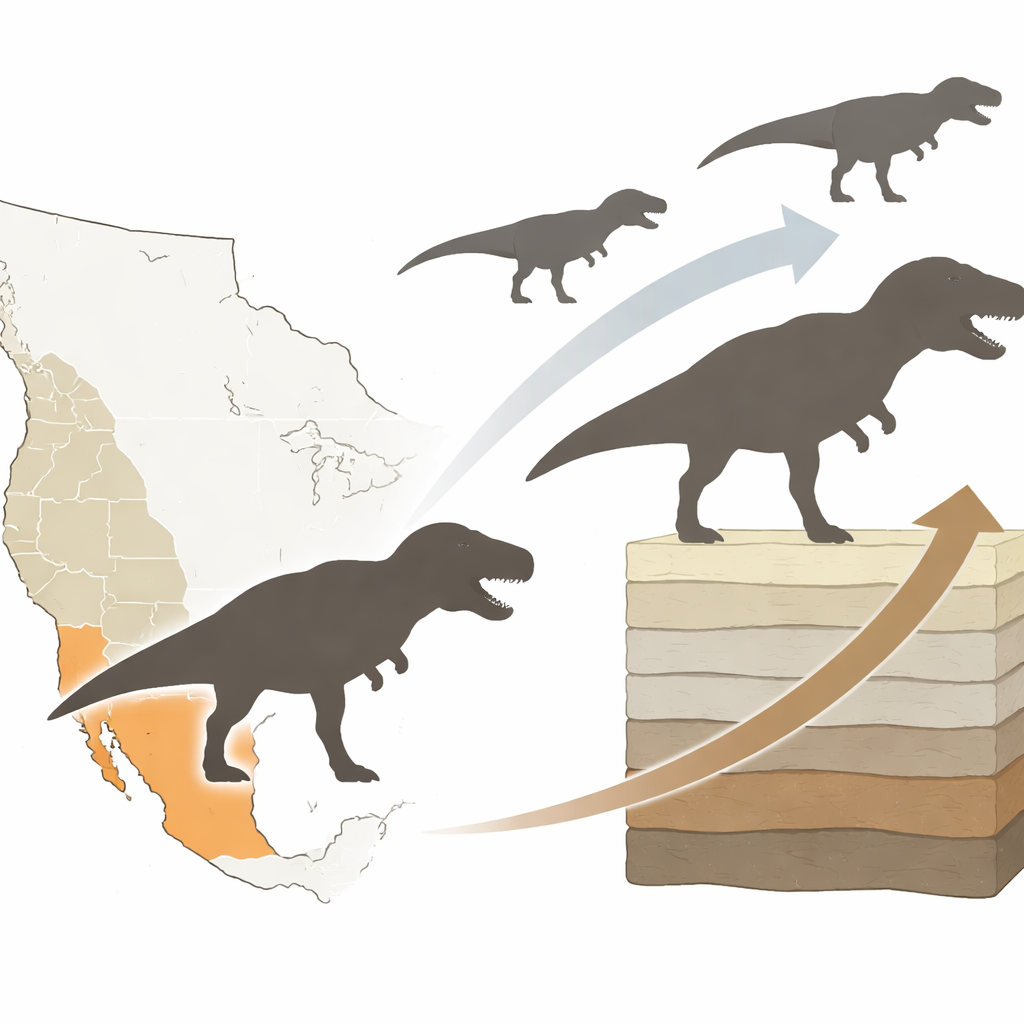
A giant hunter from the American Southwest
The fossil at the heart of this story is a left shinbone, or tibia, labelled NMMNH P-25085. It was found in the Hunter Wash Member of the Kirtland Formation in the San Juan Basin of New Mexico. Careful dating of volcanic ash layers above and below the site shows that the rocks are about 74–75 million years old, in the late Campanian stage of the Late Cretaceous. At that time, western North America was a long, narrow continent called Laramidia, bordered by a shallow inland sea. The Hunter Wash ecosystem was slightly younger than classic dinosaur sites in Alberta and Montana but older than the final-age dinosaur beds that yield T. rex itself.
Reading the story written in a single bone
Although only one bone is preserved, it is a remarkable one. At 96 centimeters long and 12.8 centimeters wide at midshaft, the tibia reaches around 84% of the length and 78% of the thickness of the biggest known T. rex specimen, nicknamed “Sue.” By scaling the limb dimensions against mass estimates for Sue, the authors infer that the New Mexico animal weighed at least 4 tonnes and possibly close to 6 tonnes—roughly twice as heavy as other tyrannosaurs known from the same time period. In other words, this was no ordinary predator, but a true giant among its peers.
Telling look-alikes from true relatives
Size alone is not enough to identify a species, so the team closely compared the tibia’s shape with that of many other tyrannosaurs. The Hunter Wash bone is unusually straight and robust, with a long, broad, triangular flare toward the ankle end. This combination of traits is not seen in the local mid-sized tyrannosaur Bistahieversor, whose shinbone is more curved and narrow at the bottom. Instead, the New Mexico tibia strongly resembles those of later, giant forms such as Tyrannosaurus rex and its Asian cousin Tarbosaurus. Using a large evolutionary family tree that incorporates over 500 skeletal features, the researchers found that this bone clusters with T. rex and a recently named giant species, Tyrannosaurus mcraeensis, forming part of the same southern giant-tyrannosaur group.
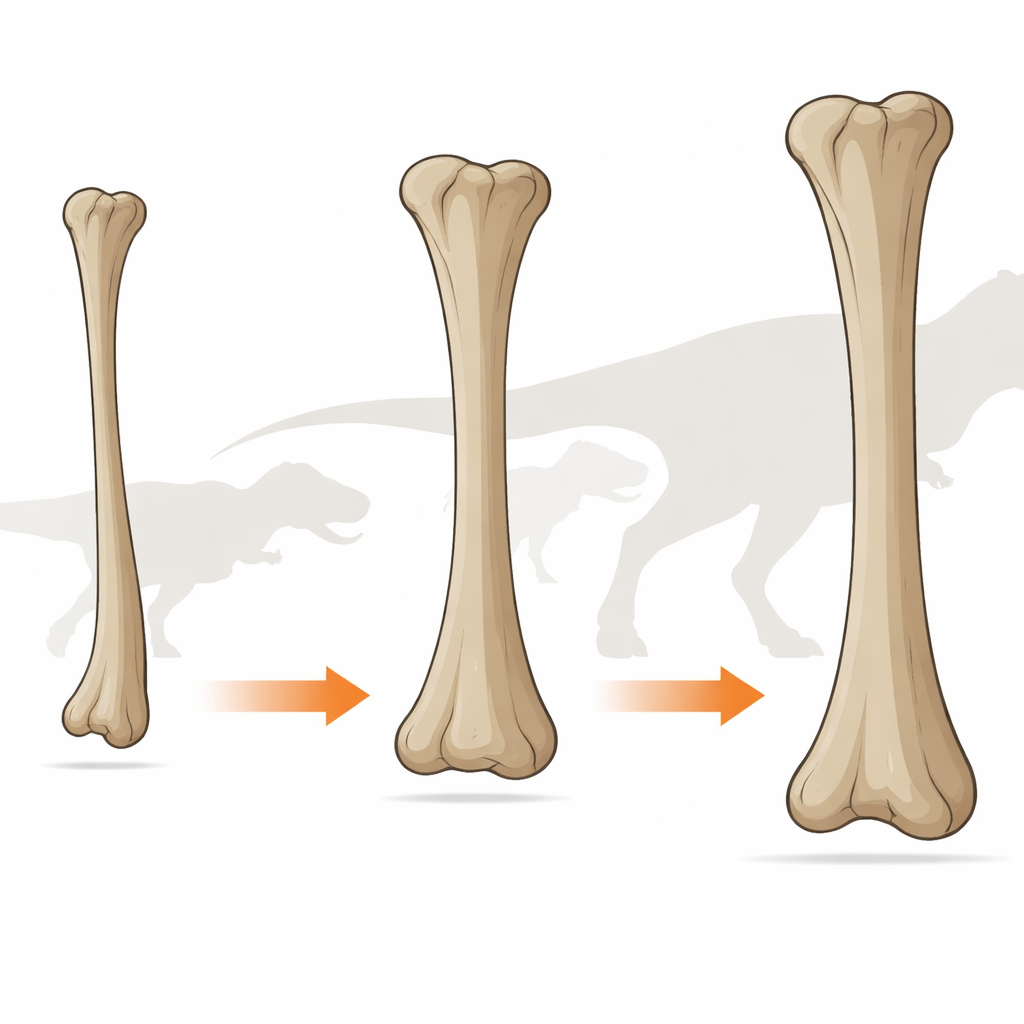
Early rise of the southern giants
Because the Hunter Wash rocks are securely dated to around 74 million years ago, this shinbone records the oldest known giant tyrannosaur from North America. Until recently, scientists thought truly massive tyrannosaurs only appeared later, close to the time of T. rex, and mainly in northern regions like Alberta and Montana. This new find pushes the appearance of such giants back several million years and places their early evolution firmly in the American Southwest. At the same time in more northern habitats, top predators were smaller tyrannosaurs weighing 2–3 tonnes, underscoring how different northern and southern ecosystems were.
What this means for T. rex and dinosaur worlds
To a non-specialist, the big picture is that T. rex did not suddenly emerge out of nowhere as a lone giant at the end of the dinosaur age. Instead, this New Mexico tibia shows that heavy, T. rex–style hunters had already evolved in the south by the late Campanian, long before T. rex spread across western North America. The find supports the idea that the lineage leading to T. rex likely arose in southern Laramidia and only later expanded northward to dominate. It also hints that southern dinosaur communities were especially prone to producing giants, from horned dinosaurs to long-necked plant-eaters—and now, we know, to early T. rex–like tyrannosaurs as well.
Citation: Longrich, N.R., Dalman, S., Lucas, S.G. et al. A large tyrannosaurid from the Late Cretaceous (Campanian) of North America. Sci Rep 16, 8371 (2026). https://doi.org/10.1038/s41598-026-38600-w
Keywords: tyrannosaur evolution, Cretaceous New Mexico, giant predators, Tyrannosaurus origins, dinosaur paleontology