Clear Sky Science · en
Randomised control trial on the sustained carry-over effects of pulsed electromagnetic field therapy for the treatment of Achilles tendinopathy
Why sore heels matter to everyday life
A painful Achilles tendon can sideline anyone—from runners training for a race to people who just want to walk to work without limping. Achilles tendinopathy, a long‑lasting injury of the tendon at the back of the ankle, often stubbornly resists standard care. The most trusted exercise program helps many patients, but not all, and progress can be slow. This study explored whether adding a gentle, non‑invasive technology called pulsed electromagnetic field (PEMF) therapy to the usual exercise routine could provide extra, longer‑lasting relief.
An ankle injury that won’t go away
Achilles tendinopathy is common in both athletes and less active, often middle‑aged adults. It is linked to repeated strain on the tendon, which can outpace the tissue’s ability to repair itself. People feel stiffness and pain when they first get moving, when they exercise, and eventually even during simple daily tasks. While many treatments exist—ranging from shoe inserts to massage to surgery—there is no single gold‑standard solution. Eccentric exercises, which carefully load the calf muscles and Achilles tendon as they lengthen, are widely recommended as the first step, but they do not fully relieve symptoms for a large share of patients.
A gentle magnetic boost to rehab
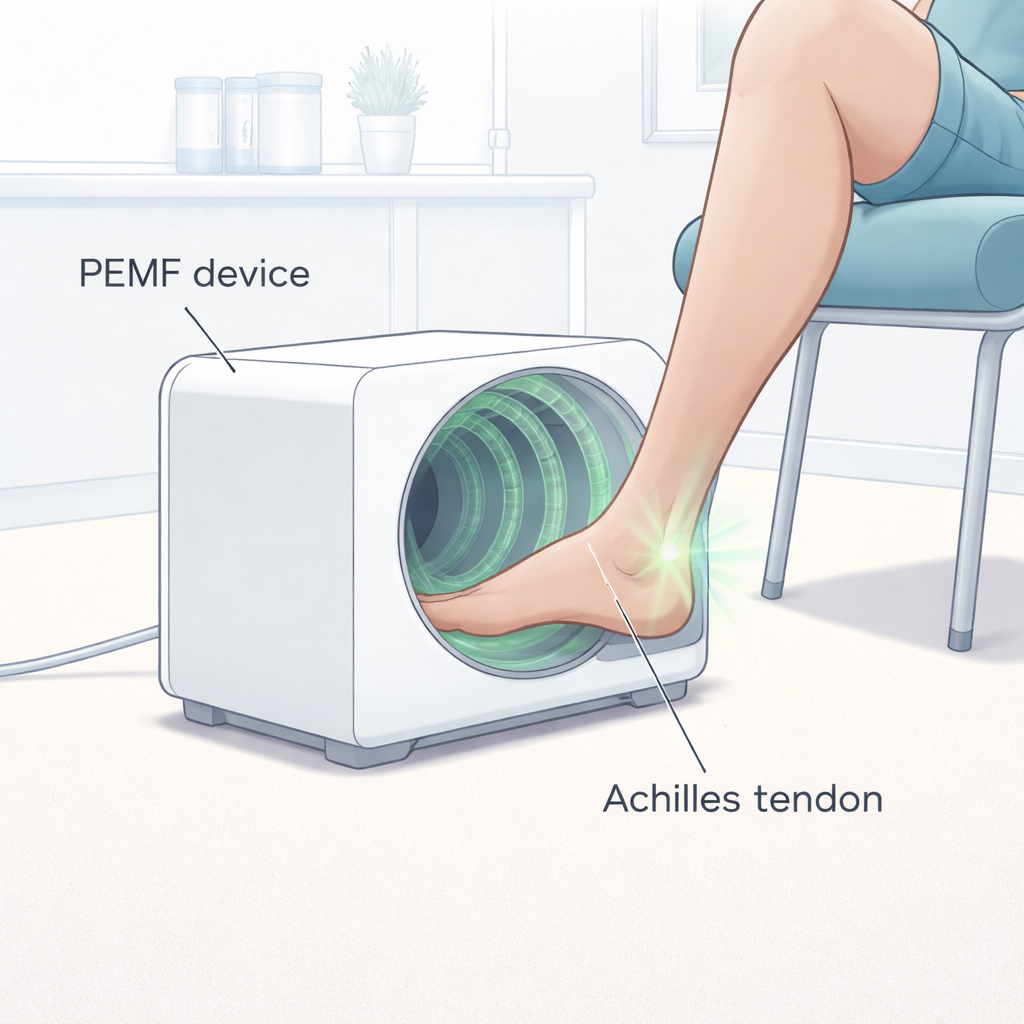
PEMF therapy has been used for other joint and muscle problems, such as knee arthritis and back pain. It delivers low‑energy magnetic pulses through coils surrounding the body part being treated, without causing heat or discomfort. Laboratory studies suggest these pulses can encourage tendon cells to multiply, turn on healing genes, and release natural anti‑inflammatory signals. However, for Achilles problems, doctors still do not know what dose works best, or even whether PEMF adds enough benefit to be worth the time and cost in the clinic. This trial set out to test whether people receiving real PEMF treatment, on top of their home exercise program, would do better over six months than those receiving a sham (placebo) version of PEMF plus the same exercises.
How the trial was carried out
Researchers in Hong Kong enrolled adults aged 18 to 70 with stubborn Achilles tendinopathy confirmed by both symptoms and ultrasound. Sixty‑five volunteers were randomly assigned to one of two groups. Both groups performed the same 12‑week home‑based eccentric exercise program. One group received active PEMF therapy—short, twice‑weekly sessions for eight weeks—by resting the foot and ankle inside a coil‑filled device that generated low‑intensity magnetic pulses. The other group received sham PEMF: the device looked and sounded the same but produced no magnetic field. Neither the patients nor the assessing physiotherapist knew who was getting the real treatment. The team tracked pain, daily function, sports activity and overall quality of life at the start, and again at 4, 8, 12 and 26 weeks.
What the researchers found
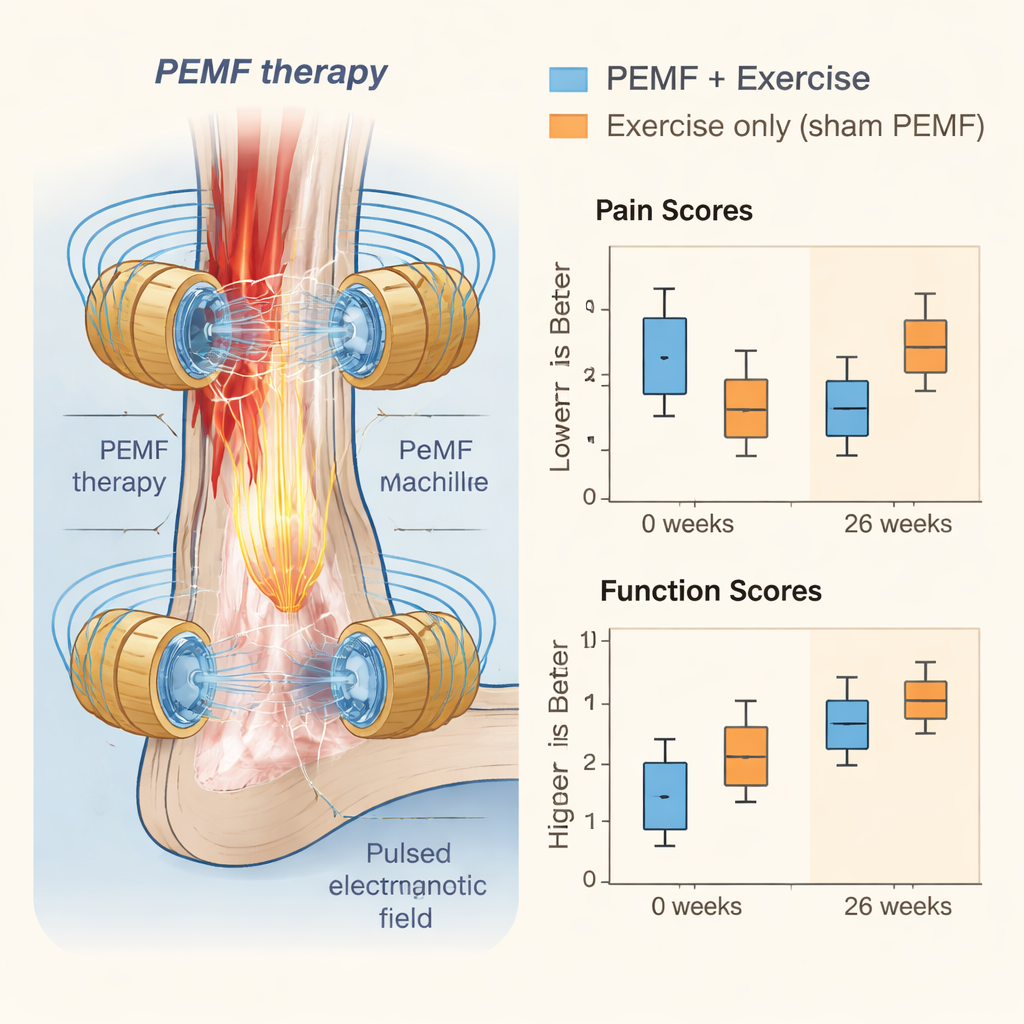
Both groups improved steadily over time. On the main Achilles score, which combines pain and activity into a single number, patients in the active PEMF group gained about 20 points on average by week 26, while those in the sham group gained about 11 points. The improvement in the PEMF group crossed a threshold considered clearly meaningful for patients, suggesting that many felt a substantial change in how their ankle behaved day to day. Pain ratings on a simple 0–10 scale dropped in both groups, and quality‑of‑life scores rose, again with somewhat larger changes in the active PEMF group. Statistically, the differences between groups were not strong enough to be labeled “definite” in this relatively small sample, in part because only 34 of the original 65 participants completed every follow‑up visit. Importantly, no side effects related to PEMF were reported.
What this means for people with persistent heel pain
The trial suggests that combining PEMF therapy with a structured eccentric exercise program is safe and may offer extra, longer‑lasting relief for some people with chronic Achilles tendon pain. Exercise remains the cornerstone of care, since it provides benefits that magnetic treatment alone cannot, such as strengthening and remodeling the tendon. But PEMF could become a useful add‑on for patients who are not improving enough with exercise and other conservative measures, potentially delaying or avoiding surgery. Larger studies are still needed to pin down the best treatment schedule and to confirm exactly how much additional benefit PEMF provides, but this work points toward a promising new tool in the fight against stubborn heel pain.
Citation: Ko, V.MC., Fu, SC., Yung, P.SH. et al. Randomised control trial on the sustained carry-over effects of pulsed electromagnetic field therapy for the treatment of Achilles tendinopathy. Sci Rep 16, 7567 (2026). https://doi.org/10.1038/s41598-026-38596-3
Keywords: Achilles tendinopathy, pulsed electromagnetic field therapy, sports injury rehabilitation, chronic tendon pain, noninvasive pain treatment