Clear Sky Science · en
Adsorption kinetics and isotherms of malachite green removal from aqueous solution using TiO2 loaded on f-MWCNTs nanocomposite
Why Cleaning Up Colored Wastewater Matters
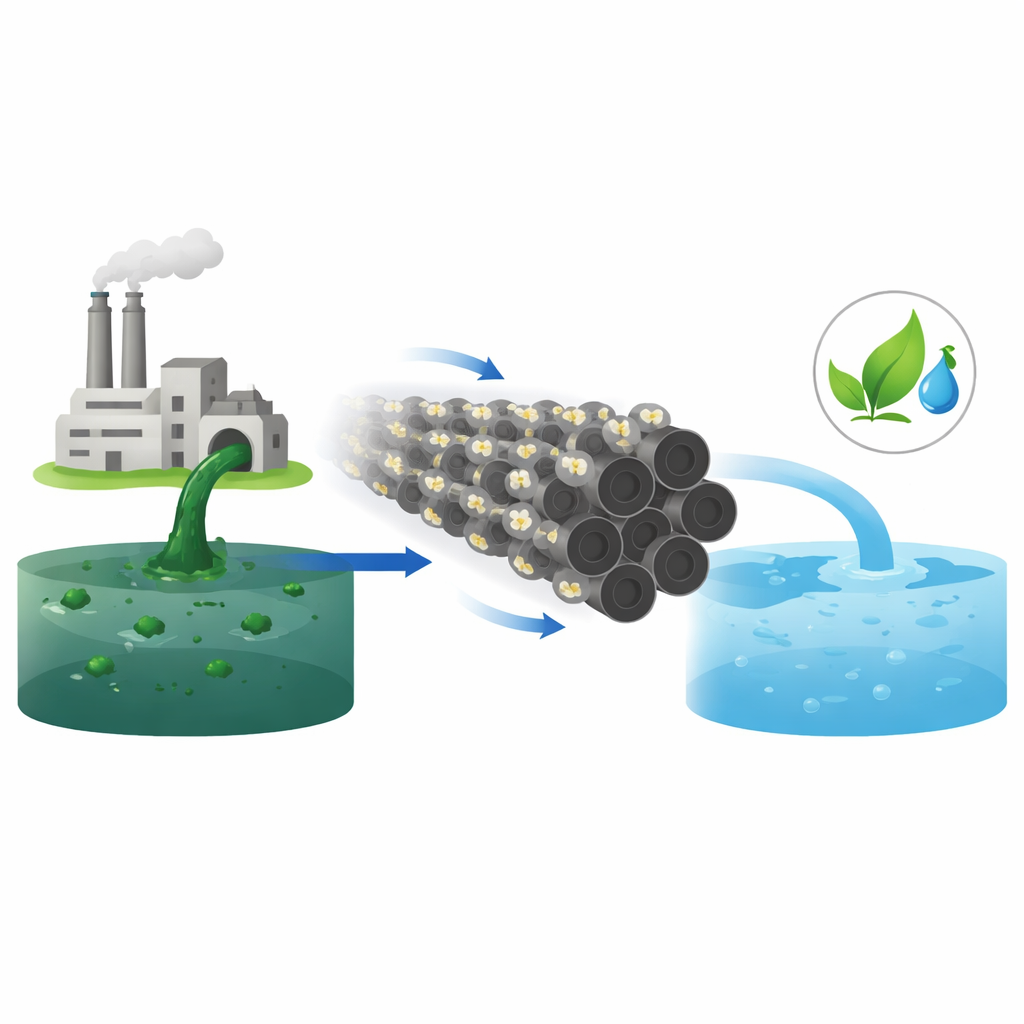
Bright synthetic dyes give us colorful clothes, leather, and paper, but when these chemicals are washed down factory drains, they can linger in rivers and lakes for years. One such dye, called malachite green, is especially worrisome because it is toxic, long‑lasting, and linked to cancer. This study explores a new kind of tiny cleaning material—a nanocomposite—that can pull malachite green out of water very quickly and efficiently, pointing toward faster and more practical ways to treat polluted industrial wastewater.
A Tough Dye and a New Tiny Cleaner
Malachite green is widely used in textiles and leather processing and has even been applied, controversially, in fish farming as an antimicrobial agent. Once released into the environment, it does not easily break down, and conventional treatment methods often struggle to remove it completely. The researchers set out to design a better “sponge” for this dye by combining two advanced materials: titanium dioxide nanoparticles and multi‑walled carbon nanotubes whose surfaces had been chemically “roughened up” with oxygen‑containing groups. By loading titanium dioxide onto these functionalized nanotubes, they created a hybrid material intended to offer both a large surface area and many active spots where dye molecules could stick.
Building and Probing the Hybrid Nanotube Material
The team synthesized the nanocomposite using a hydrothermal process, in which titanium dioxide powder is treated in a hot alkaline solution and then attached to the carbon nanotubes in water under prolonged mixing. They carefully examined the resulting powder with a suite of microscopes and spectroscopic tools. These tests confirmed that the titanium dioxide kept its crystalline structure and spread evenly over the nanotube network rather than clumping separately. Measurements of gas adsorption revealed a highly porous, sponge‑like architecture with more than twice the surface area of the plain titanium dioxide, meaning far more room for dye molecules to be captured during treatment.
Fast and Effective Dye Removal from Water
To see how well the new material cleaned water, the researchers ran batch experiments in which small amounts of the nanocomposite were shaken with solutions of malachite green under different conditions. They found that performance depended strongly on water acidity: removal was modest in acidic conditions but climbed above 95 percent around a mildly basic pH of 8, where the surface of the material carries a negative charge that attracts the positively charged dye. Remarkably, under these optimal conditions—pH 8, just 0.005 grams of adsorbent in 10 milliliters of solution, and room temperature—the system reached equilibrium in about 10 minutes, achieving an adsorption capacity of about 39 milligrams of dye per gram of material. This is comparable to or better than many conventional adsorbents, but with far faster cleanup.
How the Dye Sticks to the Nanotube Surface
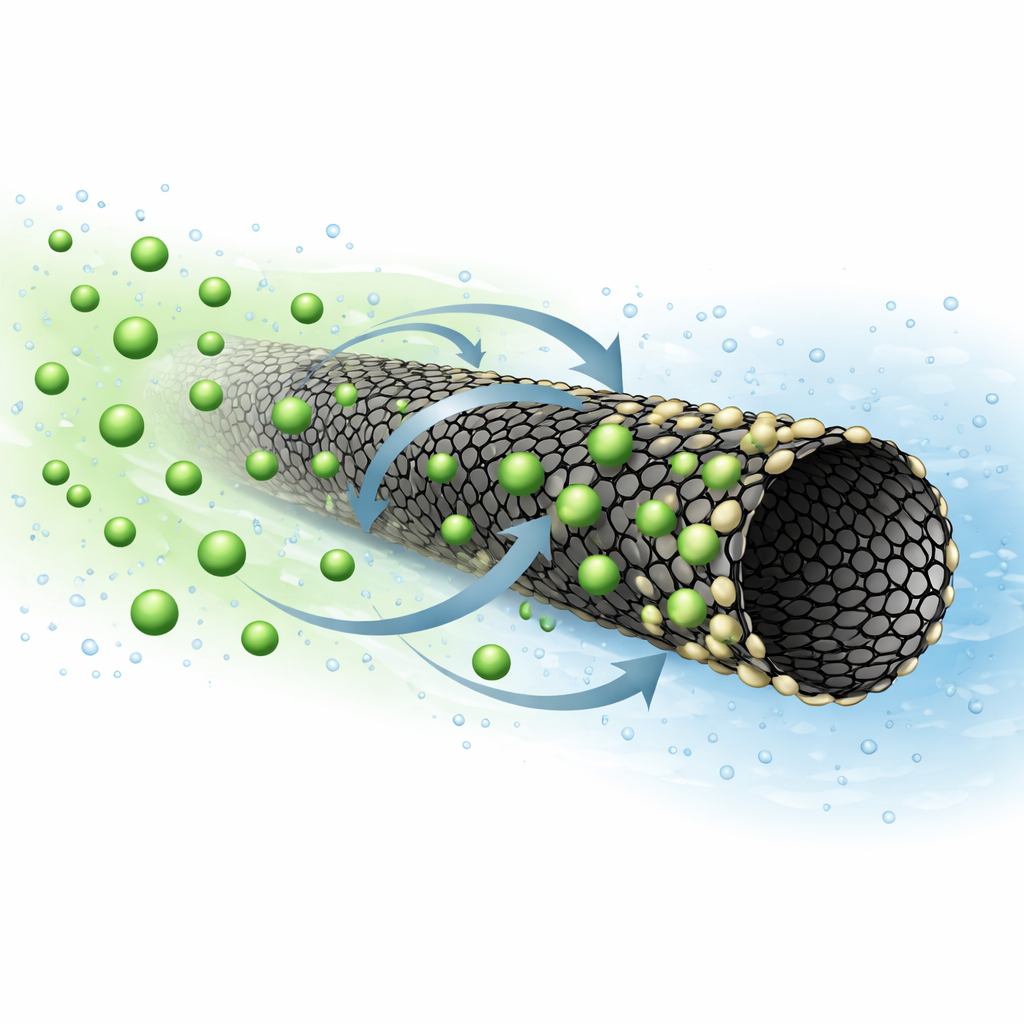
By fitting the experimental data to standard mathematical models that describe how molecules attach to surfaces, the authors concluded that malachite green forms mainly a single layer on a relatively uniform surface, as captured by the so‑called Langmuir description. At the same time, other models that account for varied binding strengths and multiple layers also matched the data well, suggesting a blend of physical and chemical sticking. The best‑fitting time‑based model indicated that bonding is not just a matter of molecules bumping into the surface but involves stronger interactions, such as electrostatic attraction between opposite charges and specific contact with surface groups. Microscopy and infrared measurements before and after dye uptake further supported a picture in which dye molecules cluster on the outer surfaces and within the pores without altering the underlying crystal framework.
Reuse and Promise for Cleaner Industry
For any water‑treatment technology to be practical, the cleaning medium must be reusable. The researchers showed that the nanocomposite could be regenerated by washing it with a simple sodium hydroxide solution and reused at least five times with almost no loss in performance. Overall, the study demonstrates that a carefully engineered combination of titanium dioxide and functionalized carbon nanotubes can act as a rapid, robust, and recyclable dye sponge. While these tests were carried out in simplified laboratory solutions rather than in real factory effluent, the results suggest a promising route toward compact treatment units that can quickly strip harmful colorants like malachite green from wastewater before it reaches the environment.
Citation: Jomardani, F., shakeri, R., Akbarzadeh, R. et al. Adsorption kinetics and isotherms of malachite green removal from aqueous solution using TiO2 loaded on f-MWCNTs nanocomposite. Sci Rep 16, 8567 (2026). https://doi.org/10.1038/s41598-026-38582-9
Keywords: wastewater treatment, malachite green, nanocomposite adsorbent, titanium dioxide, carbon nanotubes