Clear Sky Science · en
Differential effects of biologically and chemically synthesized copper oxide nanoparticles on artemisinin biosynthesis gene expression in Artemisia absinthium
Fighting Malaria with a Bitter Herb
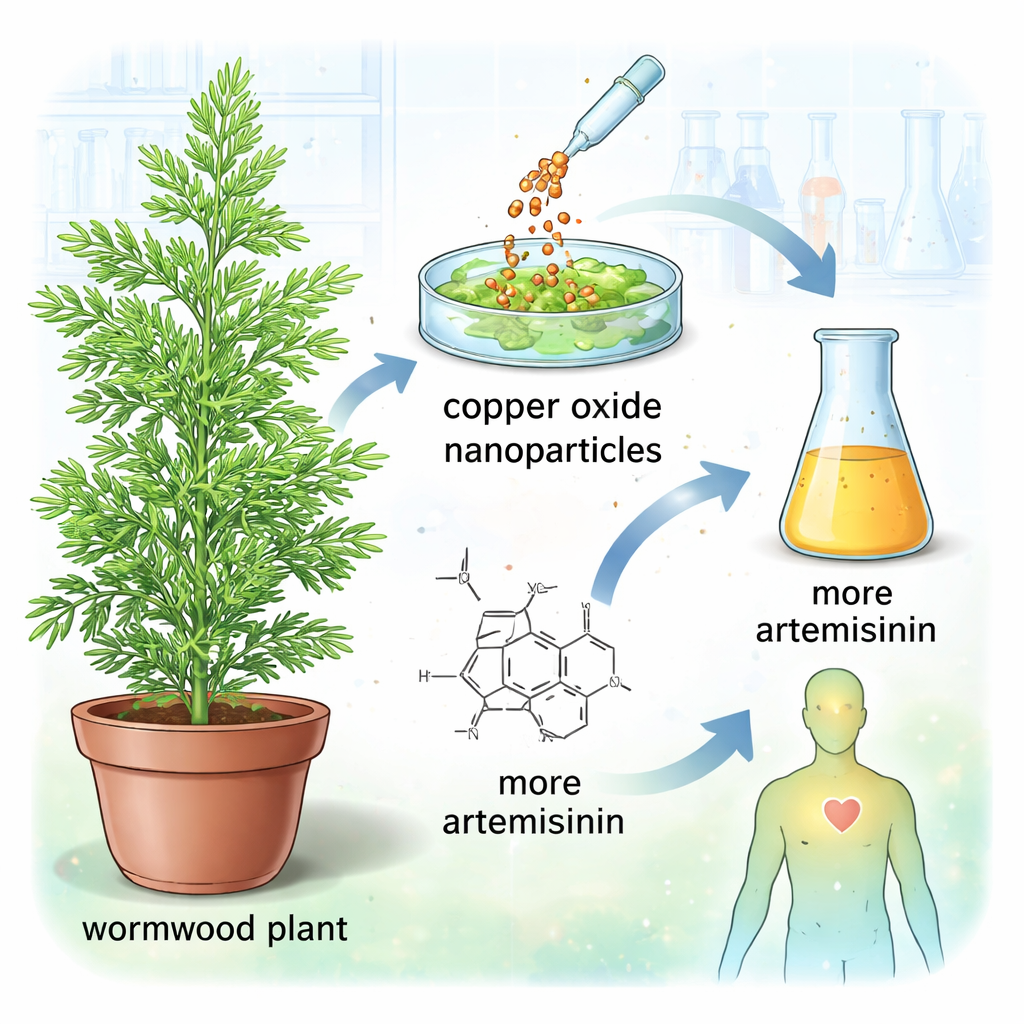
Malaria still kills hundreds of thousands of people each year, and one of our best weapons against it is a compound called artemisinin, originally found in the bitter herb Artemisia absinthium, also known as wormwood. But the plant makes only tiny amounts of this life-saving molecule. This study explores whether tiny particles of copper oxide—engineered at the nanoscale and made either with plant-based "green" methods or conventional chemistry—can gently push wormwood plants to turn up the internal machinery that leads to more artemisinin.
Why Boosting a Plant’s Medicine Matters
Artemisinin is a natural defense compound produced in the leaves of Artemisia absinthium. Modern antimalarial treatments often rely on it, yet farmers and pharmaceutical companies face a stubborn problem: the plant’s natural yield is low and unpredictable. Growing huge fields is land- and water-intensive, and overharvesting threatens ecosystems. Researchers are therefore looking for cleaner ways to coax plants, or even plant tissues grown in flasks, to produce more of these valuable molecules on demand. One promising idea is to use nanoparticles as "elicitors"—tiny stress signals that safely nudge plants into stepping up their chemical defenses, including medicinal compounds.
Tiny Copper Particles as Gentle Triggers
In this work, scientists created copper oxide nanoparticles using two routes. One was a green method, in which an extract from wormwood leaves acted as a natural helper to form and stabilize the particles under microwave heating. The other was a classic wet-chemical method relying on industrial reagents. The resulting nanoparticles were carefully checked with electron microscopes, X-ray diffraction, and light-scattering tools. Both types were small, stable, and nearly impurity-free, but they differed in size distribution, surface charge, and the plant-derived coating that remains on the green-made particles—features that can change how they interact with living cells.
Talking to the Plant’s Inner Machinery
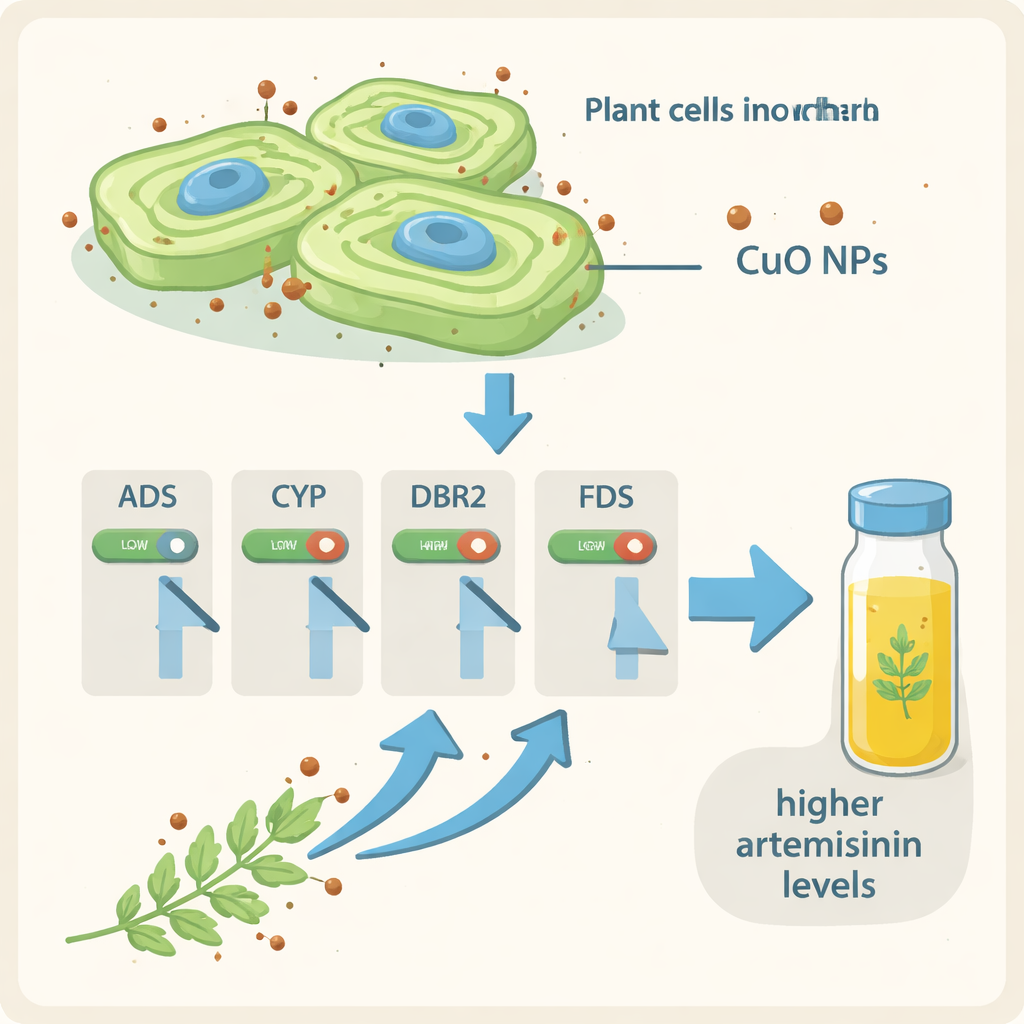
Instead of whole fields, the team worked with small stem segments of wormwood grown in sterilized glass containers on nutrient gel. They added very low doses (2 and 4 parts per million) of either green-made or chemically made copper oxide nanoparticles to the growth medium. After a month, they did not measure artemisinin directly; instead, they asked a more fundamental question: did the plants switch on the key genes that build the compound? Using a sensitive technique that counts messenger molecules inside cells, they measured seven crucial genes in the artemisinin pathway, including those that drive the main production line and one, called RED1, that diverts material away from artemisinin.
Turning Up the Right Genetic Dials
The results showed that copper oxide nanoparticles can act like precise volume knobs on the plant’s chemistry. At certain doses, both green and chemically synthesized particles strongly increased the activity of genes that feed into artemisinin production, such as FDS, ADS, CYP71AV1, DBR2, and ALDH1—often roughly doubling their activity compared with untreated controls. Meanwhile, the competing gene RED1 rose only slightly, suggesting that more of the plant’s internal building blocks stayed on the path toward artemisinin instead of being shunted into useless byproducts. Interestingly, green-made nanoparticles at 4 ppm and chemically made ones at 2 ppm gave the strongest boosts, hinting that not only dose but also how the particles are made shapes their biological impact.
Greener Routes to Powerful Plant Medicines
For nonspecialists, the key message is that nanotechnology can help medicinal plants make more of the drugs we depend on, without resorting solely to genetic modification or expanding farmland. By using very low amounts of carefully designed copper oxide nanoparticles—especially those made with eco-friendly, plant-based methods—scientists can encourage wormwood’s own genes to favor artemisinin production. While this study did not yet weigh the final drug levels, it maps out how the plant’s inner switches respond, paving the way for follow-up work that links these genetic changes to actual increases in medicine. In the long run, such approaches could offer a more sustainable, controlled, and scalable way to supply vital antimalarial treatments.
Citation: Mahjouri, S., Rad, R.M., Jafarirad, S. et al. Differential effects of biologically and chemically synthesized copper oxide nanoparticles on artemisinin biosynthesis gene expression in Artemisia absinthium. Sci Rep 16, 7339 (2026). https://doi.org/10.1038/s41598-026-38581-w
Keywords: artemisinin, Artemisia absinthium, copper oxide nanoparticles, plant tissue culture, antimalarial drugs