Clear Sky Science · en
Simulation of deformation characteristics of irregular rock specimens with different mining face lengths
Why the shape of empty space underground matters
When coal is mined, the rock roof above the excavated void can sag, crack, and sometimes fail suddenly. These roof collapses do not just threaten miners and machinery below; they also change how gas moves through old workings and how the ground surface behaves. This study looks at a deceptively simple question with big practical consequences: how does the length of the mined-out area, and the shape of the remaining coal, change the way the overlying rock deforms and breaks?
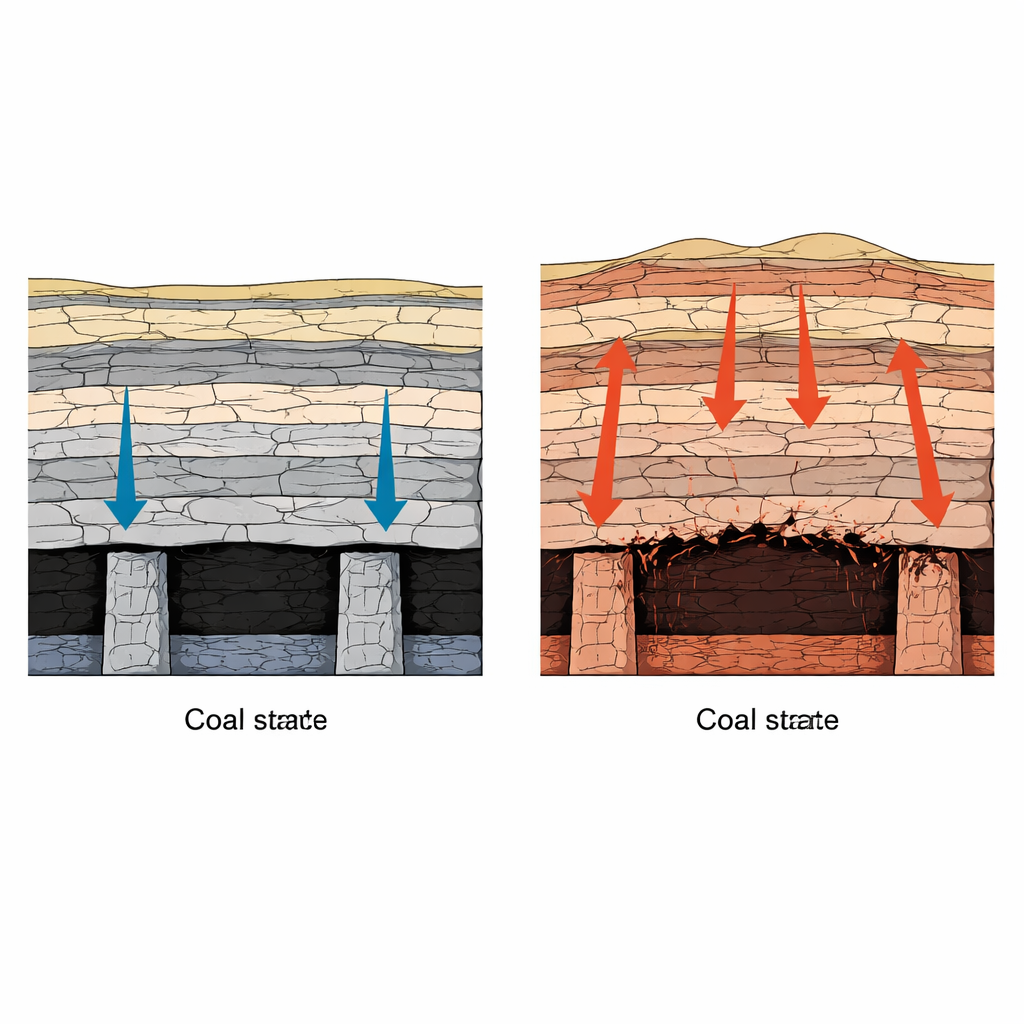
Digging longer, stressing the rock differently
The authors focus on the section of coal left behind to support the roof, known as a coal pillar, and on the irregular opening beneath the overlying rock. Rather than assuming neat, regular shapes, they built model blocks that imitate a coal seam overlain by mudstone and sandstone, then cut out openings of different lengths to mimic short and long mining faces. Under controlled loading in the laboratory, these blocks were squeezed from above to simulate the weight of overlying rock. By changing only the length of the opening, they could see how a longer “gap” in support alters the stress on the pillar and the roof.
Listening to rocks break and watching them strain
To track what happened inside the specimens as they were compressed, the team combined several modern sensing tools. Acoustic emission probes “listened” for tiny cracking events, counting each burst of elastic energy as the rock material fractured internally. At the same time, a high-speed optical system followed thousands of painted speckles on the specimen surface, reconstructing detailed maps of displacement and strain—how much each part stretched, compressed, or sheared—as loading progressed. From these measurements they built stress–strain curves, identified peak strength and residual strength, and linked them to where and when cracks formed.
From gradual damage to sudden failure
The results show a clear trend: as the mining length increased from short to long, the maximum stress the specimens could carry dropped by more than half, and their remaining strength after peak load also declined. Shorter openings produced more gradual, distributed cracking. Acoustic signals accumulated more slowly and to higher totals, indicating that damage was spread over a larger internal region and evolved step by step. Surface strain maps showed broad, curved zones of elevated strain near the roof of the opening, with cracks branching in several directions, allowing the specimens to deform plastically before failing.
In contrast, longer openings behaved in a more brittle and localized way. The onset of intense acoustic emission moved earlier in the loading history, but the total number of events fell, meaning the rock failed after less distributed damage. Strain concentrated sharply along narrow bands that tilted across the specimen, and major cracks followed these bands almost directly. Instead of many small cracks and gradual spalling, one or two dominant cracks cut through the block, causing abrupt blocky failure and a rapid drop in load-bearing capacity. The authors describe this shift as a move from progressive damage to sudden instability as mining length grows.
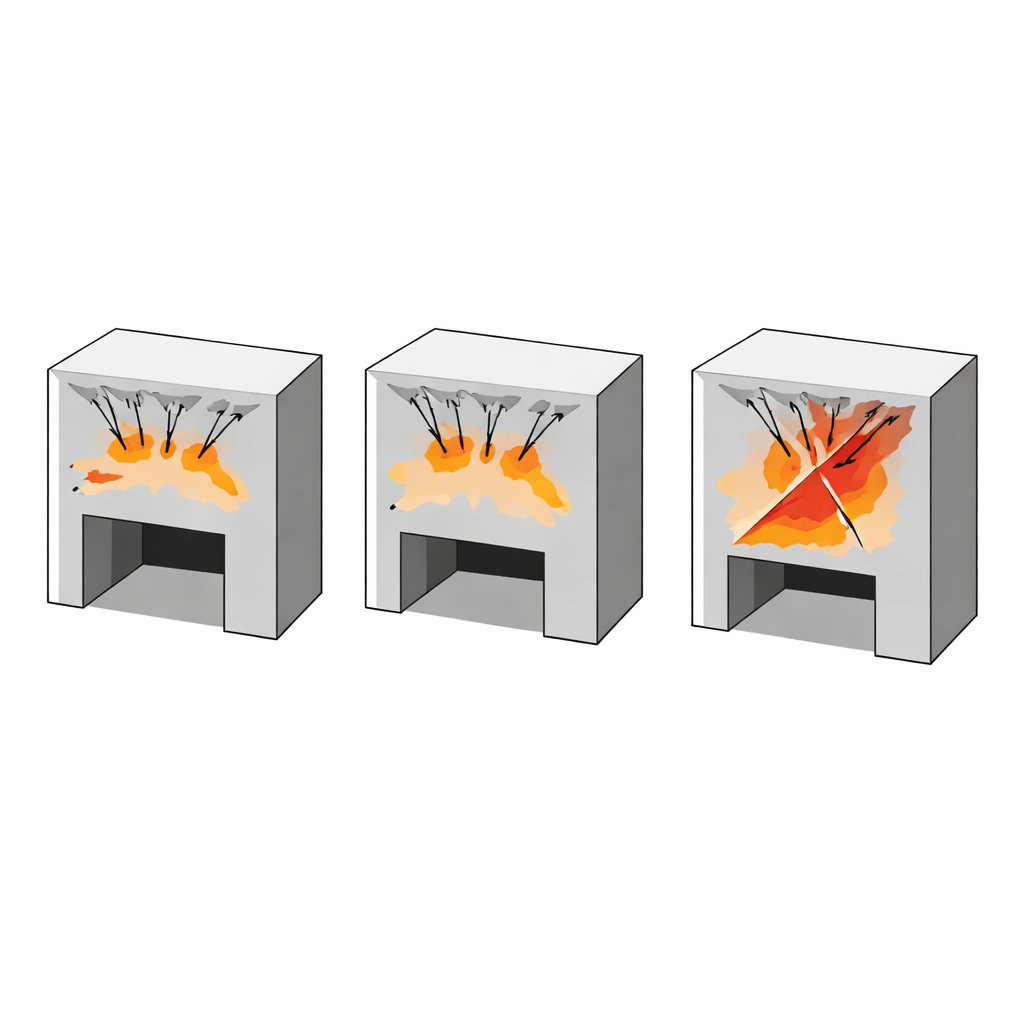
Virtual specimens confirm the pattern
To test whether these laboratory observations would hold in a more general setting, the researchers built three-dimensional computer models of the same layered specimens and openings using engineering simulation software. They imposed similar loading conditions and tracked how stress and the so-called plastic zone—the region where rock has yielded and no longer behaves elastically—evolved. The simulations closely matched the experiments: with increasing mining length, peak stress decreased and the proportion of the specimen occupied by the plastic zone at failure shrank in a nearly straight-line fashion. Larger openings entered plasticity earlier, but the plastic region did not grow as widely before overall failure, supporting the idea of “early damage, limited spread, fast collapse.”
What this means for safer and cleaner mining
For a non-specialist, the key takeaway is that how far you extend an underground opening without support has a strong and predictable influence on how the rock above will fail. Shorter mining faces and wider, stronger coal pillars encourage damage to develop gradually and over a broader zone, giving more warning and preserving some load-bearing capacity. Longer faces, by contrast, push the system toward sharp, concentrated failure along a few planes, reducing the margin of safety and altering the fracture pathways that control gas movement and surface stability. By quantifying these effects in carefully controlled models and simulations, this work provides engineers with guidance for choosing mining lengths and pillar sizes that better balance resource recovery with safety and environmental protection.
Citation: Zhang, Y., Liu, X., Wei, S. et al. Simulation of deformation characteristics of irregular rock specimens with different mining face lengths. Sci Rep 16, 9463 (2026). https://doi.org/10.1038/s41598-026-38575-8
Keywords: coal mining, roof stability, coal pillars, rock fracture, numerical simulation