Clear Sky Science · en
Mechanical and thermal performance of magnesium carbon fiber sandwich composites with variable fiber orientations for aerospace structures
Why lighter, tougher airplane parts matter
Every kilogram trimmed from an aircraft saves fuel, cuts emissions, and frees space for passengers or payload. Engineers are therefore hunting for materials that are both feather‑light and remarkably strong, while also surviving the heat, cold, and impacts that structures experience in flight. This paper explores a promising candidate: sandwich panels that pair thin sheets of magnesium metal with a core of carbon‑fiber composite, and shows how simply changing the angle of the fibers inside can dramatically reshape how these panels behave.
Building a metal–carbon “sandwich”
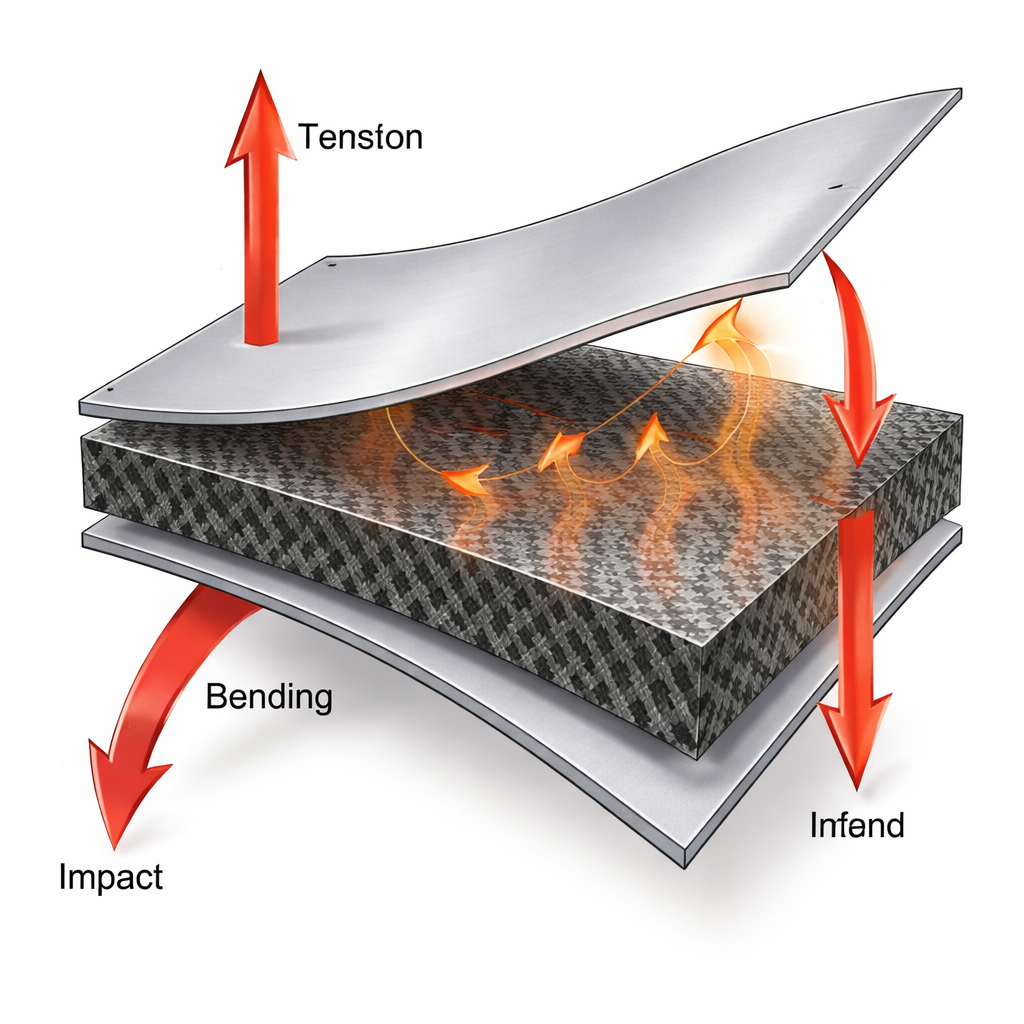
The researchers created flat panels similar to the skins and stiffened sections used in aircraft wings and fuselages. Each panel had outer face sheets made of AZ31 magnesium alloy, a metal valued for being about a third lighter than aluminum yet reasonably strong and highly conductive to heat. Between these skins they placed eight ultra‑thin layers of carbon fiber embedded in epoxy resin, forming the core of the sandwich. What they varied was the direction in which the carbon fibers ran: some panels had all fibers lined up in one direction, others had them crossed at right angles, angled at ±45 degrees, or arranged in a balanced, multi‑directional stack intended to spread loads more evenly.
Putting the panels through their paces
To see how these different designs performed, the team cut standard test coupons and subjected them to stretching, bending, and impact blows. They also heated small samples while measuring weight loss and heat flow to gauge thermal stability, and used microscopes and X‑ray techniques to inspect the internal structure. These tests mimic what aircraft components experience: steady loads from pressurization and aerodynamic forces, sharp shocks from debris or hard landings, and temperature swings from sub‑zero altitudes to hot engine surroundings. Throughout, one simple question guided the work: which fiber layouts give the best mix of strength, toughness, and heat resistance for real aircraft use?
How fiber direction changes strength and toughness
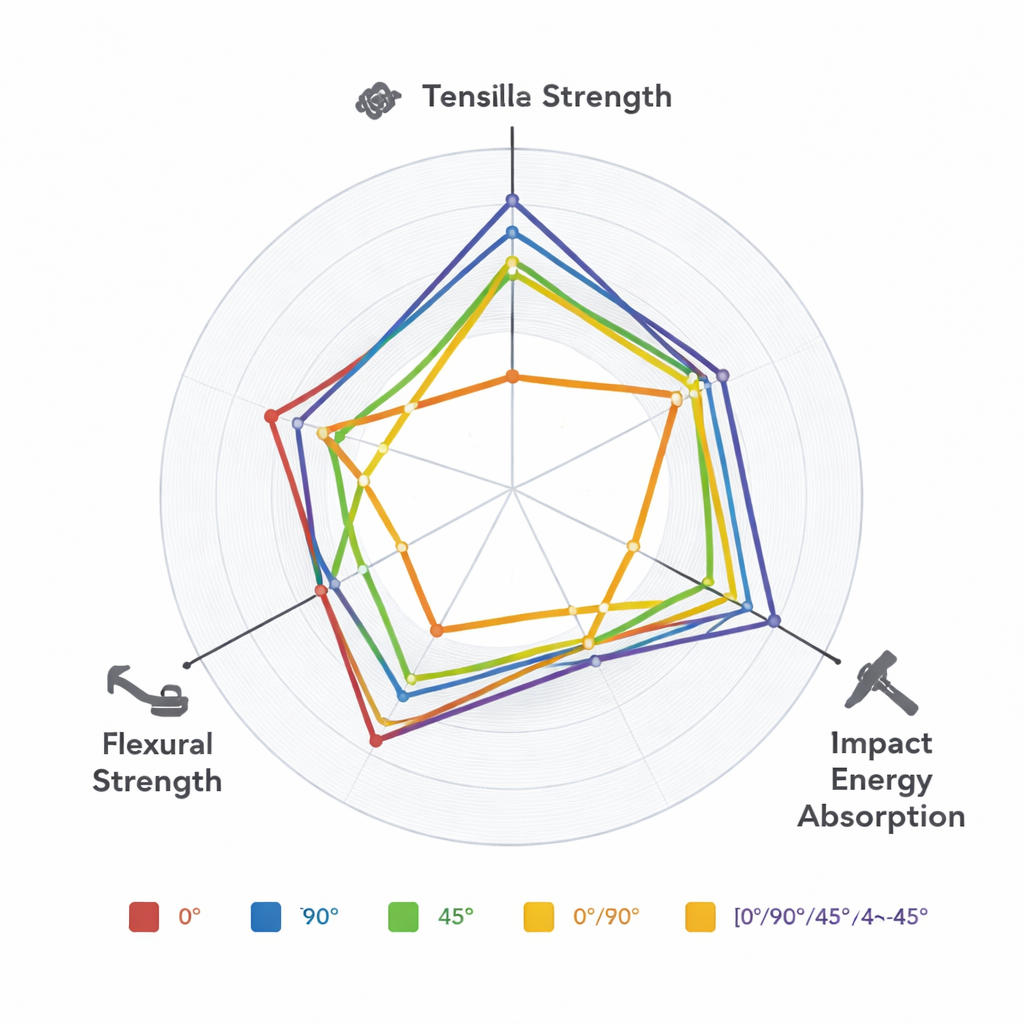
The answer turned out to depend strongly on how the panels were loaded. When pulled in tension or bent like a beam, panels whose fibers ran along the main load direction were clear winners. The all‑0‑degree design showed the highest tensile and flexural strengths, because the straight fibers could carry the stretching and bending forces directly. Panels with fibers turned sideways (90 degrees) were the weakest in these tests, since the fibers contributed little to resisting lengthwise loads. However, impact tests told a different story. Here, panels with ±45‑degree fibers absorbed far more energy before breaking. Their angled fibers encouraged cracks to twist and branch, with many fibers pulling out of the matrix—damage mechanisms that soak up impact energy rather than allowing sudden, brittle failure.
Heat, stability, and what happens inside
Thermal tests showed that all of the sandwich designs remained stable well above typical aircraft service temperatures. Significant decomposition of the epoxy core only began above about 250–300 °C, providing a comfortable safety margin over the 120–200 °C conditions found around most airframes. Yet even here, fiber layout mattered. Cross‑ply and quasi‑isotropic stacks—where fibers ran in several directions—left more solid residue after high‑temperature exposure and showed smoother heat‑flow signals, indicating a more thermally robust internal structure. Microscopic images of fractured samples supported these findings: straight‑fiber panels failed mainly by clean fiber breakage, while multi‑directional and ±45‑degree panels showed more fiber pull‑out, matrix shearing, and controlled delamination, all of which help dissipate both mechanical and thermal stresses.
A balanced design for future aircraft
For designers, the most attractive option was not the absolute strongest panel in one test, but the one that performed well across them all. The multi‑directional “quasi‑isotropic” sandwich—with fibers at 0, 90, and ±45 degrees—offered that balance. It ranked near the top in tensile and bending strength, handled impacts nearly as well as the best ±45‑degree design, and showed strong resistance to heat‑induced damage. In plain terms, this layout trades a small amount of peak strength for a big gain in all‑round reliability. The study therefore points toward magnesium–carbon sandwich panels, especially with carefully arranged fiber directions, as promising building blocks for lighter, tougher, and thermally resilient aerospace structures in next‑generation aircraft.
Citation: Annadorai, M.E., Ramakrishna, M. Mechanical and thermal performance of magnesium carbon fiber sandwich composites with variable fiber orientations for aerospace structures. Sci Rep 16, 7710 (2026). https://doi.org/10.1038/s41598-026-38567-8
Keywords: magnesium composites, carbon fiber panels, aerospace materials, sandwich structures, fiber orientation