Clear Sky Science · en
Longevity and foraging performance of honey bees treated with an RNAi-based Varroa destructor biopesticide
Why healthy bees matter to everyone
Honey bees do far more than make honey; they pollinate many of the fruits, vegetables and nuts that fill supermarket shelves. Around the world, a tiny parasitic mite called Varroa destructor is attacking bee colonies and helping spread harmful viruses, leading to heavy winter losses for beekeepers. This study tested a new, biology-inspired treatment aimed at controlling these mites while keeping bees healthy and productive, comparing it with a common chemical treatment and with no treatment at all.
A new way to protect bee colonies
Most beekeepers currently rely on chemical strips placed inside hives to kill Varroa mites. These products can build up in wax and honey over time, may stress bees, and the mites can evolve resistance. The new product tested here, called vadescana, takes a different approach. It is based on RNA interference, a natural process cells use to switch off specific genes. Vadescana is mixed into a sugary solution that bees consume and share with their nestmates. The active ingredient is designed to reach the mites and block a gene needed for mite egg production, quietly slowing their population growth rather than poisoning them outright. 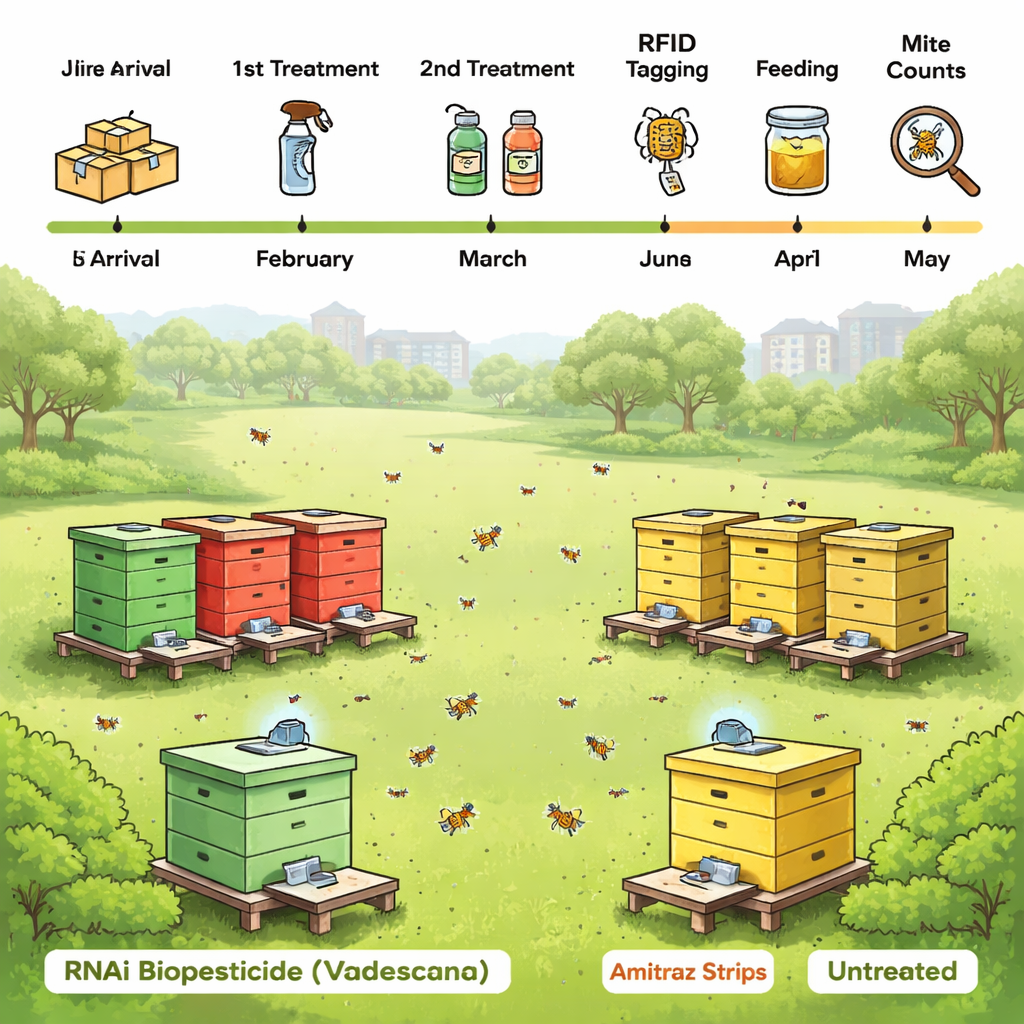
How the field test was set up
The researchers worked with nine full-size honey bee colonies placed in two small apiaries on a university campus in Wellington, New Zealand. The hives were randomly split into three groups: one received no mite treatment, one was treated with standard amitraz strips, and one was fed vadescana solution at realistic field doses. To track individual bees, the team glued tiny radio tags onto about 150 newly emerged workers from each hive. Special readers at the hive entrances automatically recorded every tagged bee going in or out, along with the time and direction. At the same time, sticky boards placed under each hive caught fallen mites each week, providing a picture of how mite numbers changed over the season.
Do treated bees live longer and work harder?
The tagged bees were followed for about three and a half months. Bees in untreated hives had the shortest lives, surviving on average about 22 days as adults. Bees from amitraz-treated hives lived the longest, around 29 days, while vadescana-treated bees were in between at about 25 days. Crucially, both treated groups outlived the untreated bees, showing that mite pressure strongly reduces bee lifespan. The movement records also captured the classic stages of a worker’s life: quiet days spent on in-hive chores, followed by an active foraging period, and finally a slow decline as the oldest bees vanished from the records.
Foraging patterns and strange bee trips
When the team focused on trips with clear “leaving” and “returning” signals, they found that vadescana-treated bees began flying outside earlier in life and made the most foraging trips overall, with relatively short flights. Amitraz bees were slightly slower to start and did fewer trips, but still showed robust foraging. Bees from untreated, mite-stressed hives flew later in life, made the fewest trips, and often stayed out for many hours or even overnight. Such long outings are a warning sign that bees may be disoriented or in poor condition. The tracking system also revealed that about 8% of bees visited other hives. Some switched homes permanently (“drifters”), usually to a neighboring hive, while others repeatedly raided other colonies for honey (“robbers”), behavior that can help spread mites and diseases between hives. 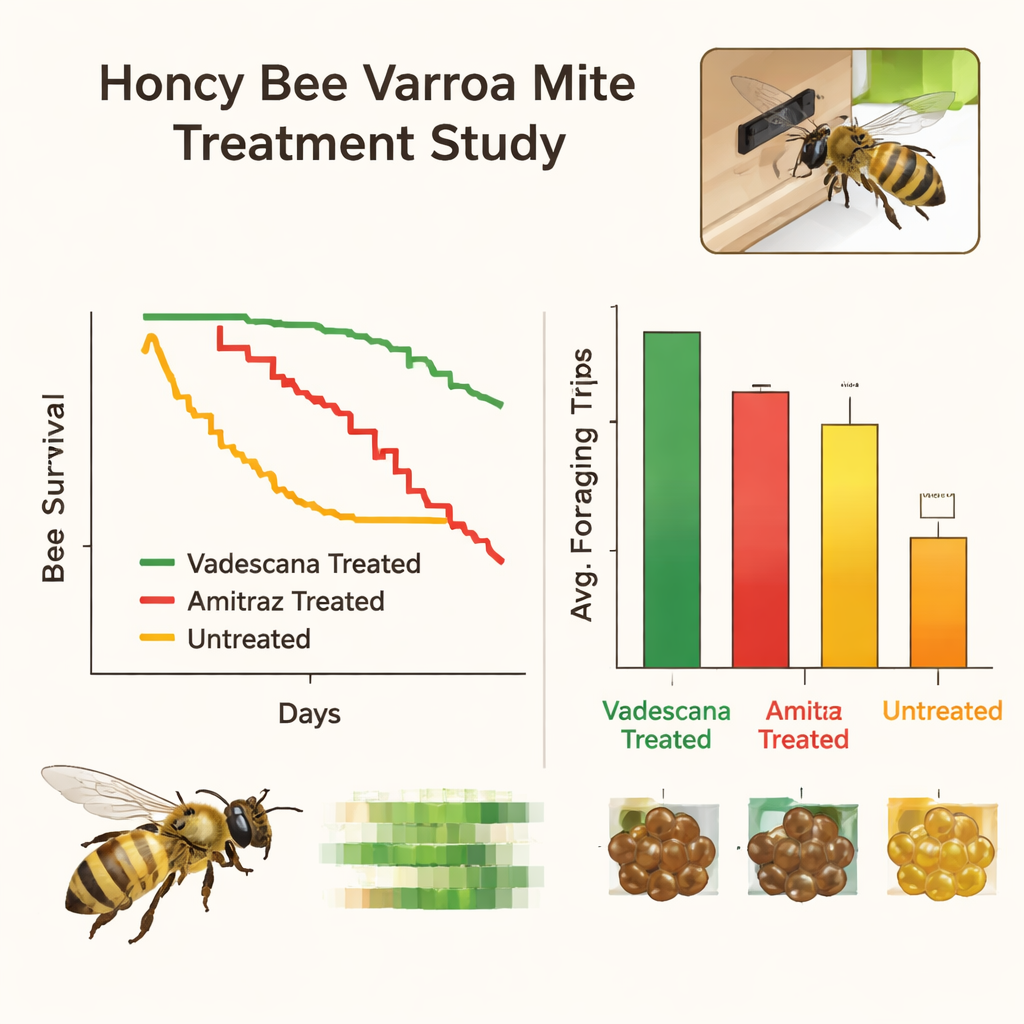
Keeping mite numbers in check
Weekly mite counts showed that both treatments held Varroa in check for roughly ten weeks, after which mite numbers rose in all hives as autumn progressed. Across the season, vadescana-treated colonies consistently had lower mite levels than untreated colonies, and slightly lower than amitraz hives, although the difference to amitraz was not always statistically clear. Because vadescana works by limiting mite reproduction rather than killing them instantly, it did not create dramatic spikes in fallen mite numbers, but it did slow the overall buildup of the parasite population.
What this means for bees and beekeepers
For non-specialists, the take-home message is that controlling Varroa mites is essential for keeping honey bees alive and productive, and that new tools based on natural gene-silencing processes can help. In this study, vadescana-treated bees lived longer than mites-infested, untreated bees and showed strong foraging activity, while their colonies carried fewer mites over time. Together with standard treatments like amitraz, RNA-based biopesticides could give beekeepers more options to manage resistant mites and reduce reliance on conventional chemicals, helping protect both bee health and the pollination services our food systems depend on.
Citation: Merk, J., Anastasi, M., McGruddy, R. et al. Longevity and foraging performance of honey bees treated with an RNAi-based Varroa destructor biopesticide. Sci Rep 16, 8208 (2026). https://doi.org/10.1038/s41598-026-38557-w
Keywords: honey bees, Varroa mites, biopesticide, RNA interference, bee foraging