Clear Sky Science · en
Reliability assessment of agricultural sensors evaluated through algal coverage in hydroponic tomato production systems
Why this matters for future farming
As food production moves indoors into greenhouses and vertical farms, growers increasingly rely on networks of tiny electronic sensors to tell them how their plants are doing. But what if the sensors themselves are misleading? This study looks at an unexpected ally—simple green algae growing on rockwool blocks—to judge whether root‑zone sensors in a hydroponic tomato system are really reporting local water and nutrient conditions accurately.
Tomatoes grown without soil
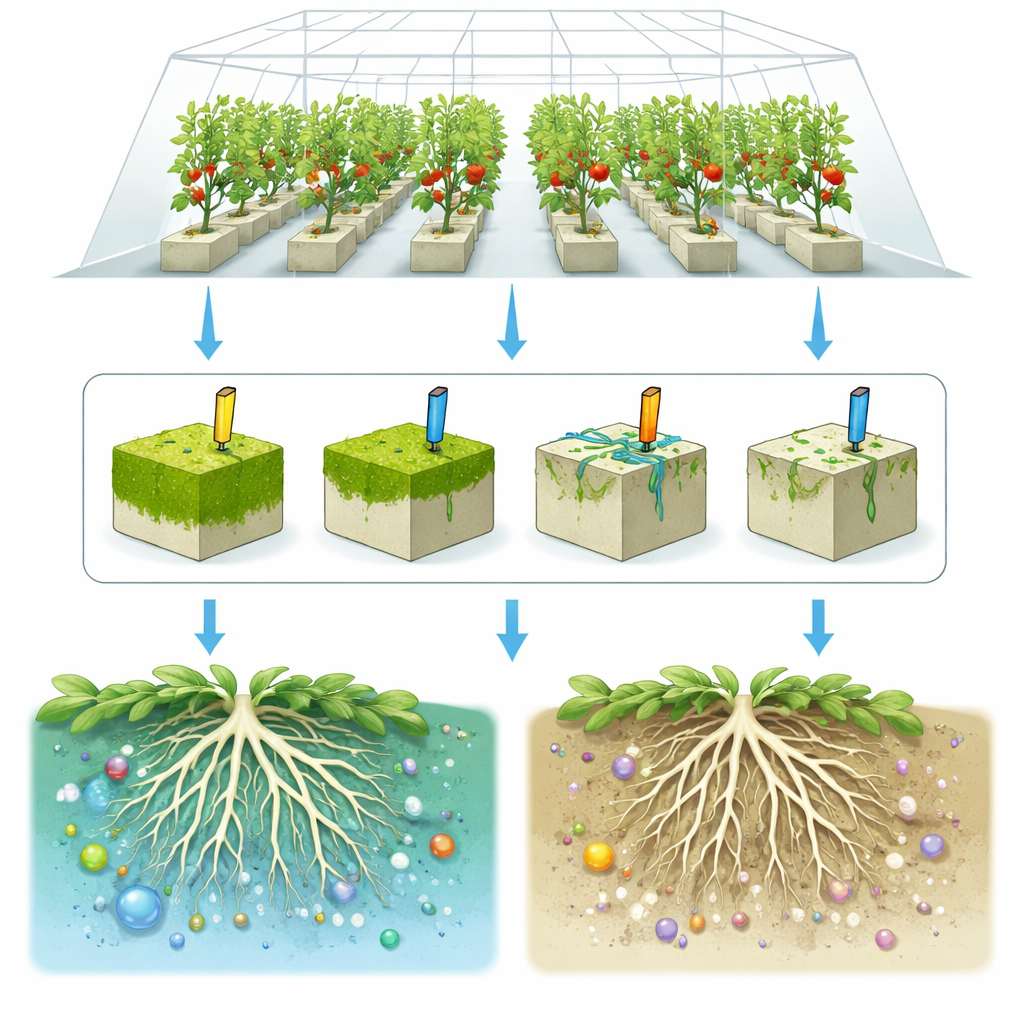
The researchers worked in a commercial‑style greenhouse where 117 tomato plants were grown without soil, using rockwool blocks as the growing medium. In hydroponic systems like this, a nutrient solution is dripped onto each block, feeding the roots directly while sensors track moisture, acidity, temperature, and the concentration of dissolved salts. In theory, identical plants, blocks, and drippers under one roof should create a very uniform environment. In practice, the team noticed something puzzling: even though the setup was standardized, sensor readings for humidity and nutrient strength varied widely from plant to plant.
Green films as natural tracers
To understand these differences, the scientists turned to a familiar nuisance in hydroponic greenhouses—algae. The rockwool surfaces around some sensors were covered almost entirely with a green film, while others had only a few scattered patches. Because algae thrive where water and nutrients are plentiful and light is available, their presence can reveal how well the nutrient solution spreads through each block. After the three‑month growing period, the team photographed every sensor location and carefully measured how much of a defined corner area of each rockwool block was covered in algae.
Comparing wet and dry micro‑zones
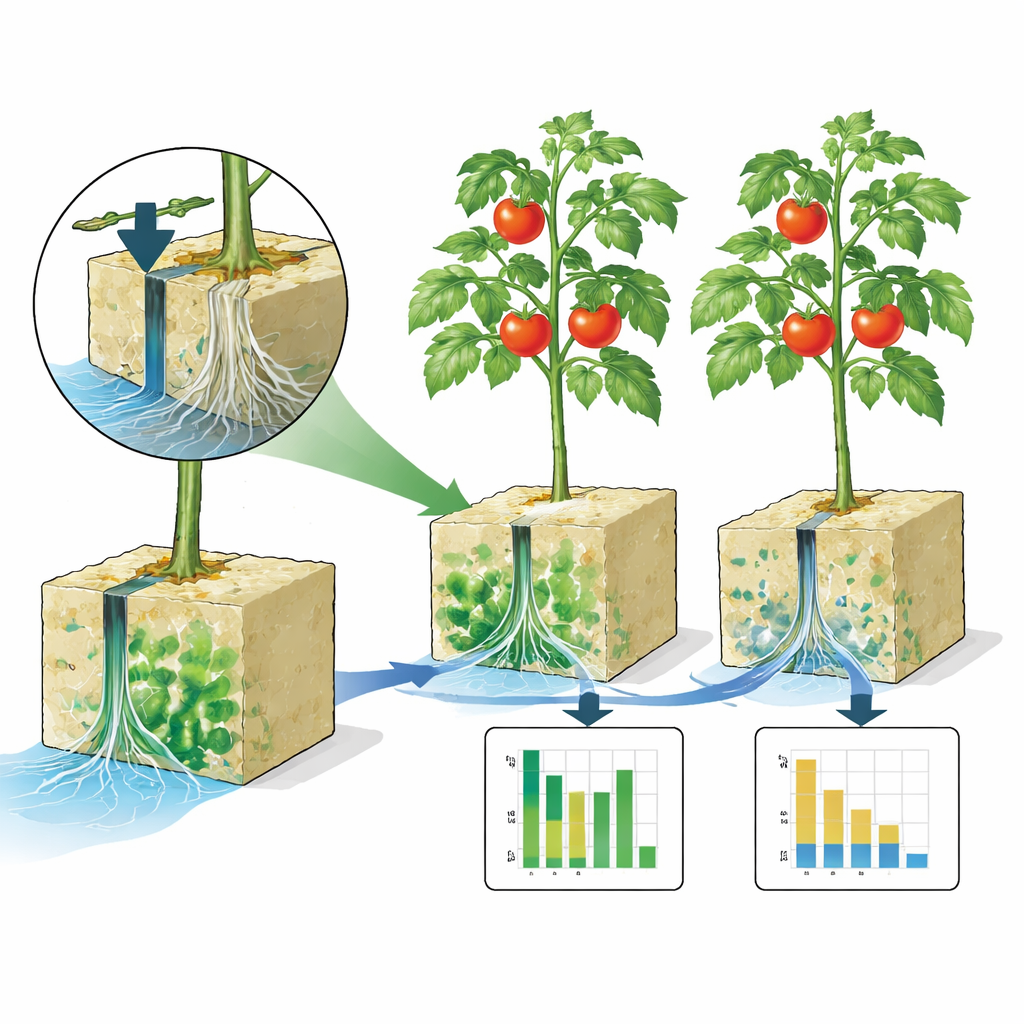
Based on these images, sensors were sorted into two contrasting groups. In one group, algae covered at least 90 percent of the observed rockwool surface; in the other, coverage stayed below 10 percent. When the researchers compared the recorded root‑zone conditions of these two sets, a clear pattern emerged. Where algae coverage was high, the surrounding rockwool stayed very damp and the dissolved salt levels were higher. Where algae coverage was low, the same type of sensors reported much drier conditions and weaker nutrient solutions. Statistical analyses confirmed that these differences in moisture, salt levels, and even acidity were systematic rather than random fluctuations.
Plants stay steady while sensors disagree
Surprisingly, the tomatoes themselves did not seem to care much about these contrasting sensor readings. The number of fruits, their weight, and the efficiency of production per plant were very similar in both the high‑algae and low‑algae groups. This suggests that tomato roots explored the whole block, tapping into water and nutrients even in places that the sensors—mounted at a fixed spot far from the dripper—did not fully capture. In other words, the plants experienced a more forgiving environment than the sensors suggested, smoothing out local wet and dry spots inside the rockwool.
What this means for smart farming
The study shows that patches of algae on rockwool can act as a kind of natural indicator of where water and nutrients actually flow, helping to interpret puzzling sensor data. High algae coverage tends to signal persistently moist, nutrient‑rich micro‑zones, whereas sparse algae point to areas that receive less solution. Rather than blaming faulty electronics, the authors argue that many apparent “sensor errors” may simply reflect how unevenly the nutrient solution spreads through the growing medium. For growers and system designers, this means that checking algal growth and sensor placement could be a practical way to validate sensor readings and refine irrigation design. More broadly, the work underlines that in digital agriculture, reliable data depend not only on well‑built devices but also on understanding the living, patchy environment those devices are trying to measure.
Citation: Khoeurn, S., Park, N.H., Jahng, H.K. et al. Reliability assessment of agricultural sensors evaluated through algal coverage in hydroponic tomato production systems. Sci Rep 16, 8529 (2026). https://doi.org/10.1038/s41598-026-38555-y
Keywords: hydroponic tomatoes, rockwool substrate, sensor reliability, algal growth, smart farming