Clear Sky Science · en
Investigation into the interactive feedback and rock burst mechanism under mining disturbance
Hidden jolts beneath our feet
Deep underground, modern coal mines operate in a world of extreme pressures. When rock suddenly snaps and throws coal and stone into tunnels, the results—known as rock bursts—can be deadly. This study looks at why these violent events are becoming more common as mines go deeper, especially when several mining fronts work close to each other. By tracing how slow, constant squeezing of the rock interacts with sharp seismic shocks, the authors aim to show when and where bursts are most likely, and how mine operators can act in advance to keep workers and equipment safe.
When mining fronts collide
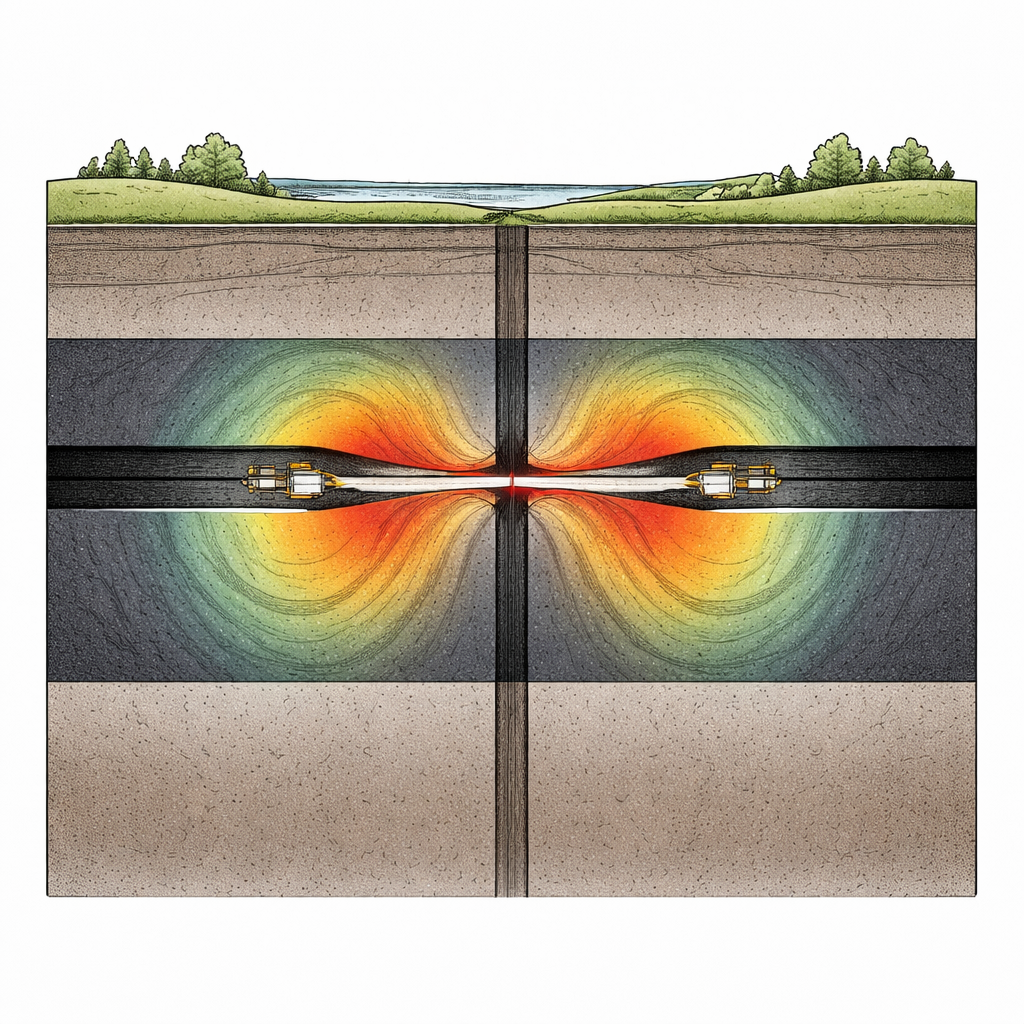
In many large coal mines, two longwall panels are mined toward each other from opposite sides of a main roadway. Each advancing front compresses the surrounding rock, building up bands of high stress ahead of the machines. On their own, these zones are already dangerous; when two such fronts approach one another, their stress fields overlap. The paper shows that this overlap can sharply raise the risk of a burst in the central roadway, which is the lifeline for people, air, and equipment. A survey of more than 190 real incidents from Chinese mines reveals that most disturbance‑type rock bursts occur during active mining or excavation, and that roadways—not the main faces themselves—suffer the majority of the damage.
How pressure builds in deep rock
Using an idealized model of two opposing mining panels, the researchers break down how static (slow, constant) stress grows as the fronts move closer. At first, when they are far apart, their influence zones do not meet and each behaves independently. As the distance shrinks, the stress zones begin to overlap and the combined pressure steadily increases. Once the panels are close enough, the overlap becomes intense, and the calculated peak stress in the rock can reach several times the natural in‑situ stress. Computer experiments, based on conditions at the Tangshan coal mine, show that three main factors make matters worse: greater depth, wider mined areas, and stronger concentration of stress around the panels. Under such conditions, the zone of dangerous static loading can extend roughly 60 meters around the opposing faces.
Shocks that add up rather than cancel out
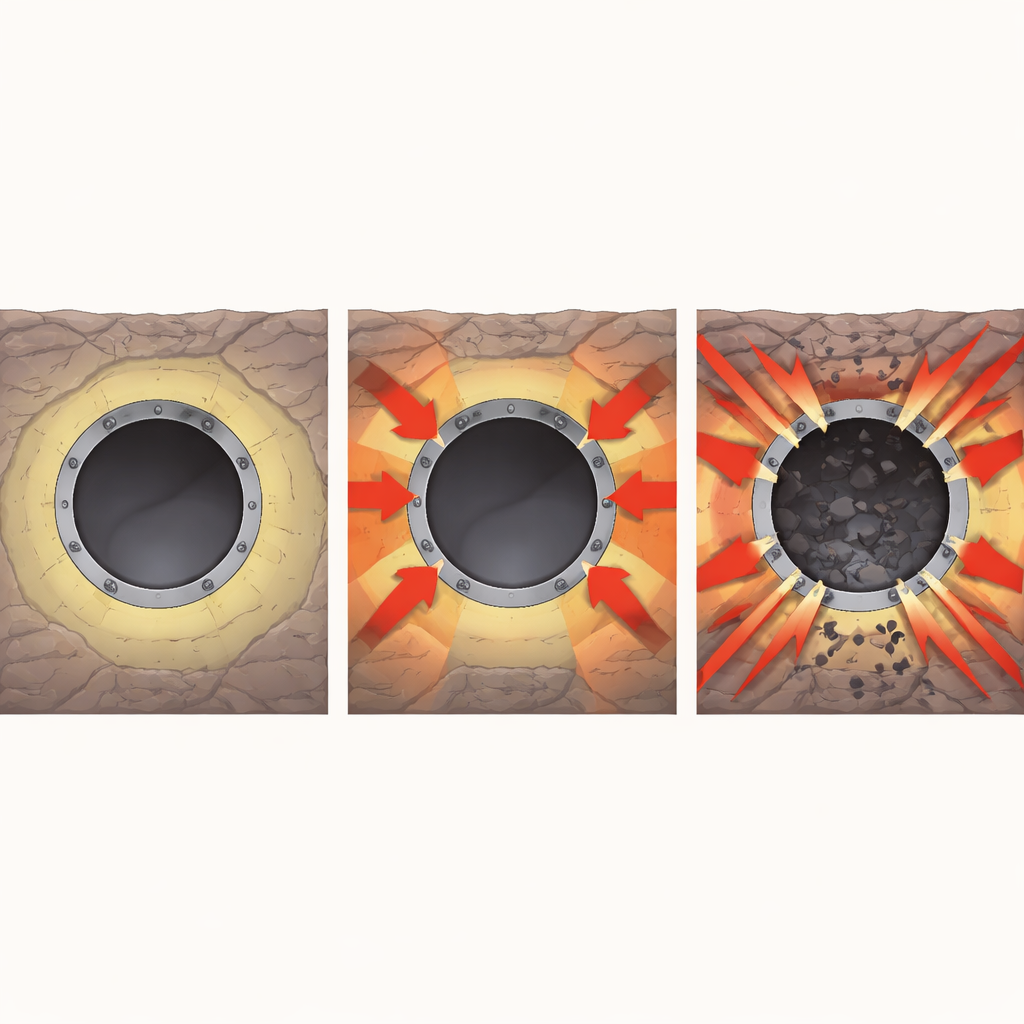
Static pressure alone is not the whole story. Mining also generates seismic waves as rock layers crack, roofs break, or explosives are fired. These waves travel through the rock much like ripples in water, but at high speed and with enough power to disturb already stressed layers. The authors model how two different seismic sources—from distinct working faces—can interact as they pass around a circular, bolt‑supported roadway. By treating the rock as an elastic medium and expanding the wave fields into mathematical series, they calculate how compressional (P) waves and shear (S) waves wrap around the tunnel. When waves from multiple sources arrive together, the resulting stresses around the tunnel walls are found to be roughly the sum of those from each source alone. This means that even moderate tremors, if combined, can push rock that is already near its limit into sudden failure.
When stored energy turns violent
To connect these pieces, the study frames rock bursts as a problem of stored energy. Slowly increasing static loads from deep burial, tectonic forces, and mining layout fill the coal‑rock mass with elastic energy, like a compressed spring. Dynamic loads from seismic waves then act as the trigger. The authors propose that a burst occurs when the combined static and dynamic stress surpasses the minimum strength needed to break the rock; at that point, the stored energy is rapidly released, hurling coal and rock into the empty space of the roadway. Depending on how much each factor contributes, events can be grouped into two practical types: high static load with weak shocks, and high static load with strong shocks.
From understanding to prevention
Building on this mechanism, the researchers outline a prevention strategy they call “source‑specific load reduction.” The idea is to monitor both the slow and sudden parts of the stress field, then take tailored action before conditions reach a critical point. For static loads, this can mean designing mine layouts that avoid overlapping stress zones, keeping safe distances between opposing faces, and adjusting the pace of advance. For dynamic loads, the team recommends measures that gently release energy in advance—such as drilling large relief holes, controlled blasting to weaken stiff roofs, or high‑pressure water jets to cut slots in the coal. Field tests at the Tangshan mine, supported by advanced stress and seismic imaging, show that such targeted steps can lower local stress, reduce the size of high‑risk zones, and allow continued production with fewer burst incidents. In simple terms, by carefully watching how the underground “spring” is wound and by bleeding off energy where it is highest, mines can greatly reduce the chances of sudden, destructive rock bursts.
Citation: Bai, J., Dou, L., Gong, S. et al. Investigation into the interactive feedback and rock burst mechanism under mining disturbance. Sci Rep 16, 8204 (2026). https://doi.org/10.1038/s41598-026-38552-1
Keywords: rock burst, deep coal mining, mine seismicity, ground control, stress monitoring