Clear Sky Science · en
Fluid–structure interaction and thermal performance: a numerical study on crossflow heat exchangers with aerodynamically optimised splitter elements
Why better heat coolers matter
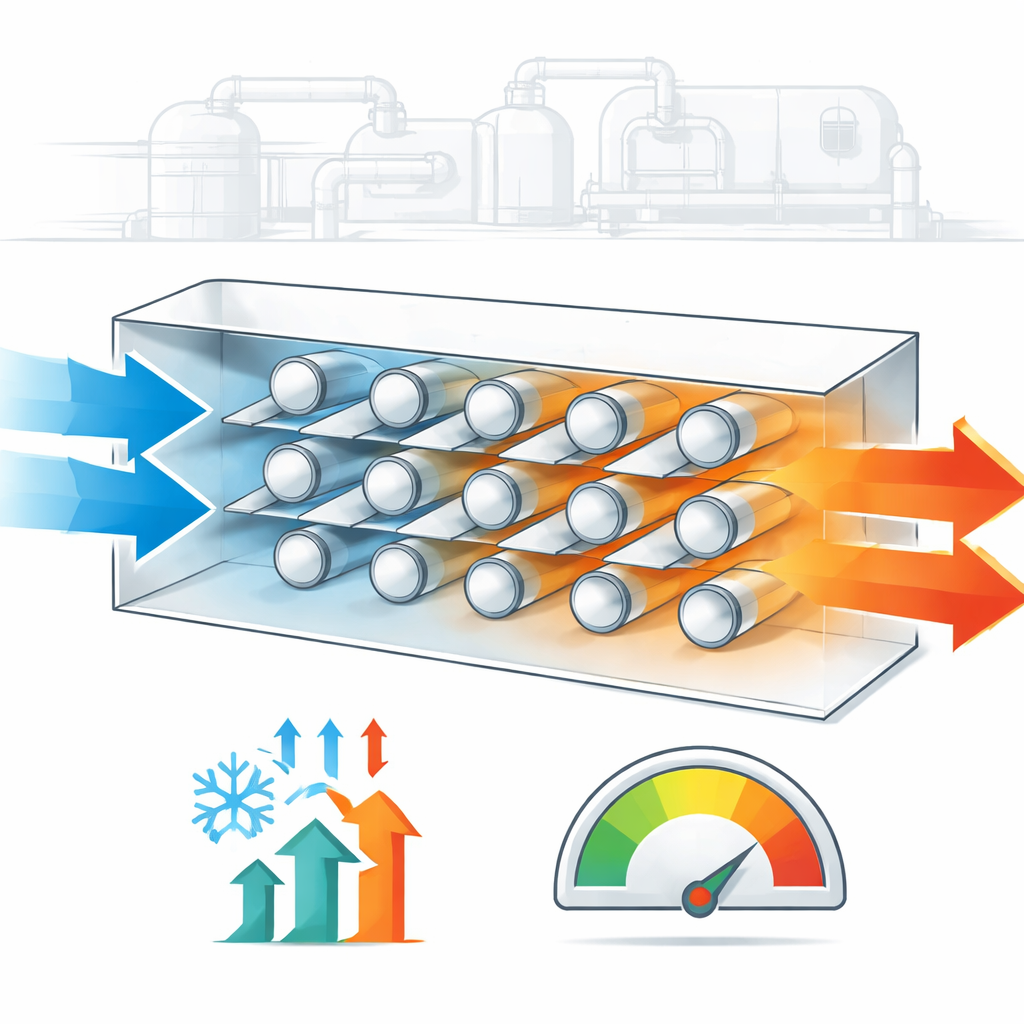
From power plants and data centers to air conditioners in homes, countless machines rely on heat exchangers to carry unwanted warmth away. Making these devices even a little more efficient can save large amounts of energy and reduce operating costs. This study looks at a simple add‑on—a thin plate placed behind each tube in a common type of heat exchanger—to see how much more heat can be removed without demanding too much extra pumping power.
A closer look at the test setup
The researchers focused on a crossflow heat exchanger, where air blows sideways across rows of metal tubes carrying a hotter fluid. Behind each round tube they attached a narrow “splitter” plate, like a small fin trailing in the airflow. By changing how long these plates were, and how rough the tube surfaces were, they could see how the overall behavior of the air changed. Instead of building many physical prototypes, they used advanced computer simulations to follow the air’s motion, pressure, and temperature in three dimensions and then checked those results against earlier laboratory measurements.
How guiding the air changes the flow
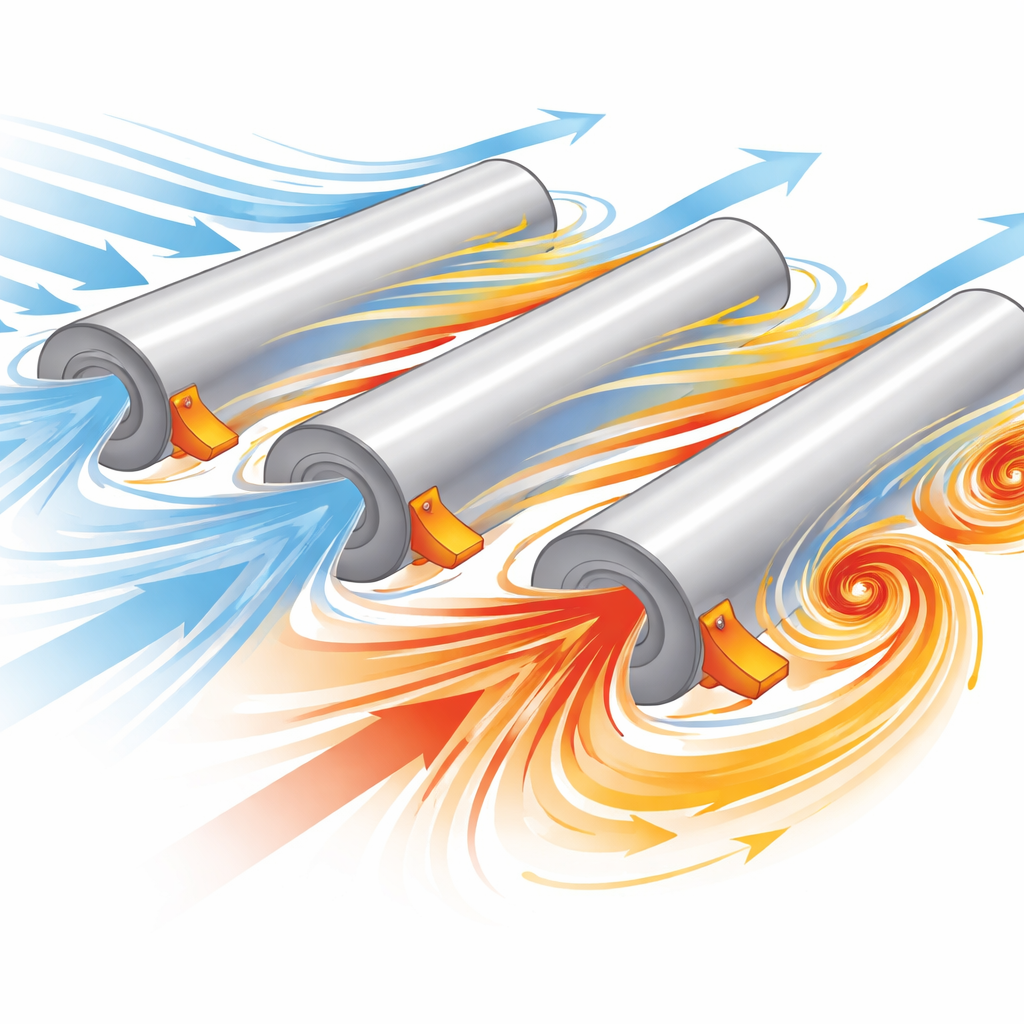
As air moves past a bare tube, it forms a patch of slow, swirling flow behind it, known as a wake. That wake acts like a blanket of warm, sluggish fluid that reduces further heat pickup. The added splitter plates reshape this wake. The simulations revealed that the plates shrink the low‑pressure region behind each tube, encourage the air to reattach sooner to the flow path, and trigger extra swirling motion near the walls. All of these effects thin the insulating layer of air that normally clings to the hot surfaces, allowing more heat to jump into the moving stream.
Balancing stronger cooling with flow resistance
More intense swirling and mixing usually come with a price: the fan or pump must work harder to push air through the exchanger. The team explored a range of flow speeds, expressed by an engineering quantity called the Reynolds number, and several splitter lengths measured relative to tube diameter. They tracked not only the rise in heat removal but also the extra pressure drop the air experienced. Longer plates tended to boost heat transfer more strongly, especially at moderate flow speeds, but also risked higher resistance at the highest speeds. The simulations showed that for carefully chosen plate lengths, the drop in friction at intermediate conditions—caused by a more orderly wake—could partly offset the added mixing, keeping the overall penalty modest.
Judging overall performance
To weigh benefits and costs together, the authors used a single score that compares how much the heat transfer improves versus how much the flow resistance increases, relative to a plain tube bank without plates. A score above one means the upgrade is worthwhile: the gain in cooling outpaces the extra work needed to move air. In every configuration tested, this performance score stayed safely above one, and it peaked for medium‑length plates at mid‑range flow speeds, where both wake control and mixing worked in concert.
What this means for real‑world devices
For designers of compact coolers in power generation, HVAC systems, and electronics, these findings offer practical guidance. By adding backward‑facing splitter plates of suitable length behind tubes, it is possible to remove up to roughly forty percent more heat while keeping pumping demands under control. The study shows not only that the concept works, but also clarifies why: the plates tame the wasteful wake behind each tube while simultaneously stirring the air where it matters most. Although the exact best dimensions will differ from one device and working fluid to another, the underlying message is clear—small, well‑placed surfaces can make conventional heat exchangers significantly more effective without a drastic redesign.
Citation: Kaushik, S., Singh, H., Kumar, A. et al. Fluid–structure interaction and thermal performance: a numerical study on crossflow heat exchangers with aerodynamically optimised splitter elements. Sci Rep 16, 9798 (2026). https://doi.org/10.1038/s41598-026-38542-3
Keywords: heat exchangers, turbulent flow, energy efficiency, cooling technology, computational fluid dynamics