Clear Sky Science · en
How to optimally allocate sampling effort in experimental ecology
Why this matters for real‑world experiments
When scientists test how ecosystems respond to climate change or pollution, they can only collect a limited number of samples. Should they spread those samples across many different conditions, or take several repeated measurements in just a few places? This study tackles that practical question head‑on, using computer simulations to show how ecologists can get the most reliable predictions from the least amount of field or lab work.
Two ways to spend your sampling budget
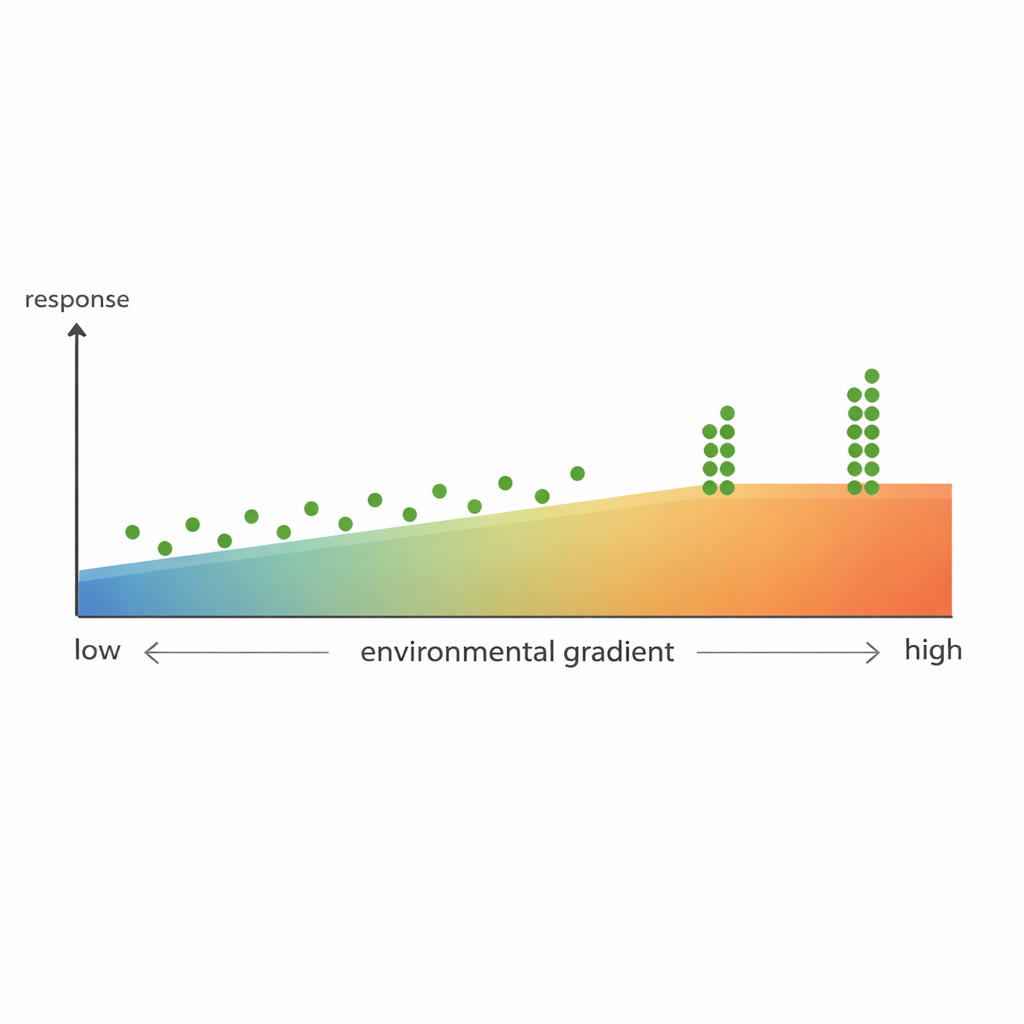
Imagine you want to know how plant growth changes along a temperature or moisture gradient. One option is to measure many locations along that gradient but only once at each spot. Another is to focus on a few temperatures or moisture levels and take several repeated measurements at each. The authors call the first approach "unreplicated" (many locations, one sample each) and the second "replicated" (fewer locations, several samples each). Because real studies are limited by time, money, and manpower, choosing between more locations or more repeats is a central design decision in experimental ecology.
Simulating nature’s curved responses
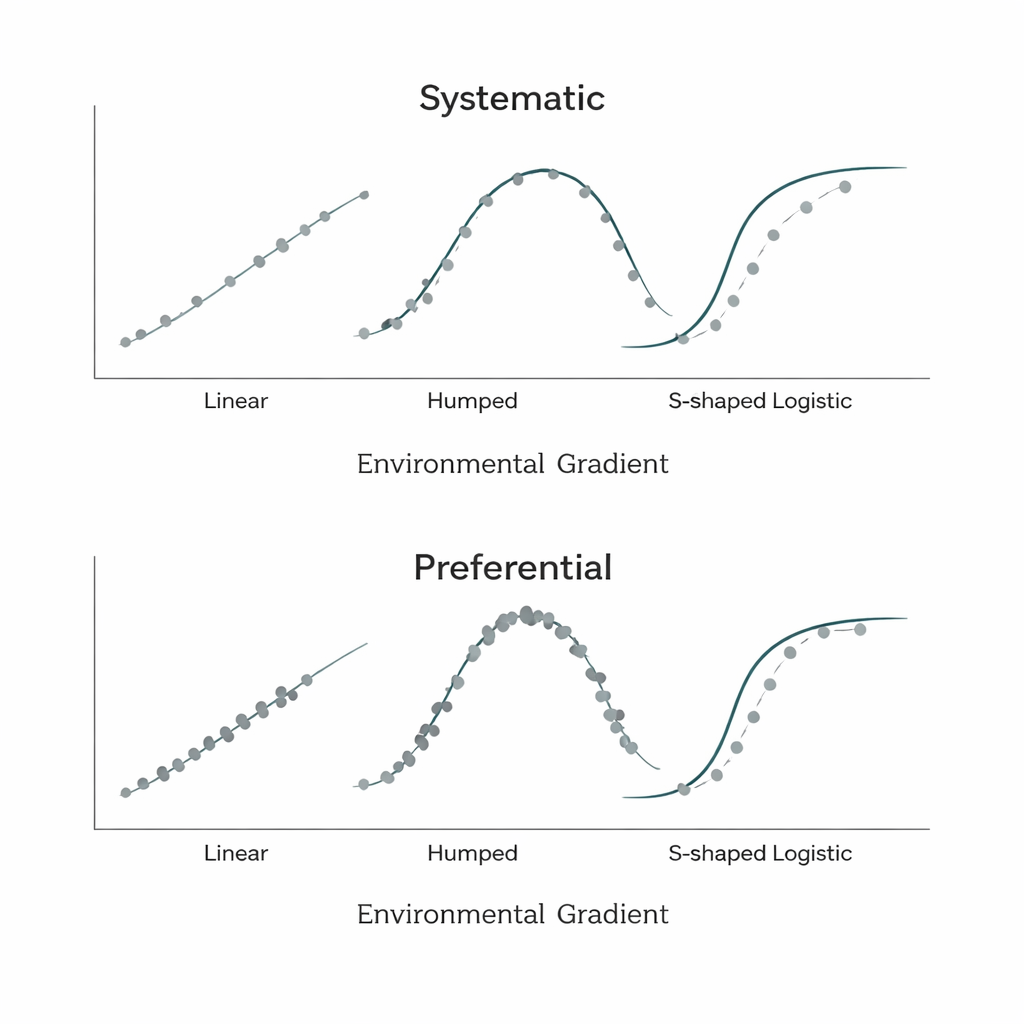
Ecological responses to changing conditions are rarely straight lines. Growth, diversity, or survival may rise and then fall, or increase steeply over a narrow range and then level off. To capture this reality, the researchers built artificial data with six typical response shapes, from simple straight lines to strongly curved, hump‑shaped, and S‑shaped (logistic) patterns. They then sampled these virtual ecosystems in many different ways: changing the total number of samples, the trade‑off between locations and replicates, and the strategy for placing sampling points along the gradient (for example, evenly spaced, random, or deliberately clustered around peaks or steep slopes). On top of this, they added different levels of random noise to mimic messy real‑world data.
What works best when the pattern is unknown
When the shape of the ecological response along the gradient was assumed to be unknown—much like in many new or exploratory studies—the clear winner was simple: take as many evenly spaced samples along the gradient as you can, and do not spend your limited budget on replicates at each point. In other words, it is better to map out the whole curve than to measure a few spots very precisely. Systematic, equidistant sampling across the full range of conditions consistently gave the most accurate predictions, even when data were noisy. Replication tended to reduce prediction accuracy in these cases because every extra replicate at one location meant one less location could be sampled, leaving large parts of the gradient poorly covered.
When prior knowledge makes repetition pay off
The picture changed when the researchers gave themselves advance knowledge of the underlying response shape, as might be available from past studies or pilot experiments. If the true pattern was simple—for example, a straight line or a single smooth hump—then taking replicates could improve predictions, especially when sampling locations were chosen systematically and included key points such as the extremes or the peak of the curve. In some complex but well‑understood patterns, carefully "preferential" sampling around critical points (where the curve is steep or extreme) helped as well. Still, on average, systematic coverage of the gradient remained as good as, or better than, more complicated sampling schemes, making it a robust default choice.
Practical lessons for designing future studies
The study’s main takeaway is straightforward for non‑specialists: if you do not yet know how an ecosystem will respond along an environmental gradient, spend your sampling budget on covering as many different conditions as possible, spaced regularly across the range. Replication—taking multiple samples at each point—becomes most useful only when past work has already revealed a simple response curve, and when you can deliberately target the most informative parts of that curve. These insights can help ecologists design more efficient experiments, push studies safely into more extreme conditions, and build models that better predict how ecosystems will behave under future climate and environmental change.
Citation: Schweiger, A.H., Garthen, A., Bahn, M. et al. How to optimally allocate sampling effort in experimental ecology. Sci Rep 16, 6503 (2026). https://doi.org/10.1038/s41598-026-38541-4
Keywords: experimental ecology, environmental gradients, sampling design, replication, climate change experiments