Clear Sky Science · en
Effects of micro-landscapes on attention restoration in older adults within community public spaces
Why Tiny Gardens Matter in Big Cities
As cities grow denser and greener getaways move farther away, many older adults find it hard to reach large parks or natural areas. Yet their minds still need the refreshment that nature provides. This study asks a simple but powerful question: can very small, carefully designed planted scenes—micro-landscapes, like bonsai-style miniature gardens—built right into community courtyards and walkways give seniors some of the same mental recovery that a park or forest would?
Small Green Corners Close to Home
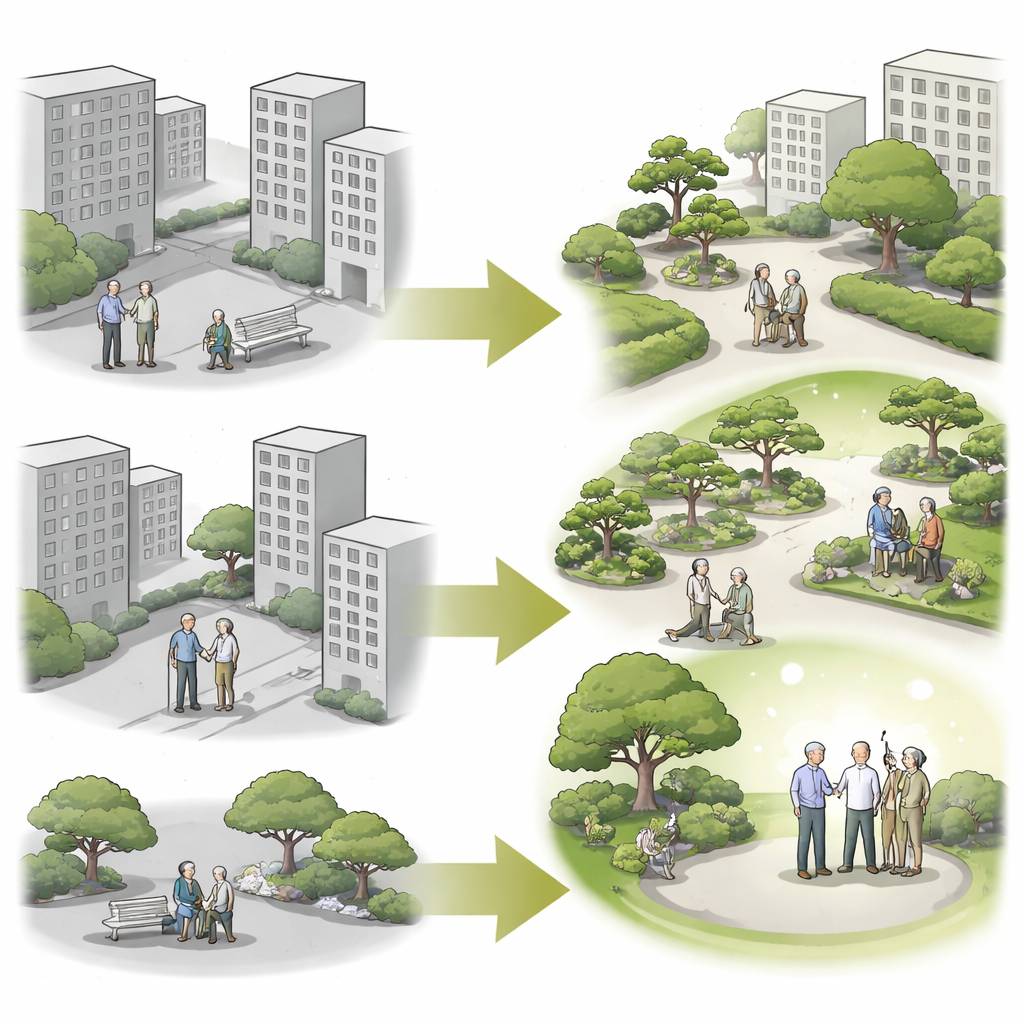
The researchers focused on community public spaces in older neighborhoods of Guangzhou, China—exactly the places where many seniors spend most of their day. Instead of looking at big parks, they studied three everyday outdoor settings: small leftover corners between buildings (nodal spaces), narrow walkways between homes and streets (path spaces), and larger open courtyards or squares (district spaces). Into photographs of these spaces they digitally “planted” bonsai-style micro-landscapes, turning drab hardscapes into tiny but vivid garden scenes, and compared seniors’ reactions to versions with and without these miniature gardens.
Testing Rest for Tired Minds
To find out whether these micro-landscapes truly help the mind recover, the team combined a questionnaire about how restorative a scene feels with eye-tracking technology that records where and how long people look, and how often they blink. Over 200 older adults rated how much each scene made them feel mentally away from daily pressures, gently engaged, and comfortable staying there. A smaller group of 31 participants viewed the same images in a lab while wearing an eye-tracker. By comparing gaze patterns and blinks across scenes, the researchers could connect people’s inner sense of restoration with their moment-by-moment visual behavior.
What Happens When Tiny Gardens Are Added
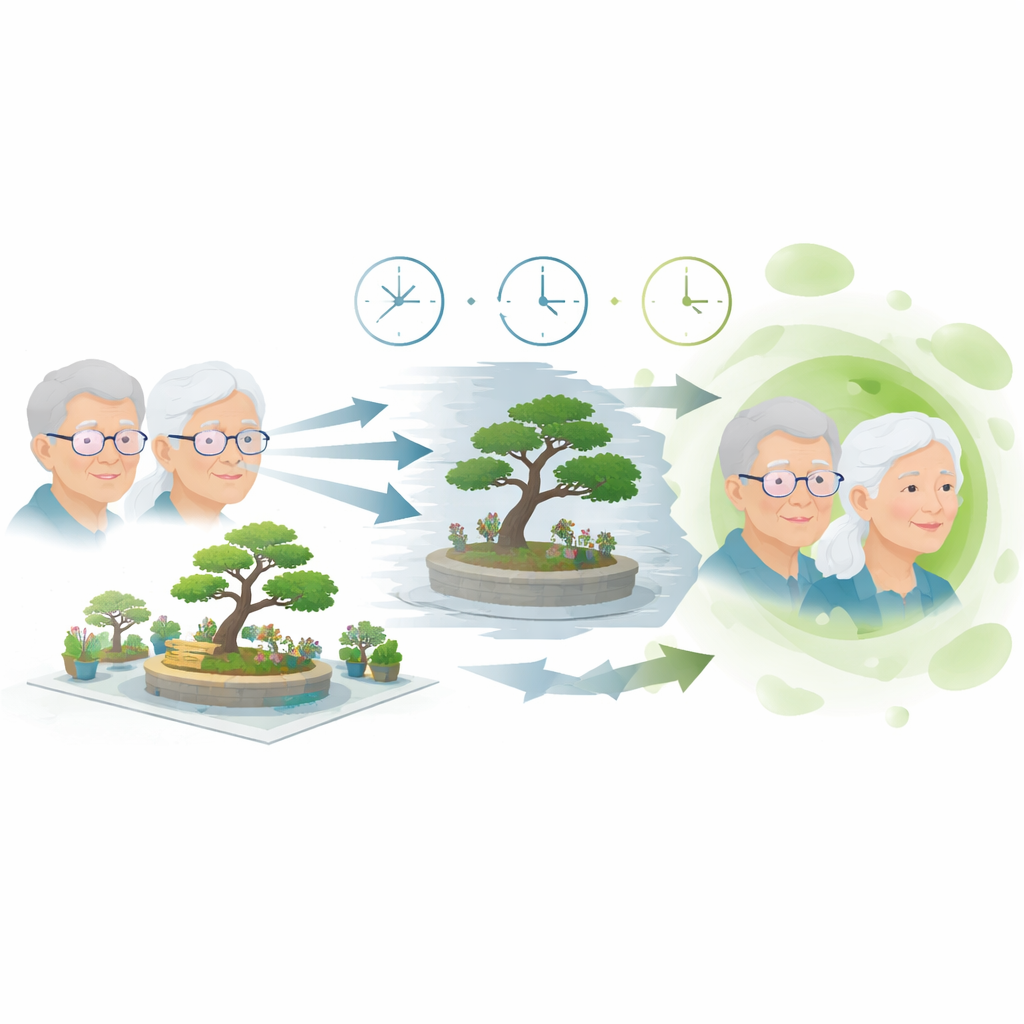
The differences were striking. Across all space types, scenes that included a micro-landscape scored far higher on perceived restorativeness—about 20 points more on average than the same spaces without greenery. These miniature gardens became natural “visual anchors,” gently pulling the eye and holding attention without effort. Eye-tracking confirmed this: when micro-landscapes were present, participants spent about 27% more time fixating on the scene, and their blink rate—an indicator of visual strain—dropped by nearly 70%. Heat maps of their gaze showed concentrated attention around the bonsai, while scenes without micro-landscapes produced scattered, restless looking. These patterns match theories suggesting that softly fascinating natural features help our directed attention recover by giving the mind something pleasant to rest on.
Why the Shape of the Space Still Matters
Not all community spaces benefited equally from tiny gardens. The most powerful effects appeared in district spaces—the larger courtyards and squares. When a micro-landscape was placed there, seniors’ restoration scores were highest, and the added greenery worked efficiently: they did not need unusually long viewing times to feel better. These spaces combined open views, clear boundaries, and freedom to linger, all of which amplified the calming pull of the micro-landscape. Path spaces along traffic routes, by contrast, still carried a sense of visual tension, even with greenery. Nodal corners, while not as efficient as courtyards, showed very long, immersive gazes, suggesting they are valuable “nearby retreats” for people who cannot walk far.
Designing Friendly Cities with Small Steps
In everyday terms, this study shows that even tiny, artfully composed planted scenes can make a real difference to older adults’ mental freshness—especially when placed in the right kind of communal space. A bonsai-like micro-garden in a well-framed courtyard can offer a pocket of calm that attracts the eye, eases strain, and helps attention recover, all within a short walk from home. For crowded cities with limited land, that means age-friendly design does not always require building new parks: thoughtfully positioning small but engaging green elements where seniors actually spend time can turn ordinary courtyards, paths, and corners into quiet “breathing spaces” for the mind.
Citation: Kun, L., Haonan, C. & Liwen, Y. Effects of micro-landscapes on attention restoration in older adults within community public spaces. Sci Rep 16, 9024 (2026). https://doi.org/10.1038/s41598-026-38527-2
Keywords: urban green spaces, older adults, attention restoration, micro-landscapes, age-friendly design