Clear Sky Science · en
Modified cell-to-cell method for slim tube test simulation considering the porous media effect
Getting More Oil Out of Old Rocks
Many of the world’s oil fields are aging, and pushing out the last portions of oil is becoming harder and more expensive. One of the most promising strategies is to inject gas into the rock so that it mixes with the oil and helps sweep it toward production wells. This study tackles a surprisingly subtle question that strongly affects the success and cost of such projects: how does the structure of the rock itself change the pressure needed for the injected gas to fully mix with the oil?
When Gas and Oil Truly Mix
For gas injection to work at its best, the injected gas and the in-place oil must become fully miscible, meaning they blend into a single, uniform fluid without a sharp boundary. Engineers describe the lowest pressure at which this complete mixing happens as the minimum miscibility pressure, or MMP. Operating above the MMP can greatly increase the amount of oil recovered, but it also demands stronger surface equipment and thicker pipelines, which raises costs. Traditionally, MMP is measured in the lab with a long, thin, rock-filled tube called a slim tube, or estimated using computer models that treat the fluids as if they were in open space, largely ignoring how the rock’s small pores alter their behavior.
Why Tiny Pores Change Fluid Behavior
Inside a real rock, oil and gas are not floating freely; they are squeezed into networks of microscopic pores. In these confined spaces, fluid molecules interact strongly with the surrounding rock walls. Heavy components in the oil tend to stick to the pore surfaces, and the curvature of tiny pores creates capillary forces that resist fluid movement. These effects shift the temperatures and pressures at which fluids change phase and mix. Earlier models tried to capture confinement by representing the rock as a single idealized tube. The authors argue that this is not realistic enough for rocks with a mix of pore sizes and connectivities, especially the “tight” formations that are becoming increasingly important in modern production.
A More Realistic Digital Slim Tube
To address this, the researchers carried out classic slim-tube experiments with real reservoir oil and a hydrocarbon gas at several pressures and at 100 °C, then built a new numerical model designed to mimic the test more faithfully. 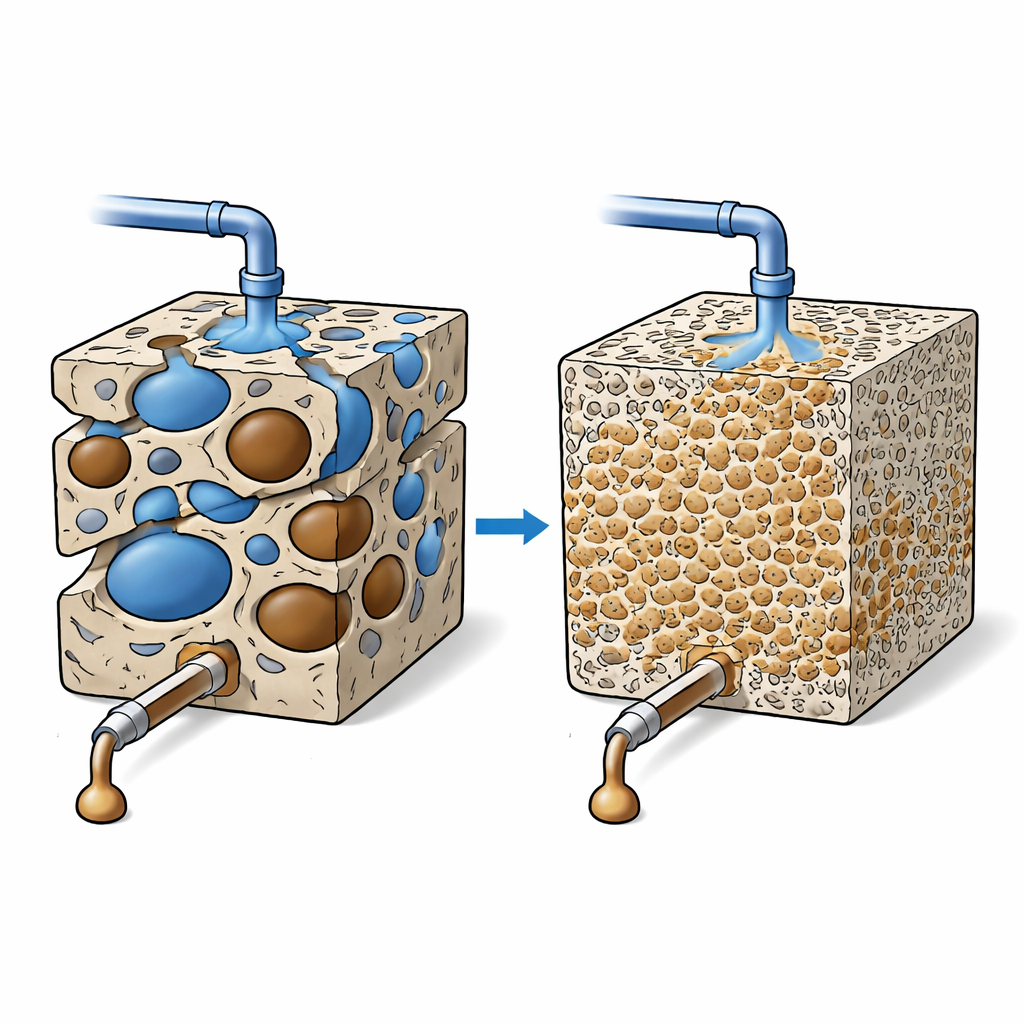
Matching Experiments and Revealing Rock Effects
The enhanced model, called a modified cell‑to‑cell simulation (MCCS), was benchmarked against the physical slim‑tube tests. By running the model with increasing numbers of cells and extrapolating to an effectively infinite number, the authors minimized numerical smearing and obtained a sharp prediction of ultimate oil recovery at each pressure. 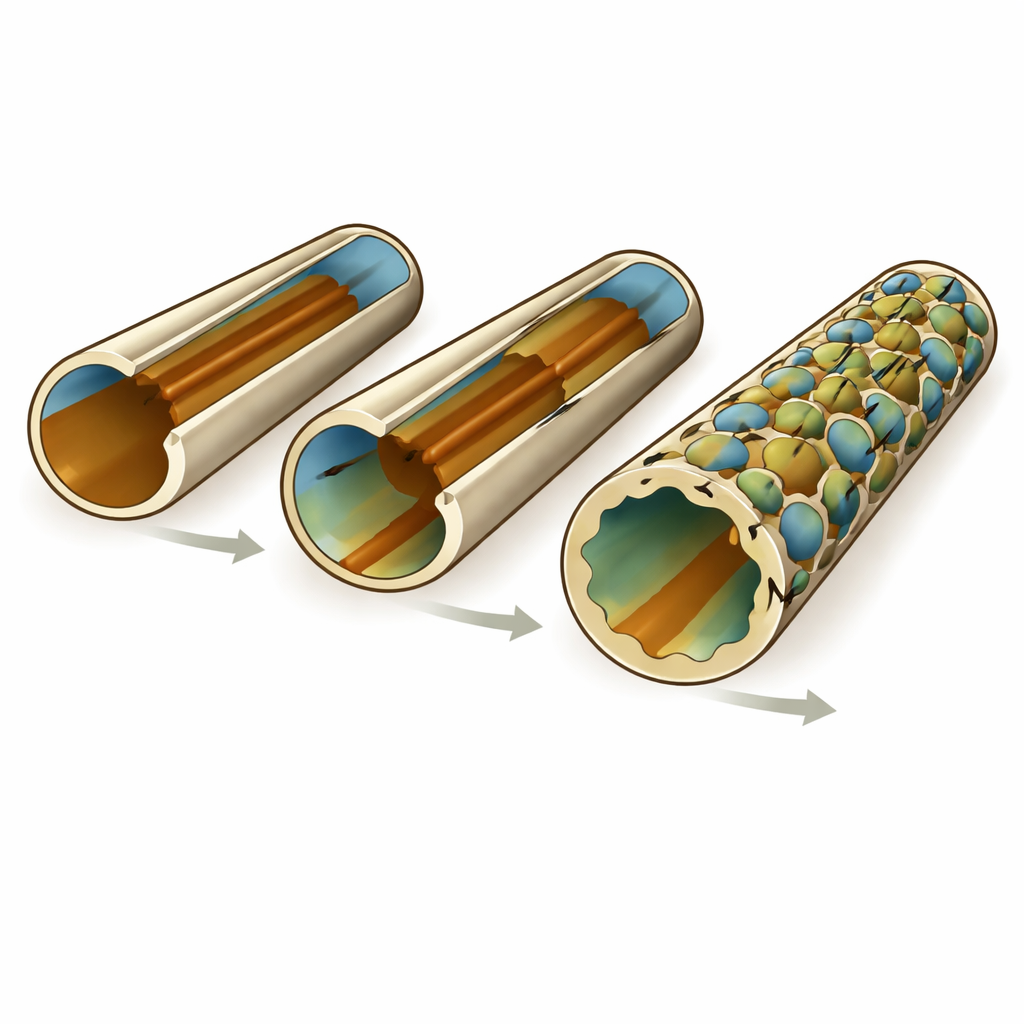
What This Means for Future Oil Projects
In plain terms, this work suggests that very tight rocks, long considered difficult targets, may actually require less pressure than expected to achieve full gas–oil mixing, provided this confinement effect is properly accounted for. The new modeling approach links that insight directly to measurable rock properties, allowing engineers to estimate MMP more reliably for a wide range of reservoirs without running endless costly lab tests. While the method still simplifies the true complexity of pore networks, it offers a practical, physics‑based tool for screening and early design of gas‑injection projects, and it highlights that the tiniest details inside the rock can make a big difference in how easily we can coax out the remaining oil.
Citation: Safaei, A., Riazi, M., Jafarzadegan, M. et al. Modified cell-to-cell method for slim tube test simulation considering the porous media effect. Sci Rep 16, 8557 (2026). https://doi.org/10.1038/s41598-026-38525-4
Keywords: gas injection, minimum miscibility pressure, porous media, enhanced oil recovery, tight reservoirs