Clear Sky Science · en
Physicochemical characteristics and mechanism analysis of loess at different high-temperature stages
Why hot soil above coal fires matters
Across parts of northwestern China, underground coal seams can quietly catch fire and burn for years. The heat rising from these hidden fires cooks the overlying loess—a fine, windblown soil that supports buildings, roads, and farmland. This study explores how loess changes when it is baked from room temperature up to 1000 °C, and what that means for ground stability and for detecting dangerous coal fires from the surface. 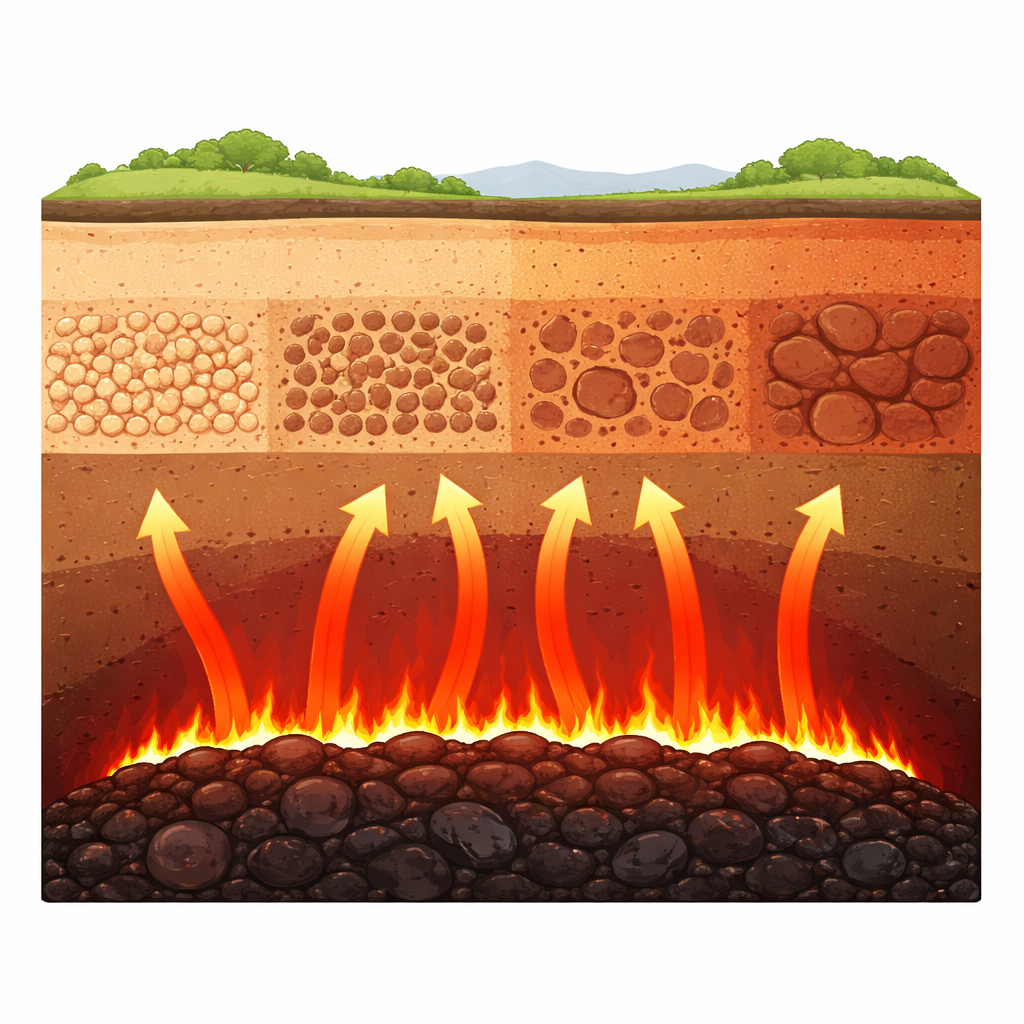
Turning up the heat in the lab
To mimic conditions above a burning coal seam, the researchers collected loess from near Xi’an, shaped it into standard cylinders, and heated it to five different target temperatures: 200, 400, 600, 800, and 1000 °C. After each heating step, they carefully measured how the soil behaved and looked. They tested how easily it cracked under tension, how fast sound waves traveled through it, how well it conducted electricity, how its internal pore spaces were arranged, and how its color changed. They also listened for tiny cracking sounds during loading, using acoustic sensors to track when and how the soil failed. 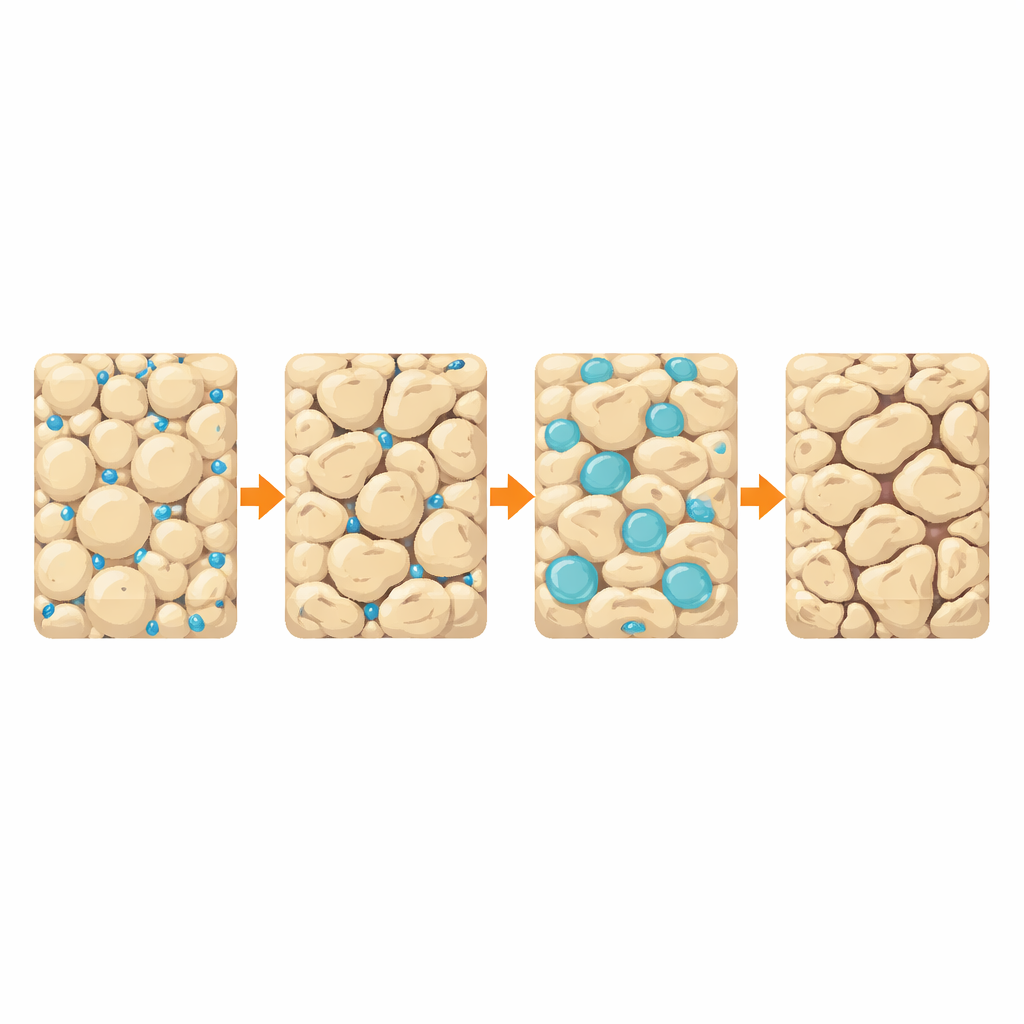
From soft dust to hard but brittle skeleton
As the loess was heated, it gradually transformed from a relatively weak, porous material into a much stronger but more brittle skeleton. Tensile strength jumped more than twentyfold by 200 °C and continued to rise, reaching its highest values between 800 and 1000 °C. At these extreme temperatures, minerals in the soil began to melt slightly and re-solidify, acting like a natural cement that bound grains together and filled the smallest pores. This process stiffened the soil, increased its elastic modulus, and reduced many of the finest pores, even as visible cracks developed. Acoustic measurements showed bursts of activity mainly at the moment of failure, revealing that damage accumulated quietly and then released suddenly as the heated loess snapped.
Hidden changes in pores, waves, and electricity
Inside the soil, the pattern of pores shifted with temperature. At room temperature, loess is dominated by very small pores; as it was heated, these tiny voids shrank or were filled in, while medium-sized pores became more common and some larger pores appeared at certain stages. These internal rearrangements affected how sound and electricity moved through the material. The speed of sound waves dropped up to around 600 °C as heat-induced cracks made the loess less uniform, then rose again at higher temperatures once new mineral cements stiffened the structure. Electrical behavior depended strongly on how much water remained and on the frequency of the test: at low frequencies, resistivity generally decreased with heating, but at higher frequencies it tended to increase sharply as water was driven off and mineral changes became more important.
Color as a clue to underground fire
Even to the naked eye, heated loess did not stay the same. Its brightness and hue shifted in a systematic way with temperature. As the soil warmed, iron-bearing minerals inside it changed form: early on they favored reddish oxides that made the loess look redder and lighter, especially up to about 600–800 °C. At still higher temperatures, these oxides partly converted into darker magnetic minerals, turning the soil browner and duller. By tracking simple color parameters related to brightness and redness, the team could link surface appearance directly to specific ranges of subsurface temperature and mineral transformation.
From laboratory insights to mine safety
Translated into plain terms, the study shows that when loess above a coal seam is strongly heated, it becomes tougher but more brittle, its tiny pores rearrange and partly seal, its electrical and acoustic signatures change, and its color shifts from pale to redder to darker tones. These predictable changes could be used in the field: color measurements, electrical surveys, and wave-speed tests can help identify zones that have experienced intense heating and may overlie active or past coal fires. Engineers can then combine this information with temperature monitoring to warn of dangerous conditions and design reinforcements where stiff but crack-prone loess might fail suddenly.
Citation: Bai, H., Yin, W., Li, X. et al. Physicochemical characteristics and mechanism analysis of loess at different high-temperature stages. Sci Rep 16, 7980 (2026). https://doi.org/10.1038/s41598-026-38524-5
Keywords: loess, coal fire, high temperature soil, ground stability, geophysical monitoring