Clear Sky Science · en
Nonlinear dynamics of a non-stationary rotor-disk-bearing system with rub-impact and geometric nonlinearity under non-ideal excitation
Why spinning machines can suddenly shake themselves apart
From jet engines to power-plant turbines, modern industry depends on shafts that spin at dizzying speeds. Most of the time they hum along smoothly. But under certain conditions, small imperfections can trigger violent shaking, strange stalls in speed and, in the worst case, catastrophic failure. This paper explores one of the hidden troublemakers in such systems—brief rubbing contact between the spinning shaft and its housing—and shows how it can dramatically change the way a rotor speeds up, vibrates and survives in service.
A closer look at a spinning shaft and its supports
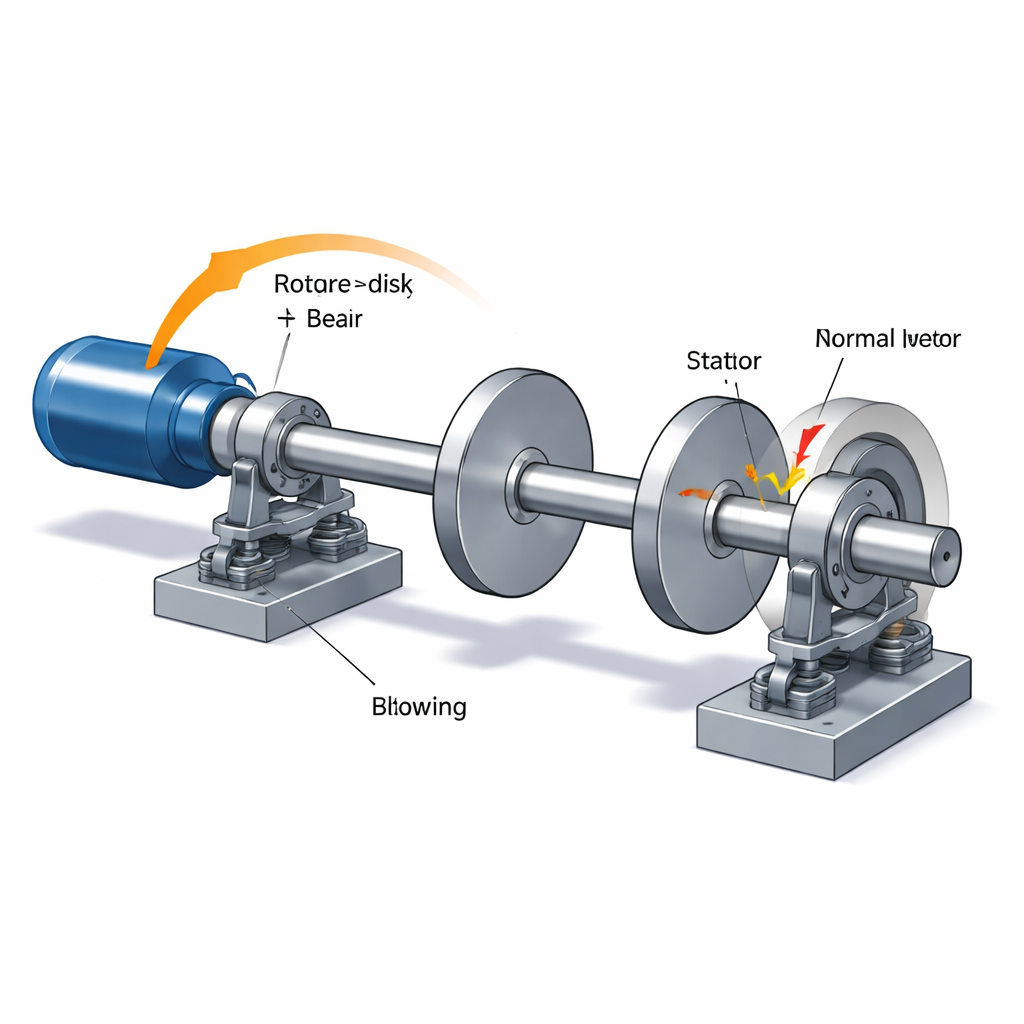
The authors study a common workhorse of rotating machinery: a metal shaft that carries two solid disks and is held in place by bearings. In a real machine, this shaft is not perfectly rigid—it bends slightly as it spins—and the bearings and surrounding structure also flex. The researchers build a detailed physical model that treats the shaft as a flexible beam, the disks as rigid bodies and the bearings as springs and dampers that can respond in both a linear and a nonlinear way. Crucially, they also allow the disks to come into occasional contact with a nearby stationary ring, or stator, whenever the sideways motion of the rotor exceeds a tiny clearance. When this happens, the disk feels a normal pushing force and a frictional dragging force, both of which strongly disturb its motion.
When the power source is less than perfect
In textbooks, a motor is usually assumed to deliver a steady twisting force, or torque, regardless of how fast the shaft is turning. Real motors are less ideal: as speed climbs, the effective torque often drops. The team explicitly builds this “non-ideal excitation” into their model by letting the applied torque decrease with rotational speed according to a simple rule that mimics real motor behavior. That choice matters because the way energy flows from the motor into the rotor—either into useful spin or into wasteful vibration—turns out to control whether the system cruises safely through its critical speeds or becomes trapped in a dangerous resonant state.
Blending heavy math with numerical experiments
To predict this behavior, the authors start from energy expressions for the shaft, disks, unbalanced masses and bearings and use a standard principle from mechanics to derive equations of motion. These equations describe bending in two directions and twisting of the shaft, and they include geometric effects from large deflections, the rubbing forces and the speed-dependent torque. Because the raw equations are too complex to solve directly, the team reduces them to a simpler set involving just the most important bending shape of the shaft. They then attack the problem in two ways: by direct computer simulation using a step-by-step integration method, and by an analytical technique called averaging that filters out fast oscillations to reveal the long-term trends. The two approaches agree closely, giving confidence that the simplified analytical results capture the true physics.
How rubbing changes resonance and traps energy
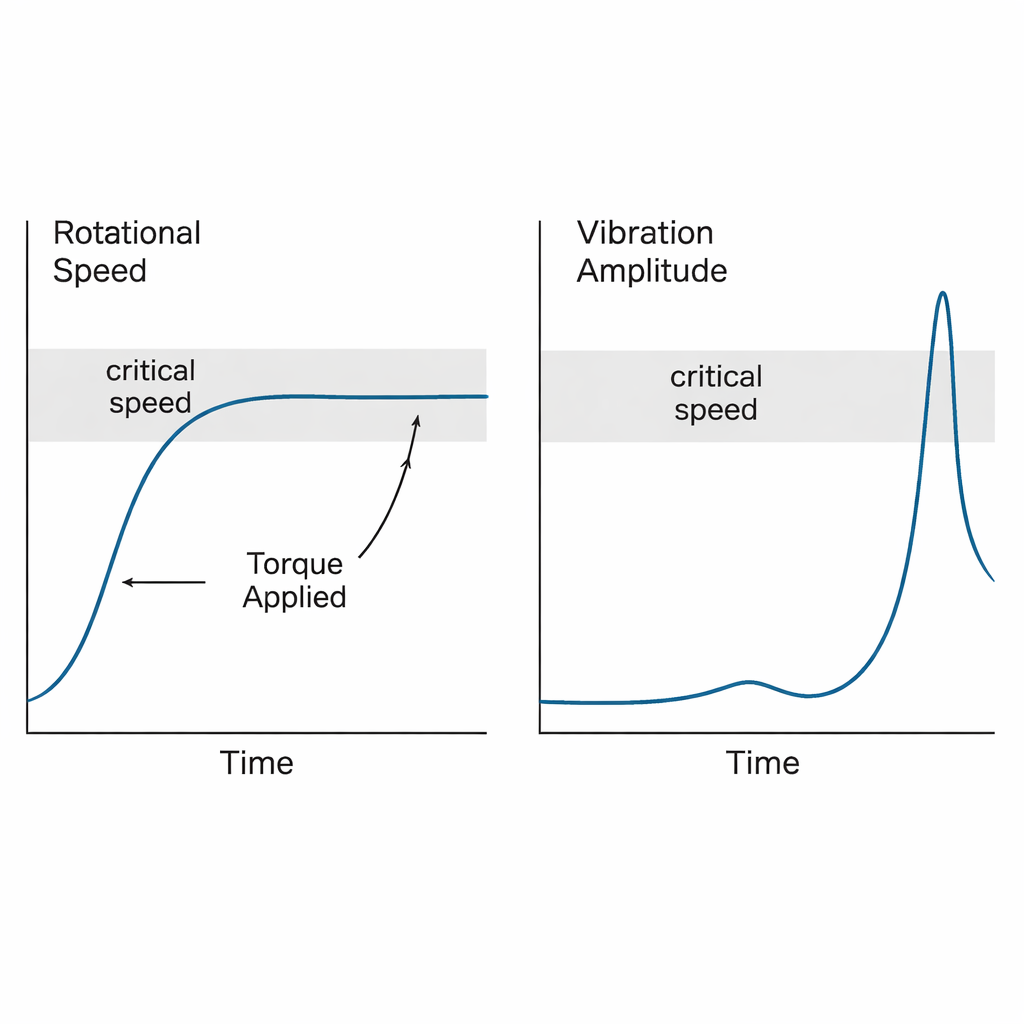
With this framework in place, the researchers explore how the rotor behaves as it accelerates from rest and passes through its first critical speed—the point where its natural tendency to bend lines up with the spin rate. Without rubbing, the shaft shows a brief surge in vibration as it crosses this speed and then settles down as it spins faster. When rubbing is allowed, the story changes dramatically. Contact between rotor and stator lengthens the time spent near resonance, greatly amplifies vibration, and can even prevent the system from ever reaching higher speeds. A striking phenomenon called the Sommerfeld effect appears: despite continued torque, the rotational speed stalls on a plateau while vibration amplitude grows, soaking up the input energy. Small changes in parameters—such as bearing stiffness, damping, clearance size, unbalanced mass or torque level—can decide whether the rotor glides through the critical region or becomes locked into this energy trap.
Design levers for safer high-speed machines
The study shows that rubbing is not just a minor nuisance but a central player in the dynamics of high-speed rotors driven by realistic motors. Stronger or more nonlinear supports, tighter clearances, larger unbalances and lower damping all make it more likely that energy will pile up as vibration instead of being converted into steady rotation, increasing the risk of damage. By contrast, well-chosen damping, bearing stiffness and torque capacity help the rotor sweep quickly through dangerous speeds and avoid prolonged resonance. In practical terms, the work offers engineers a roadmap: if a machine is stalling or shaking near a particular speed, adjusting clearances, supports or drive characteristics may be as important as balancing the rotor itself.
Citation: Ghasemi, M.A., Bab, S. & Karamooz Mahdiabadi, M. Nonlinear dynamics of a non-stationary rotor-disk-bearing system with rub-impact and geometric nonlinearity under non-ideal excitation. Sci Rep 16, 7423 (2026). https://doi.org/10.1038/s41598-026-38519-2
Keywords: rotor dynamics, rub impact, critical speed, Sommerfeld effect, rotating machinery