Clear Sky Science · en
Ixodid tick diversity and distribution across forest-fringe landscapes of the Western Ghats, India, with emphasis on Kyasanur Forest Disease vectors
Why these tiny forest dwellers matter
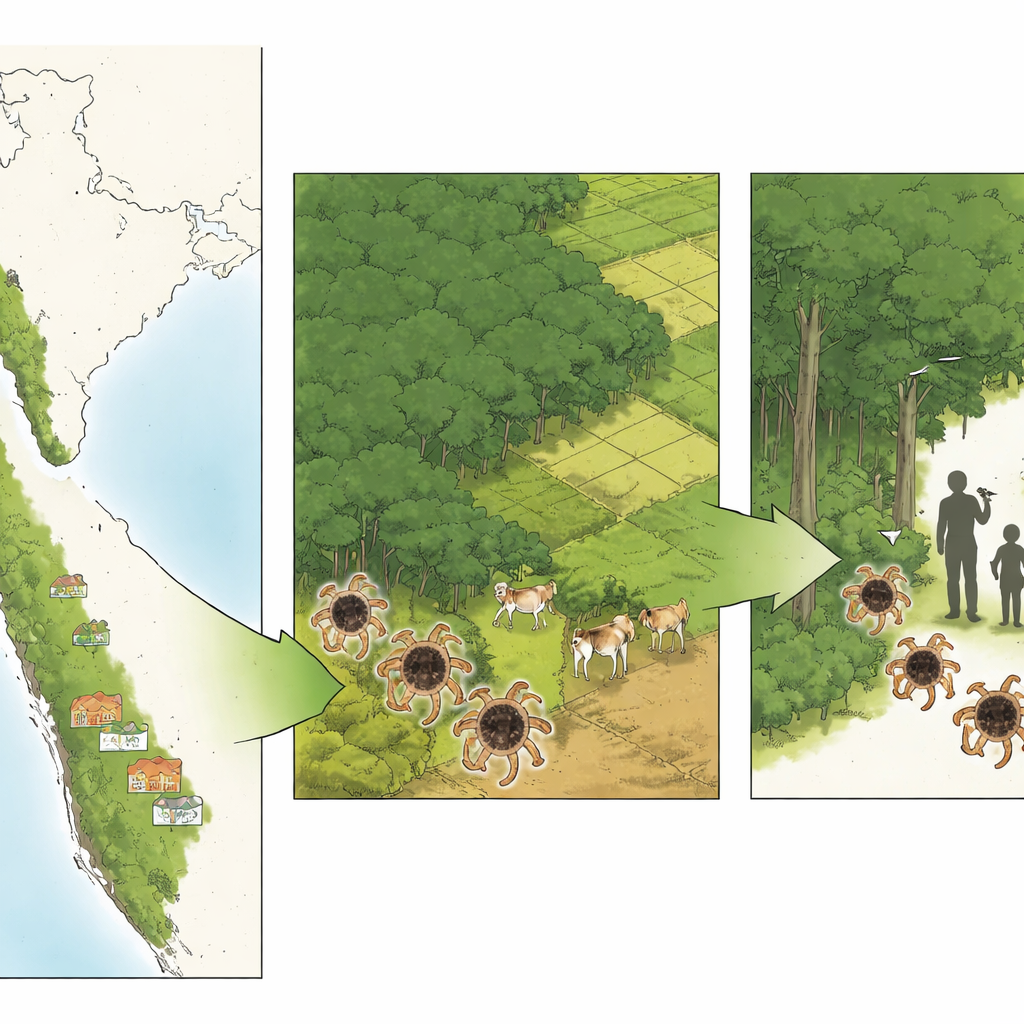
Along the lush hills of India’s Western Ghats, people, wildlife, and livestock live side by side at the edges of forests. These same places are home to blood‑feeding ticks that can carry Kyasanur Forest Disease (KFD), a severe viral fever. This study asks a simple but pressing question: where exactly are these ticks found, and what kinds of landscapes help them thrive? The answers matter for anyone living, working, or traveling near these forests, because understanding tick habitats is the first step toward preventing dangerous bites.
Taking a closer look at forest edges
The researchers surveyed 44 villages that sit right on the forest fringe across five states—Goa, Maharashtra, Karnataka, Kerala, and Tamil Nadu. Using a standard “flagging” technique, they dragged white cloths over leaf litter and low plants during the season when young ticks are most active. In total, they collected 10,350 ticks, most of them tiny nymphs that are hard to spot but important for spreading KFD. These ticks belonged to 28 different kinds, including 24 that could be confidently named and four broader tick groups.
Key culprits in familiar and new places
Among all the species, two stood out: Haemaphysalis spinigera and Haemaphysalis turturis. These are known main carriers of the KFD virus, and they turned up in large numbers across many villages. Crucially, they were common not only in districts with a history of human KFD cases, but also in areas where no human infections have yet been reported. Tick numbers, the variety of species, and how evenly different species shared a site all varied sharply from village to village. Some locations in Karnataka and Kerala hosted rich, mixed tick communities, while certain parts of Goa and Maharashtra were dominated by just one or two species. Yet, when the team compared “affected” and “unaffected” districts, they did not find clear statistical differences in how many ticks or how many species were present.
How land, plants, and weather shape tick hot spots
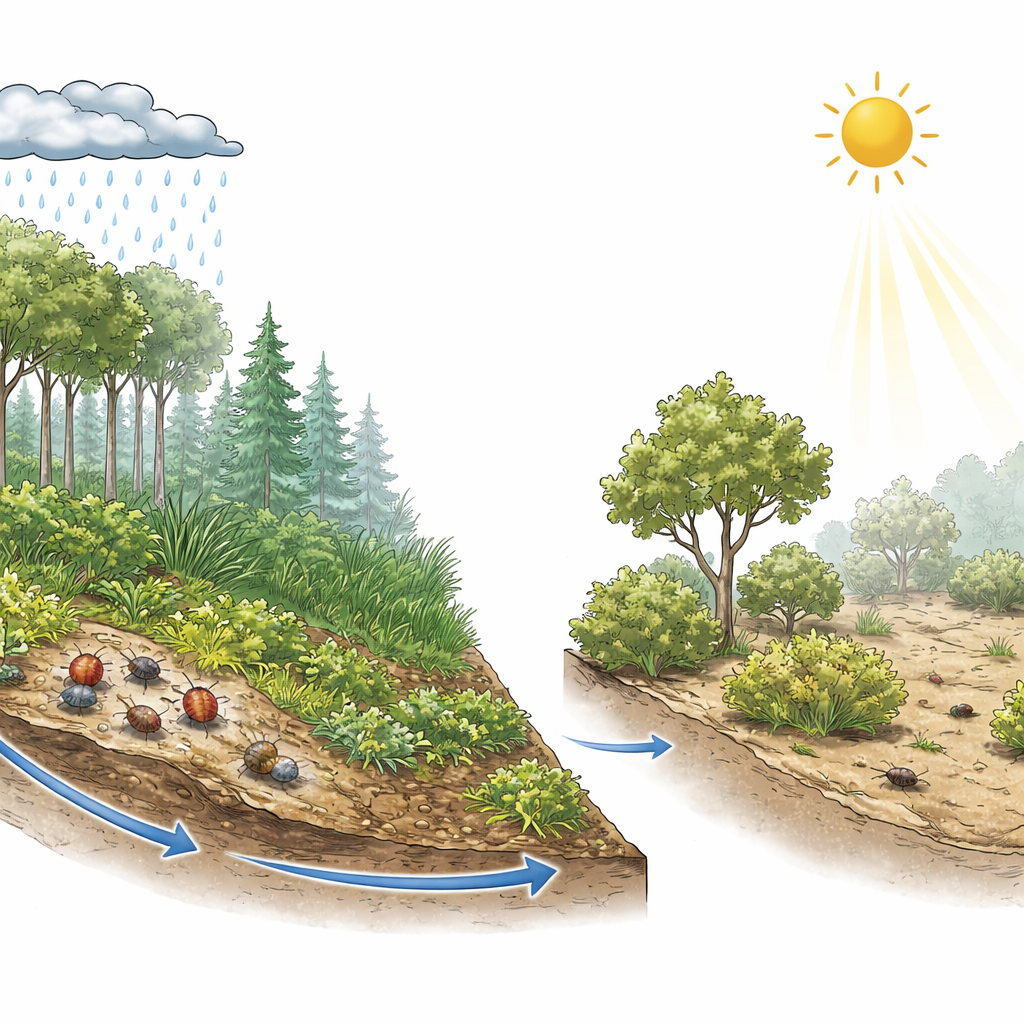
To move beyond simple maps, the scientists used a community‑level modeling approach that looks at many species together. They combined the tick data with detailed information on rainfall, temperature, sunlight, vegetation greenness from satellites, land‑cover types such as forest and cropland, terrain slope, and the timing of sampling. The models showed that no single factor explains where ticks live. Instead, moisture stood out as especially important: areas with higher rainfall and better humidity retention supported more ticks. Vegetation and land‑cover also played a big role. Forests and mixed forest–farmland mosaics tended to harbor richer tick communities than bare or heavily cleared ground, likely because dense plants keep the ground cool and damp and attract many animal hosts.
Fine‑scale patterns hidden within broad regions
Terrain—how steep or rough the ground is—added another layer, influencing how water collects and how animals move through the landscape. Seasonal timing and differences between years mattered too, reflecting changes in monsoon rains and plant growth. Some tick species responded in similar ways to these conditions, hinting that they share preferred microhabitats or hosts. Others showed contrasting patterns, suggesting that they divide up the environment rather than competing directly. Overall, the study reveals that what happens at the scale of individual hillsides, forest edges, and patches of understory vegetation can be more important than state borders or known outbreak districts.
What this means for people on the ground
Put simply, the study shows that dangerous KFD‑carrying ticks are already widespread across the Western Ghats, even in places where human cases have not been documented. That means the absence of reported illness does not guarantee safety. Because tick communities are shaped by moisture, vegetation, land use, and local terrain, tracking these environmental clues can help forecast where risk is rising. The authors argue for proactive surveillance that goes beyond known hotspots, combining tick sampling with data on wildlife, livestock, and microclimate. Such landscape‑based monitoring can guide targeted warnings, vegetation management, and personal protection efforts for communities living at the forest edge, helping to reduce the chance that a hidden tick bite turns into a serious disease.
Citation: Konuganti, H.K.R., Elango, A., Krishnamoorthi, R. et al. Ixodid tick diversity and distribution across forest-fringe landscapes of the Western Ghats, India, with emphasis on Kyasanur Forest Disease vectors. Sci Rep 16, 9264 (2026). https://doi.org/10.1038/s41598-026-38517-4
Keywords: Kyasanur Forest Disease, tick-borne disease, Western Ghats, vector ecology, forest fringe landscapes