Clear Sky Science · en
Phase shift optimization in reconfigurable intelligent surface-assisted UAV in hierarchical aerial computing networks
Smarter Skies for a Hyper-Connected World
As billions of everyday objects—cars, cameras, factory robots, and farm sensors—connect to the internet, our current networks struggle to keep up. This paper explores a futuristic way to push computing power into the sky by combining drones, high-altitude platforms, and a new kind of programmable surface that can bend and boost radio waves. Together, they form an airborne "cloud" that can serve huge numbers of devices faster and more reliably than today’s ground-based systems.
Layers of Computers Above Our Heads
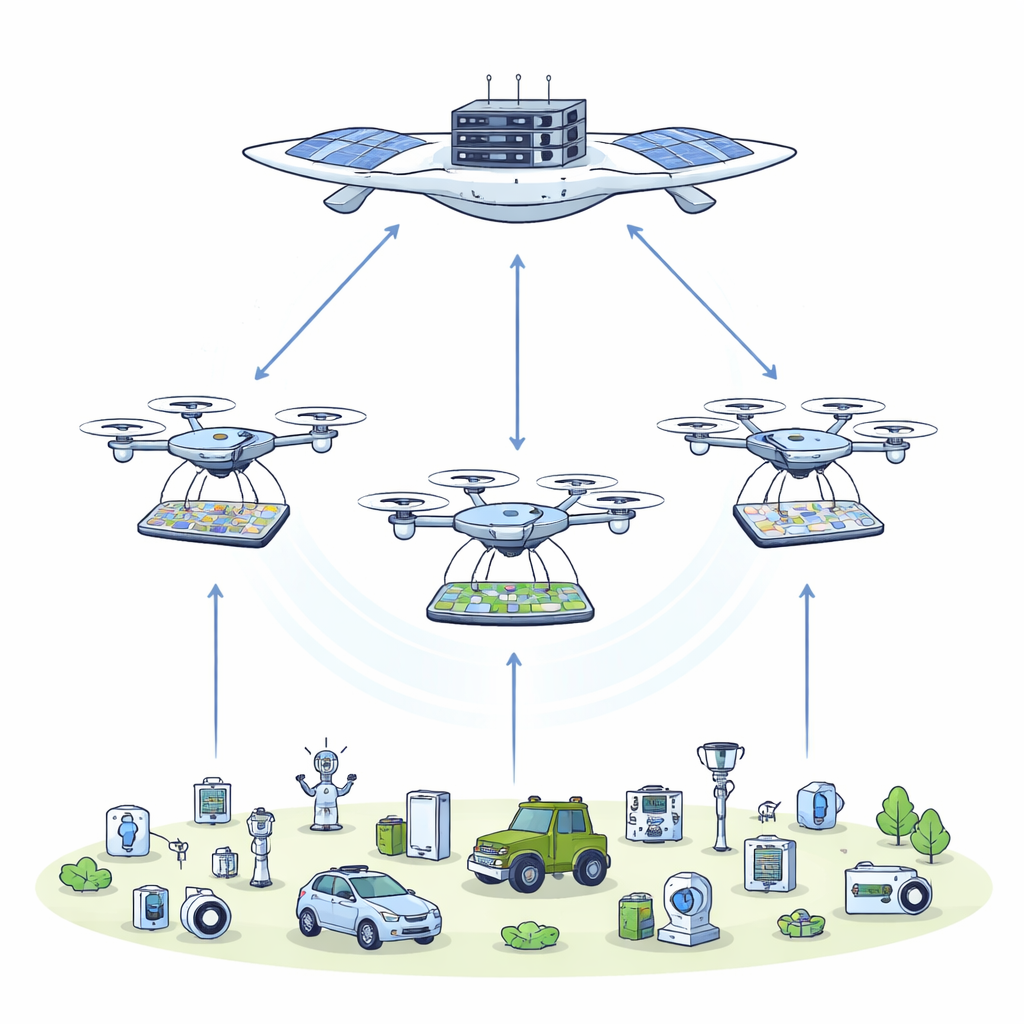
The authors imagine a three-layer system hovering above a city or region. On the ground, small internet-connected gadgets generate data and ask for help with heavy calculations they cannot handle themselves. In the middle layer, unmanned aerial vehicles (UAVs)—essentially smart drones—act as flying mini–data centers. At the top, a high-altitude platform (HAP), like a long-endurance aircraft or balloon 20 kilometers up, provides far greater computing muscle. Devices can send their tasks up to nearby drones, which either process the data directly or forward it further up to the powerful platform, depending on who has time, energy, and capacity to spare.
Bending Radio Waves to Clear the Air
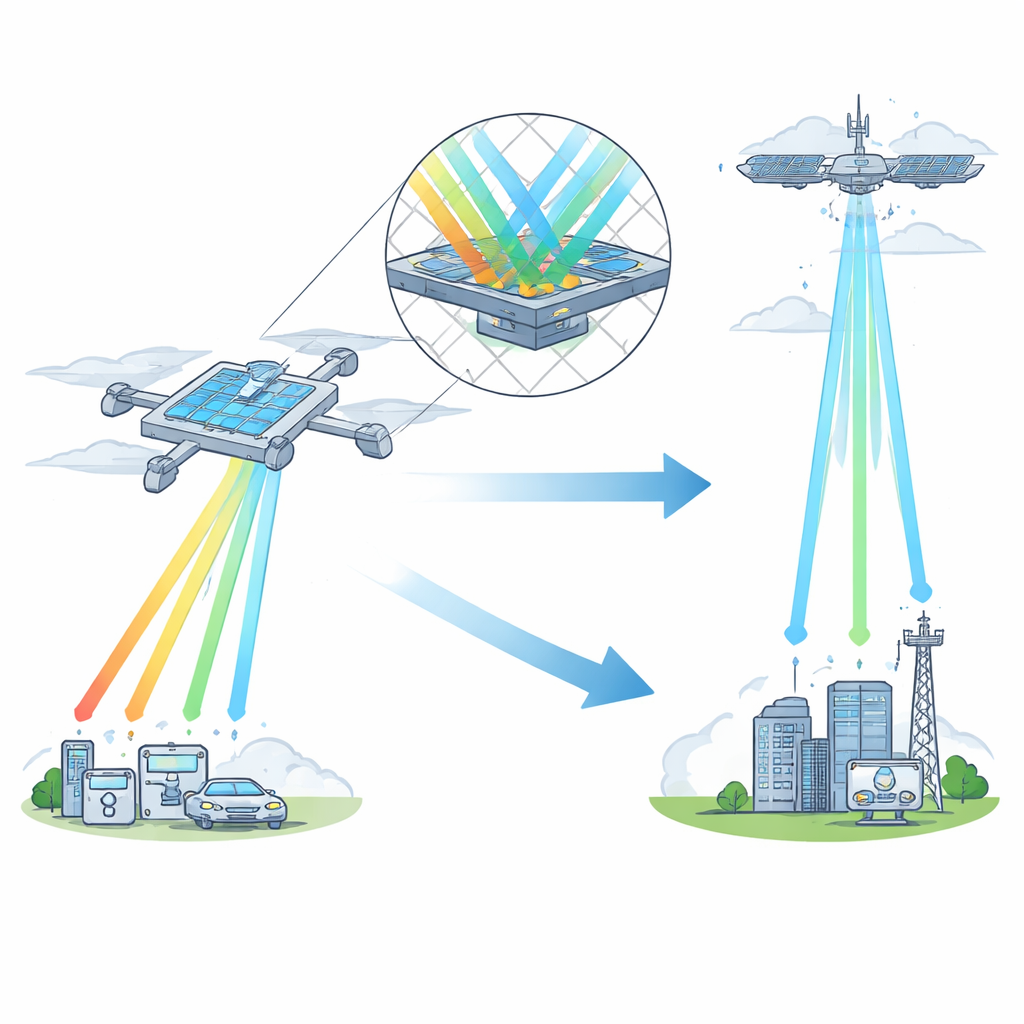
A key ingredient is a technology called a reconfigurable intelligent surface, a thin sheet covered with many tiny electronic patches that can reflect radio waves in chosen directions. In this design, each drone carries such a surface. Instead of signals simply bouncing around the environment, the surface shapes and focuses them, like a very agile mirror. By carefully adjusting the phase of each patch—that is, how its reflection lines up in time with the others—the system can strengthen useful links and cut down on interference. This makes the connection from ground devices up to the drones much faster and more reliable, which is crucial when many devices are competing to be heard.
Sharing Airborne Resources Fairly and Efficiently
Making this flying hierarchy work is not just a matter of hardware; it also needs smart decision-making. The authors design a three-step strategy. First, they match each ground device to a suitable drone, balancing how much computing power, energy, and radio capacity each drone has left. Second, they fine-tune the reflective surface on every drone using a mathematical method that respects the physical limits of the hardware while steadily improving signal quality. Third, they reshuffle the most demanding tasks from crowded drones up to the high-altitude platform, then reuse any freed-up capacity to serve previously unserved devices. This step-by-step coordination helps the whole system behave like a single, well-managed cloud in the sky.
What the Simulations Reveal
Using large-scale computer simulations, the team compares their design against an earlier aerial network that does not use these smart reflective surfaces or unified control. With the same number of drones and one high-altitude platform, the new system processes about 18 to 22 percent more data and manages to serve nearly all available devices, even as their number climbs. It keeps about 95 percent of tasks successfully completed under their delay limits, compared with around 79 to 80 percent for the older approach. Average waiting time for a task drops from roughly 3.6 seconds to 2.5 seconds. The tradeoff is energy: running the intelligent surfaces and handling more tasks nearly doubles total energy use, which the authors highlight as an important challenge for future, greener designs.
Why This Matters for Everyday Technology
For non-specialists, the main takeaway is that carefully controlled radio reflections and layered computing in the sky could become a backbone for future 6G networks. Instead of relying only on crowded cell towers and distant data centers, your car, smartwatch, or factory sensor could tap into a flexible web of drones and high platforms overhead. The study shows that, with the right coordination, this airborne cloud can handle more devices, finish more jobs on time, and deliver smoother service in demanding settings such as smart cities and industrial sites. If engineers can also tame the extra energy cost, this combination of flying computers and programmable radio surfaces could be a cornerstone of tomorrow’s always-connected world.
Citation: Diaa, B., Ibrahim, I.I., Abdelhaleem, A.M. et al. Phase shift optimization in reconfigurable intelligent surface-assisted UAV in hierarchical aerial computing networks. Sci Rep 16, 7950 (2026). https://doi.org/10.1038/s41598-026-38514-7
Keywords: 6G IoT networks, aerial edge computing, reconfigurable intelligent surfaces, UAV and HAP offloading, wireless resource optimization