Clear Sky Science · en
Spatio-temporal dynamics of riverine cyanobacteria and selected water quality indicators under two hydrological regimes
Why slower rivers matter for everyone
Rivers are not just scenic backdrops; they provide drinking water, cool power plants, carry ships, dilute pollution, and support wildlife. This study followed the Moselle, a large, dammed river in Western Europe, through two very different summers: one unusually wet and cool (2021) and one hot, dry, and slow-flowing (2022). The researchers wanted to know how these contrasting conditions change water quality and trigger harmful blooms of cyanobacteria—tiny organisms sometimes called “blue-green algae” that can make water unsafe for people and animals.
Two summers, two very different rivers
At first glance, the Moselle looks like the same river in both years, but its behavior was dramatically different. In 2021, high rainfall and frequent high-flow events, including a major summer flood, kept the water moving quickly downstream. In 2022, long dry spells meant the river trickled along at a fraction of its usual flow. Water that needed about 10 days to travel 240 kilometers in 2021 took more than a month in 2022. At the same time, water temperatures rose from an average of 20 °C in 2021 to over 24 °C in 2022, turning the river into a much warmer, slower system—ideal conditions for certain microbes to thrive. 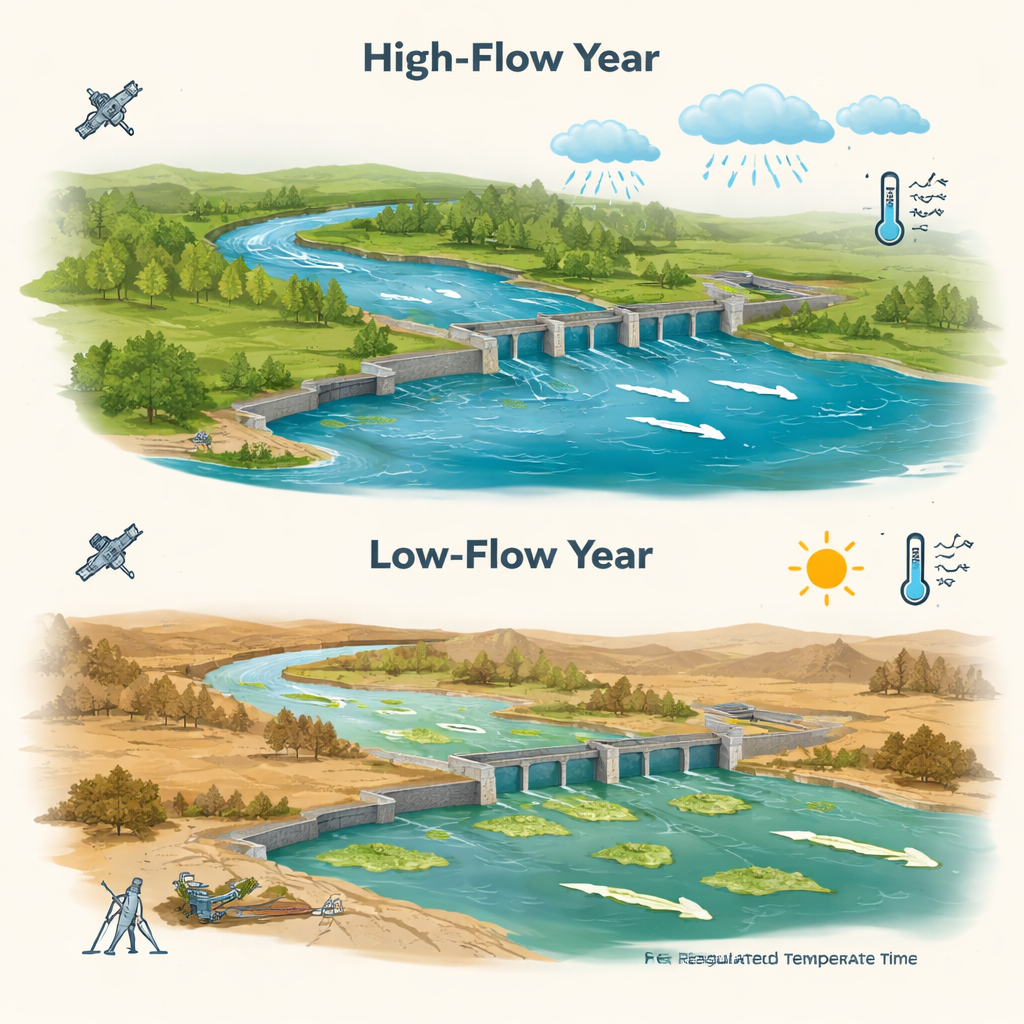
When slow, warm water feeds a bloom
The team monitored the Moselle using weekly measurements at its mouth, detailed sampling along a 240-kilometer stretch, computer models of flow, and satellite images of chlorophyll, a pigment used to estimate algal biomass. During the hot, dry summer of 2022, they observed a massive cyanobacterial bloom, dominated by the scum-forming genus Microcystis. Chlorophyll levels at one site climbed to around 177 micrograms per liter—more than 20 times higher than in 2021—and cyanobacteria made up most of the phytoplankton community. In contrast, the wetter 2021 summer showed very low chlorophyll levels, and the phytoplankton was dominated by harmless diatoms, with virtually no Microcystis detected.
Changing the river’s chemical recipe
Low, slow water did not just favor cyanobacteria; it also altered the river’s “nutrient soup.” In 2022, the Moselle carried less nitrogen but relatively more phosphorus and organic carbon than in 2021. Total nitrogen and nitrate dropped sharply along the river during the drought, likely because there was less runoff from fields and stronger biological removal. Phosphorus, much of it from wastewater sources that keep flowing even in dry weather, became more concentrated in the reduced volume of water. As the bloom developed, organic carbon rose to high levels, reflecting both the buildup of biomass and the release of dissolved substances by the cyanobacteria. Together, warmer temperatures, longer residence time, and a nutrient mix tipped toward phosphorus created a chemical setting that strongly favored Microcystis over other algae.
A river-wide view from space
To understand how the bloom spread, the researchers turned to satellites. Images from the European Sentinel-2 mission showed chlorophyll increasing first in the upper and lower reaches of the Moselle in 2022, with bright patches of high values stretching over long sections of the river from June to October. These space-based observations matched field measurements: the upper river developed a mixed algal bloom, while downstream sections became dominated by cyanobacteria. In 2021, satellite data showed almost no such signal, except for a brief, likely misleading spike during a turbid flood event. The work demonstrates how satellite monitoring, coupled with on-the-water sampling and flow modelling, can track harmful blooms as they form and move along regulated rivers. 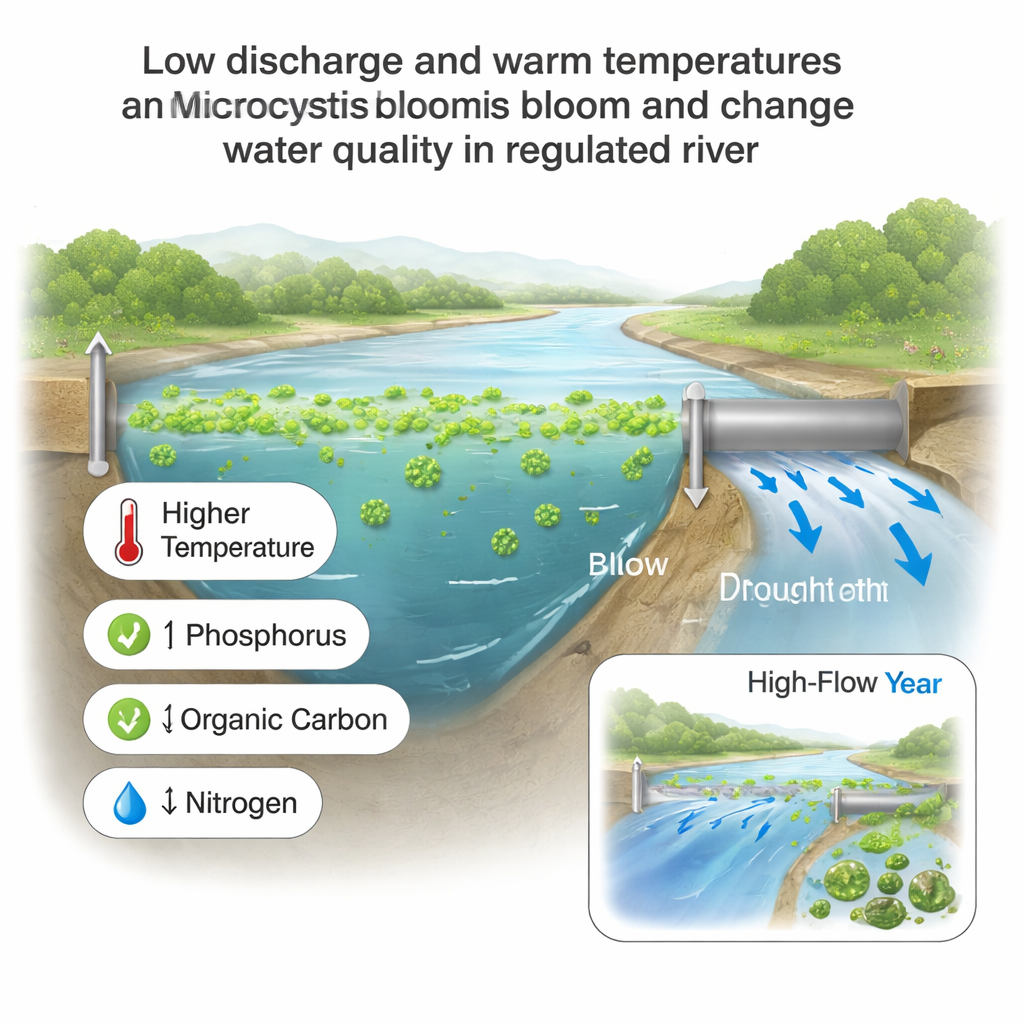
What this means for rivers in a warming world
For non-specialists, the message is clear: when climate change brings hotter, drier summers, regulated rivers like the Moselle are more likely to experience slow, warm, nutrient-rich conditions that favor toxic cyanobacterial blooms. These blooms can worsen official water quality ratings, threaten drinking water supplies and recreation, and disrupt ecosystems. The study suggests that as extreme droughts become more common, water managers will need to watch not just how much water is in rivers, but how long it stays, how warm it becomes, and how nutrients are balanced. Combining traditional monitoring with models and satellite tools can provide early warning and help protect both people and nature.
Citation: Klotz, F., Herrmann, M., Ishikawa, M. et al. Spatio-temporal dynamics of riverine cyanobacteria and selected water quality indicators under two hydrological regimes. Sci Rep 16, 6508 (2026). https://doi.org/10.1038/s41598-026-38511-w
Keywords: cyanobacterial blooms, river water quality, climate-driven drought, regulated rivers, Microcystis