Clear Sky Science · en
Comprehensive evaluation of sound absorption property in dual-layer porous concrete pavement
Quieter streets through smarter pavement
Anyone who lives near a busy road knows how relentless traffic noise can be, especially the hiss and roar of tires on concrete. This study explores a promising way to make streets quieter by redesigning the road surface itself. Instead of relying on barriers or windows to block noise, the researchers focus on a special type of "porous" concrete pavement and show how building it in two carefully tuned layers can soak up more sound right where it is created.
How roads themselves can swallow sound
Traffic noise comes from engines, air turbulence, and, most importantly at city speeds, the contact between tires and pavement. Much of this sound lies between 700 and 1300 hertz, around the pitch of a human voice. Porous concrete pavements are full of connected air pockets. As sound waves enter these tiny channels, friction and heat gradually drain away their energy. Compared with conventional dense concrete, such pavements can cut noise by several decibels, a change people clearly notice. Until now, most research has treated the pavement as a single uniform layer, even though many real roads are built with two layers of concrete for cost and construction reasons.
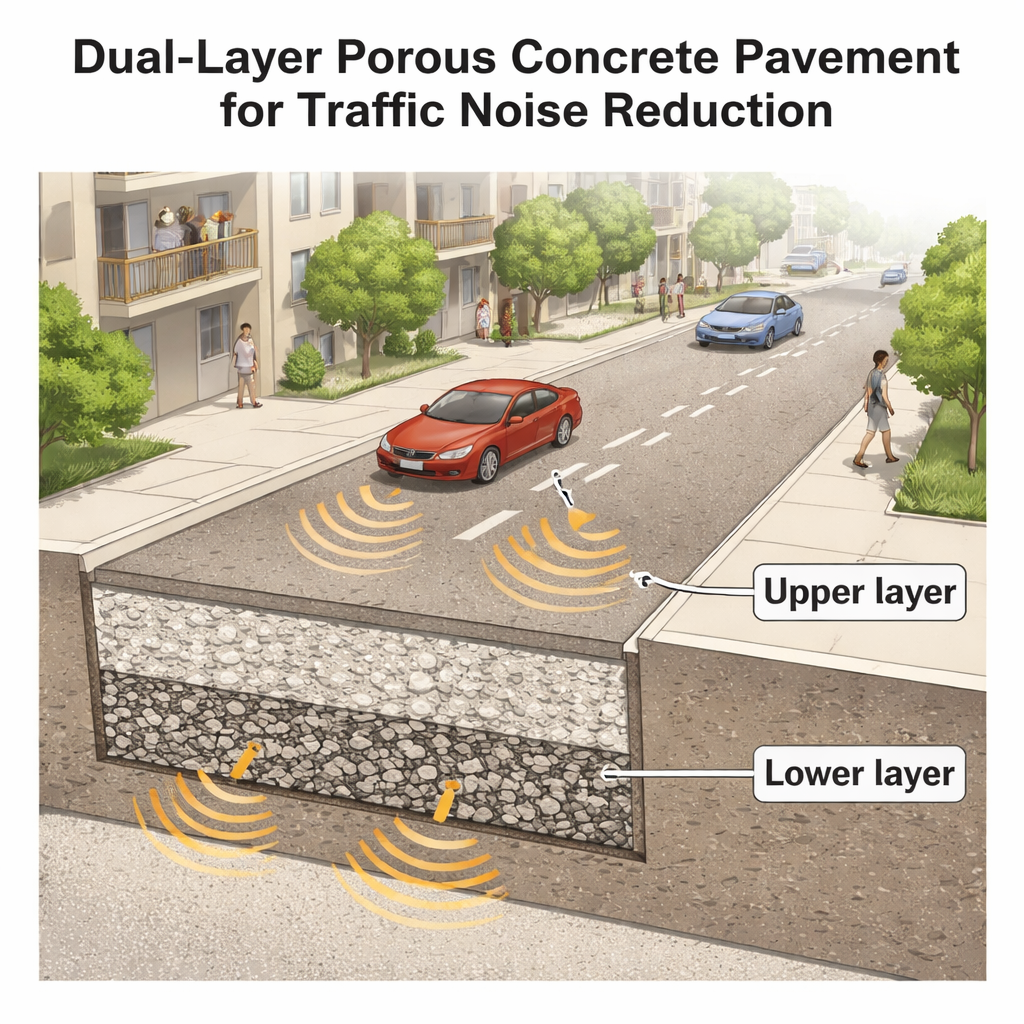
Building and testing two-layer concrete
The team designed dozens of pavement samples, each made from an upper layer and a lower layer of porous concrete stacked together. They varied three key ingredients: the size of the stone pieces in each layer (small, medium, or large), the ratio of cement paste to stone (which controls how many voids form), and the thickness of each layer. Some samples were a total of 10 centimeters thick, with both layers equally thick, while others were 15 centimeters thick, with a thin top layer and a thicker base. To measure how well each design absorbed sound, the researchers used a standardized standing wave tube: a long metal tube with a loudspeaker at one end and the concrete sample at the other. By playing sounds from 200 to 2000 hertz and recording how much was reflected, they calculated an average sound absorption score for each design.
What matters most in a quiet pavement
Across all of the experiments, the stone size and the cement-to-aggregate ratio strongly influenced how well the concrete absorbed sound. Smaller stones created more, finer pathways for the sound waves, which generally improved absorption compared with mixes containing only larger stones. Using less cement paste (a lower cement-to-aggregate ratio) increased the amount of air space in the concrete, which also tended to boost sound absorption, especially in the upper layer that directly faces the tires. Thickness mattered too, but in a more subtle way. Thicker pavements shifted the frequencies at which the material absorbed best toward lower pitches and sometimes introduced additional absorption peaks. However, simply making the pavement thicker did not guarantee better noise reduction: some well-designed 10-centimeter two-layer samples outperformed thicker ones with less favorable stone and cement combinations.
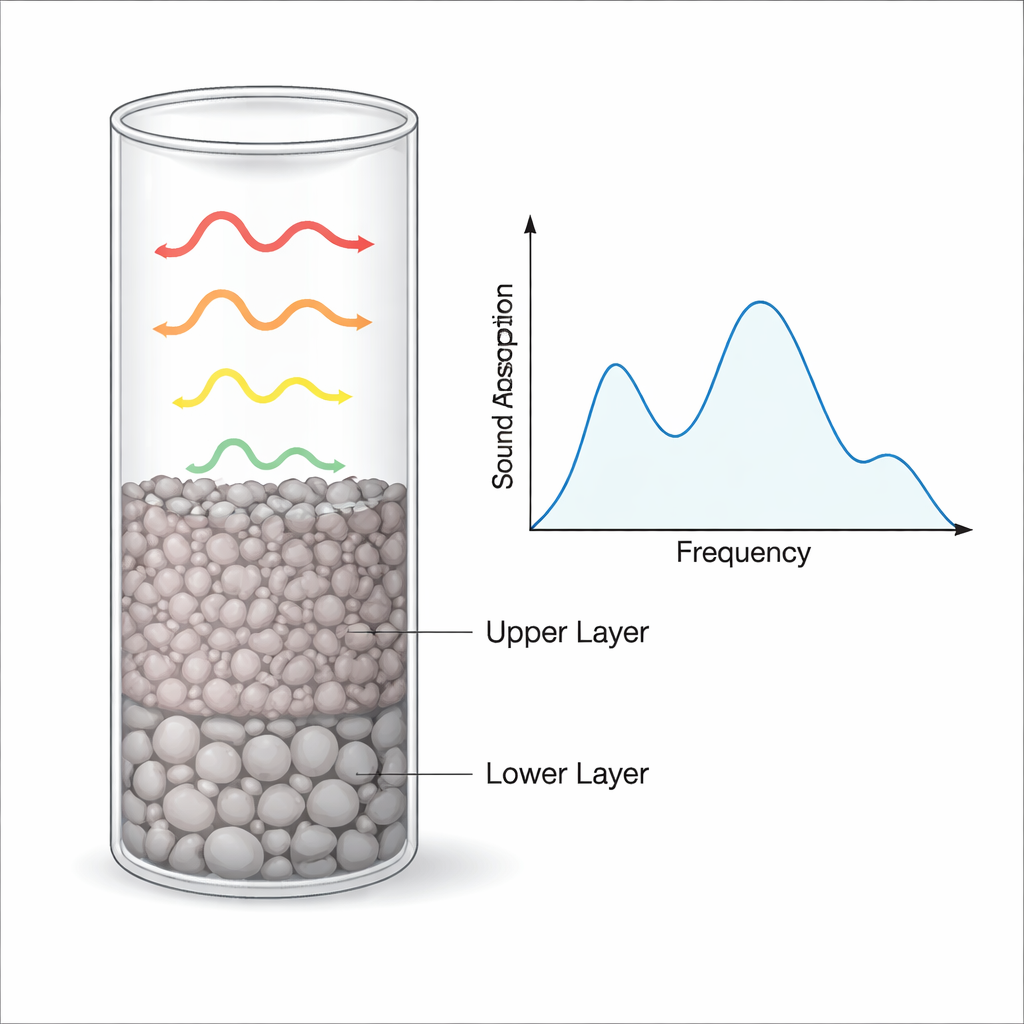
Finding the best combinations for different road designs
When both layers used the same stone size, the researchers found that the details of the layering still mattered. Changing the cement ratio between top and bottom layers altered how many prominent absorption peaks appeared and at which frequencies they occurred. When the two layers used different stone sizes, the pattern became even more interesting. For pavements 10 centimeters thick, the best results came from placing smaller stones with a low cement ratio in the surface layer and larger stones with a low cement ratio underneath. This arrangement created a highly absorbent skin backed by a coarser, still open base that continued to drain away sound energy. For thicker 15-centimeter pavements, that same fine-over-coarse strategy lost much of its advantage. In that case, using small stones and low cement ratios in both layers produced the strongest overall absorption.
Why simple porosity is not enough
One surprising result was that total porosity—the fraction of the concrete’s volume occupied by air—did not reliably predict how well the dual-layer pavements absorbed sound. Samples with similar porosity but different stone size distributions or layer arrangements could have very different acoustic performance. This contrasts with traditional single-layer porous concrete, where higher porosity usually tracks with better sound absorption. In dual-layer systems, the way pores connect across the interface between layers, and the exact mix in each layer, turns out to be more important than porosity alone.
What this means for quieter cities
For road designers, the study provides clear, layman-friendly takeaways. If a city wants to build a relatively thin, 10-centimeter porous concrete pavement, it should use smaller stones and a low cement content at the surface, supported by a lower layer made with larger stones but still relatively little cement. For thicker 15-centimeter pavements, both layers should rely on small stones and low cement content to perform best. Above all, engineers should not rely solely on a single number like porosity to judge acoustic quality. Instead, they need to consider layer structure, stone size, and cement content together to create pavements that quietly soak up the sound of passing traffic, improving the daily soundscape for people living and working along busy roads.
Citation: Zhang, Y., Han, Y., Khair, A. et al. Comprehensive evaluation of sound absorption property in dual-layer porous concrete pavement. Sci Rep 16, 7073 (2026). https://doi.org/10.1038/s41598-026-38509-4
Keywords: traffic noise, porous concrete, road pavement, sound absorption, urban acoustics