Clear Sky Science · en
Analytical solution of moistened trapezoidal porous fins considering all nonlinear effects
Keeping Cool with Smarter Metal Fins
From air conditioners and refrigerators to car radiators and laptop heat sinks, many everyday machines rely on small metal "fins" to shed unwanted heat. This study looks at a special kind of fin – one that is both porous (full of tiny passages) and shaped like a trapezoid – and asks how well it can cool when moist air condenses on it. Understanding this behavior can help engineers design more efficient and compact cooling systems for electronics, vehicles, and climate-control equipment.
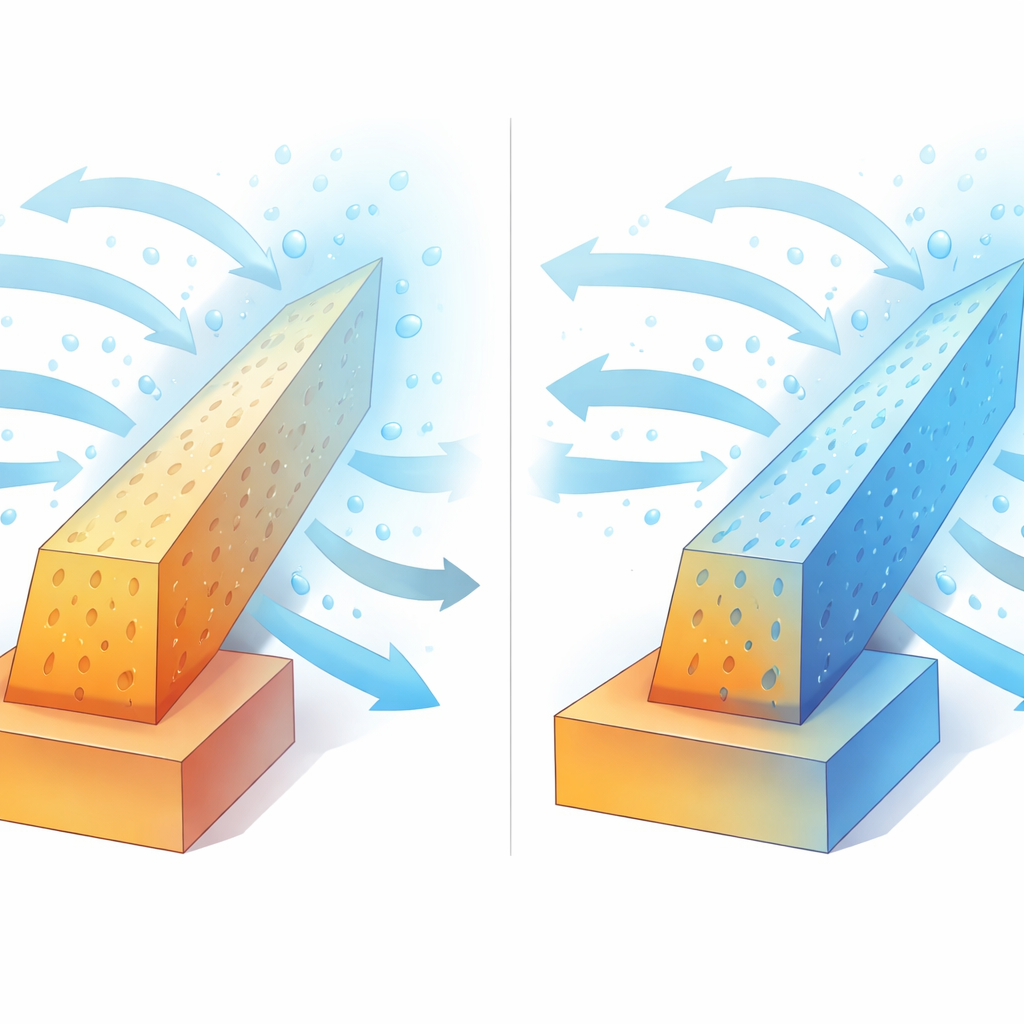
What Cooling Fins Do in Real Machines
Cooling fins work by increasing the surface area through which heat can escape from a hot object into the surrounding air. Trapezoidal fins, which are thicker at one end and thinner at the other, are popular because they strike a good balance between heat removal, material use, strength, and ease of manufacturing. Making these fins porous – riddling them with tiny channels – further increases the area in contact with the air and allows air to move through the fin as well as around it. In devices such as cooling coils in air conditioners or dehumidifiers, the fin surface can become colder than the surrounding moist air, causing water vapor to condense on the fin and adding an extra pathway for heat flow.
Why Moisture Makes Cooling More Complicated
When a cold fin sits in humid air, two kinds of heat transfer happen at once. First, there is sensible heat, the familiar process where warmer air cools down as it touches a colder surface. Second, there is latent heat, which is released when water vapor in the air turns into liquid droplets on the fin. This combined heat and moisture exchange is highly nonlinear: the rate of condensation depends strongly on the local surface temperature and humidity. Earlier studies examined various fin shapes and materials, but none had analyzed a porous trapezoidal fin under these fully coupled moist conditions while also accounting for the way the fin’s thermal conductivity can change with temperature.
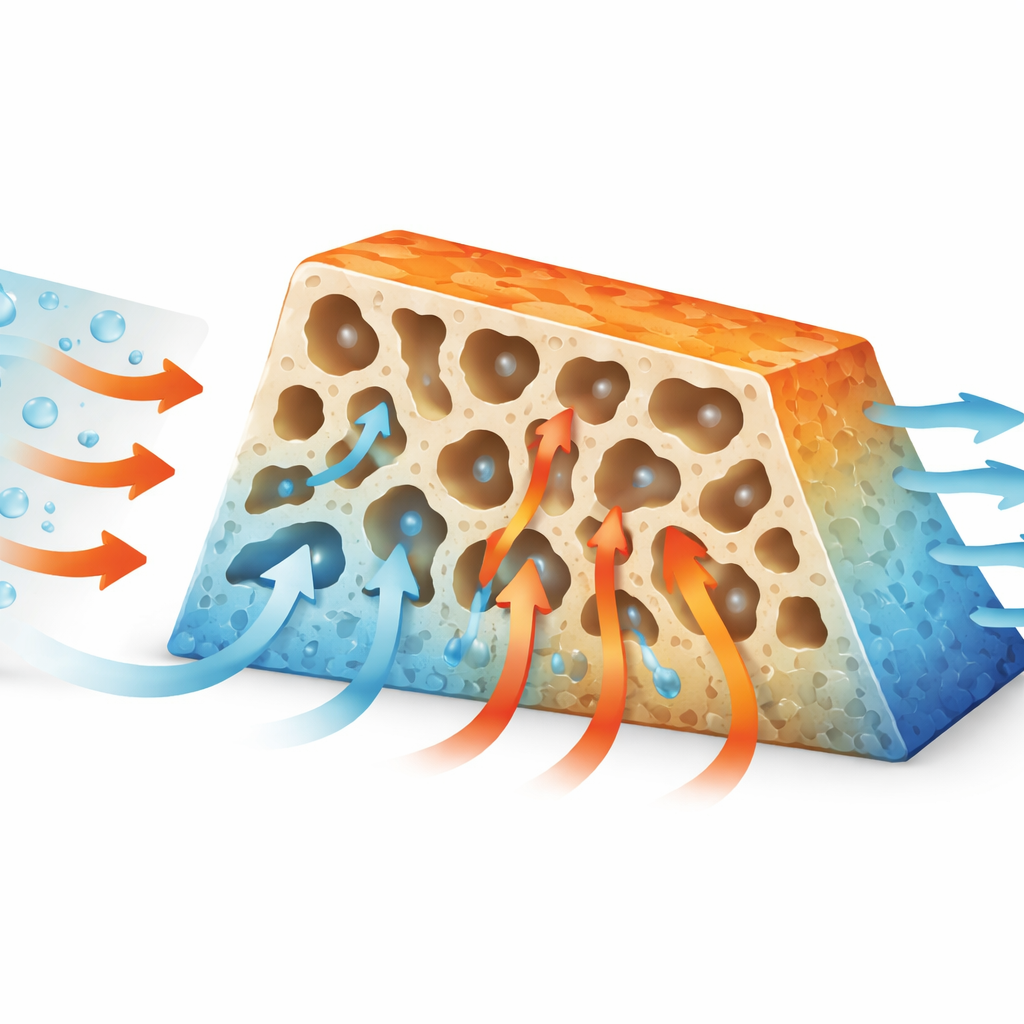
How the Researchers Tackled the Problem
The authors built a mathematical model of a single porous trapezoidal fin exposed to still, humid air. Their equations describe how heat conducts along the fin, how buoyancy-driven air moves through the pores, and how heat and moisture are exchanged at the surface as condensation occurs. To capture the moisture behavior accurately, they expressed the air’s humidity ratio as a smooth polynomial curve of surface temperature, fitted to psychrometric data, rather than relying on rough linear approximations. Because the resulting equation is strongly nonlinear, they used a semi-analytical technique called the Differential Transformation Method to obtain temperature profiles and to calculate how efficiently the fin removes heat. They rigorously checked these solutions against high-precision finite-difference simulations and earlier published results for other fin shapes, finding agreement to within about one-tenth of a percent.
What Happens When Shape and Moisture Are Varied
With the verified model in hand, the team explored how key design and environmental parameters affect fin performance. They compared "dry" fins, where only sensible heat transfer occurs, to "wet" fins, where condensation and latent heat are present. They also examined different trapezoidal expansion ratios – essentially, how much thicker the fin is at one end versus the other. For dry fins, the temperature difference between base and tip was modest (around 1.5–2.5 °C), but when the surface was wet these differences roughly tripled, indicating much steeper cooling along the length. Interestingly, fins with negative expansion ratio – thinner at the base and thicker toward the tip – showed the highest efficiency, because this geometry better distributes material where it contributes most to heat transfer. In contrast, wet porous fins consistently performed less efficiently than dry ones, despite removing more total heat, because condensation adds resistance and blocks pores. The study also found that making thermal conductivity temperature-dependent had only a minor influence on dry fins but became more noticeable in wet conditions, and that changes in ambient humidity mainly affected surface temperatures rather than overall efficiency.
What This Means for Future Cooling Designs
For non-specialists, the central message is that both geometry and moisture matter greatly when designing porous cooling fins. A trapezoidal porous fin can be tuned, especially through a negative expansion ratio, to achieve higher efficiency, but once condensation starts, some of that advantage is lost as liquid water hinders heat flow through the pores. The authors provide compact formulas that let engineers quickly estimate temperature profiles and efficiencies without resorting to heavy numerical simulations. These insights can guide the design of more compact, reliable, and energy-efficient heat exchangers, dehumidifiers, and electronic cooling systems operating in humid environments.
Citation: Sayehvand, Ho., Maleki, J. & Haftlang, P.B. Analytical solution of moistened trapezoidal porous fins considering all nonlinear effects. Sci Rep 16, 8239 (2026). https://doi.org/10.1038/s41598-026-38507-6
Keywords: porous fins, trapezoidal fin, condensation, heat and mass transfer, cooling efficiency