Clear Sky Science · en
Association of cytokine levels with treatment duration and patient family history in Egyptian multiple sclerosis patients
Why this research matters to patients and families
Multiple sclerosis (MS) is a long‑lasting disease in which the body’s own immune system attacks the brain and spinal cord. Many people living with MS, and their families, wonder how well modern treatments actually calm this immune attack over time and whether family history changes how the disease behaves. This study followed nearly 200 Egyptian MS patients and measured key immune signals in their blood to see how they relate to treatment duration, disability, and family history of autoimmune diseases.
Looking at immune signals in the blood
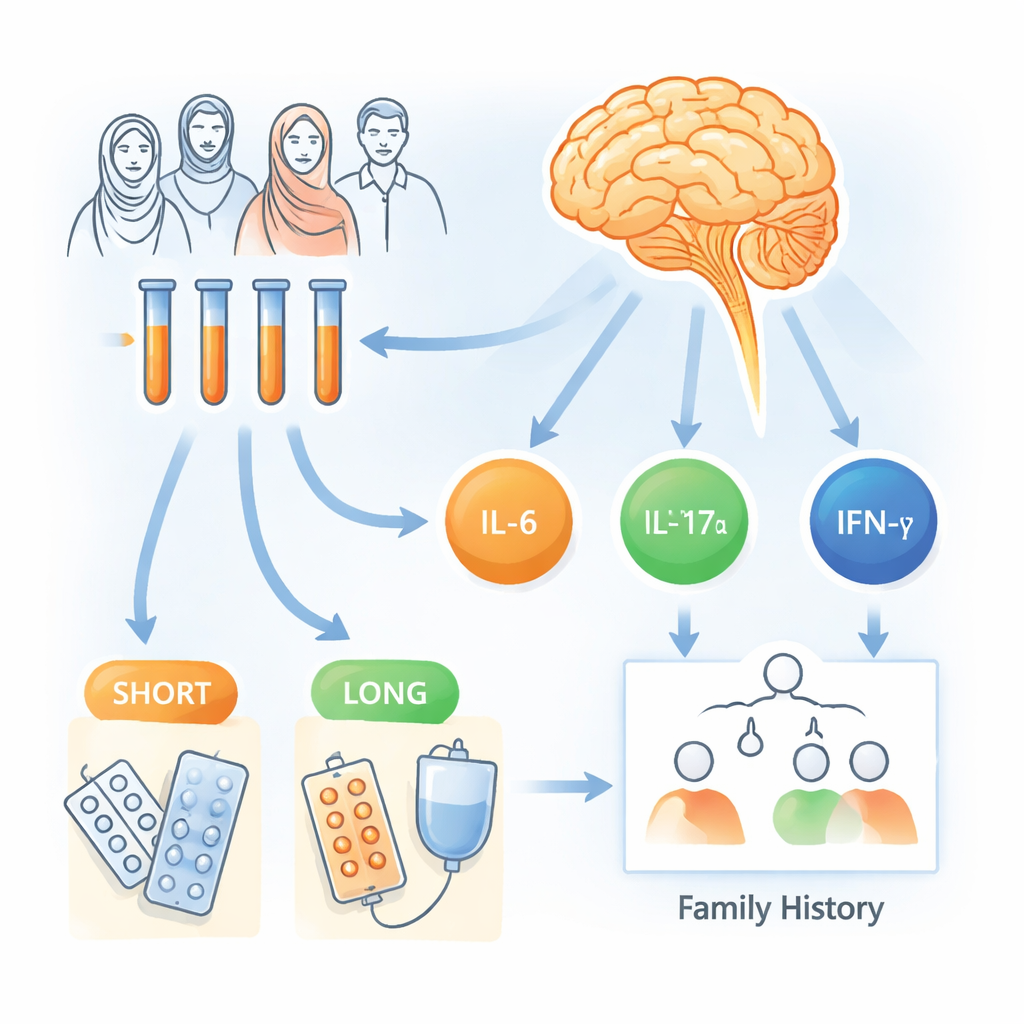
The researchers focused on four small proteins called cytokines that act as chemical messengers of inflammation: IL‑6, IL‑17A, TNF‑α, and IFN‑γ. Higher levels of these messengers generally mean a more active immune attack. Instead of using spinal fluid, which requires a lumbar puncture, they used blood samples, a simpler and less invasive approach that could realistically be used in routine care. They then compared cytokine levels with patients’ disability scores, brain scan findings, and personal and family medical histories.
Comparing short and long time on treatment
All 192 patients had definite MS and were divided into groups based on how long they had been on disease‑modifying therapies (DMTs) such as interferon‑beta, fingolimod, dimethyl fumarate, and B‑cell–targeting antibodies like rituximab. Some were recently diagnosed and had never started treatment, others were on treatment for less than a year, and another group had been on therapy for more than two years. The team found that patients treated for less than 12 months often had equal or even higher inflammatory signals than untreated patients, especially for IL‑17A and TNF‑α. In contrast, those treated for more than 24 months showed clearly lower levels of IL‑6, TNF‑α, and IFN‑γ, suggesting that the immune‑calming benefits of these drugs build up over time.
Linking immune markers to disability
To understand what these blood markers might mean for daily life, the scientists compared cytokine levels to the Expanded Disability Status Scale, a standard measure of MS‑related disability. Among patients who had not yet started treatment, higher IL‑6 was associated with worse disability, while higher IL‑17A and IFN‑γ were linked to milder disability scores. TNF‑α did not show a clear relationship with disability in this group. These patterns suggest that IL‑6, in particular, may reflect how aggressively the disease is damaging the nervous system, making it a candidate marker for tracking disease progression in individual patients.

Family patterns and stronger inflammation
The study also explored whether having relatives with MS or other autoimmune diseases, such as rheumatoid arthritis or lupus, changed the picture. Patients with a family history of autoimmunity developed MS at a noticeably younger age compared with those without such a history, hinting at inherited risk factors. Among all the cytokines measured, TNF‑α stood out: it was significantly higher in patients with a family history of autoimmune disease. Because the gene for TNF‑α sits in a region of the genome already linked to MS and other autoimmune conditions, these results support the idea that shared genetic traits may drive stronger inflammatory responses across related disorders.
What this means for people living with MS
Put simply, this work shows that long‑term use of MS drugs can gradually quiet key inflammatory signals in the blood, but this calming effect is not immediate and may take more than a year to become clear. IL‑6 appears to track with worsening disability, while TNF‑α seems to reflect an inherited tendency toward more active autoimmunity. Although these blood tests are not ready to replace brain scans or guide treatment on their own, they bring us closer to simple, blood‑based markers that could help doctors personalize therapy, judge whether a drug is working over time, and better understand why MS can run more aggressively in some families.
Citation: Mohsen, E., Haffez, H., Ahmed, S. et al. Association of cytokine levels with treatment duration and patient family history in Egyptian multiple sclerosis patients. Sci Rep 16, 7951 (2026). https://doi.org/10.1038/s41598-026-38500-z
Keywords: multiple sclerosis, cytokines, disease-modifying therapy, autoimmune family history, biomarkers