Clear Sky Science · en
On certain novel numerical and analytical solutions for the pure-cubic Schrödinger equation in optical fibers with Kerr nonlinearity
Light Pulses That Refuse to Fade
Modern communication networks rely on laser pulses racing through glass fibers at nearly the speed of light. Ordinarily, those pulses would spread out and blur, limiting how much information we can send. This paper explores a special class of pulses, called solitons, that can travel vast distances without changing shape. By combining advanced mathematics with careful computer simulations, the authors show how many different kinds of self-sustaining light pulses can arise in optical fibers whose refractive index changes with light intensity (the Kerr effect).
A Simple Equation for Complicated Light
The study centers on a mathematical model known as the nonlinear Schrödinger equation, tailored here to describe light in Kerr-type optical fibers. In this setting, light behaves both like a wave that naturally spreads and like a medium that reshapes itself in response to the wave’s own intensity. The competition between spreading (dispersion) and self-focusing (nonlinearity) can lock a pulse into a stable form—a soliton. The authors focus on the “pure-cubic” version of the equation, where the nonlinear response grows with the cube of the light’s amplitude, and they also include higher-order effects such as third-order dispersion and self-steepening, which become important for ultrashort, high-speed pulses.
From Moving Waves to Solitary Shapes
To tame this complex equation, the researchers first convert it from a full space-and-time problem into an ordinary differential equation by tracking waves that move with a fixed speed, a strategy called a traveling-wave reduction. They then assume that the pulse profile follows certain standard shapes—built from hyperbolic functions, trigonometric functions, or algebraic series—and solve for the parameters that make these guesses satisfy the original equation. Using three related analytical tools (the extended hyperbolic function method, the polynomial expansion method, and a modified extended tanh method) they obtain explicit formulas for many kinds of waves, including bright solitons (localized peaks of light), dark solitons (localized dips in an otherwise continuous beam), kink-like fronts, periodic wave trains, and even singular pulses whose intensity can spike dramatically.
Checking the Math With Careful Computation
Exact formulas are only useful if they genuinely describe how waves evolve. To verify their results, the authors turn to numerical methods, in particular the Adomian decomposition technique and high-precision split-step simulations. These approaches approximate how a pulse changes step by step as it propagates along the fiber, without oversimplifying the nonlinear behavior. By feeding their analytical soliton shapes into these numerical solvers, they show that the computed evolution closely follows the predicted profiles: bright pulses stay bell-shaped, dark pulses keep their notches, kink and V-shaped waves remain sharp, and singular solutions display the expected extreme peaks. Any small discrepancies appear mainly at early times, when numerical transients are strongest, and then quickly die out.
Rich Landscapes of Nonlinear Light
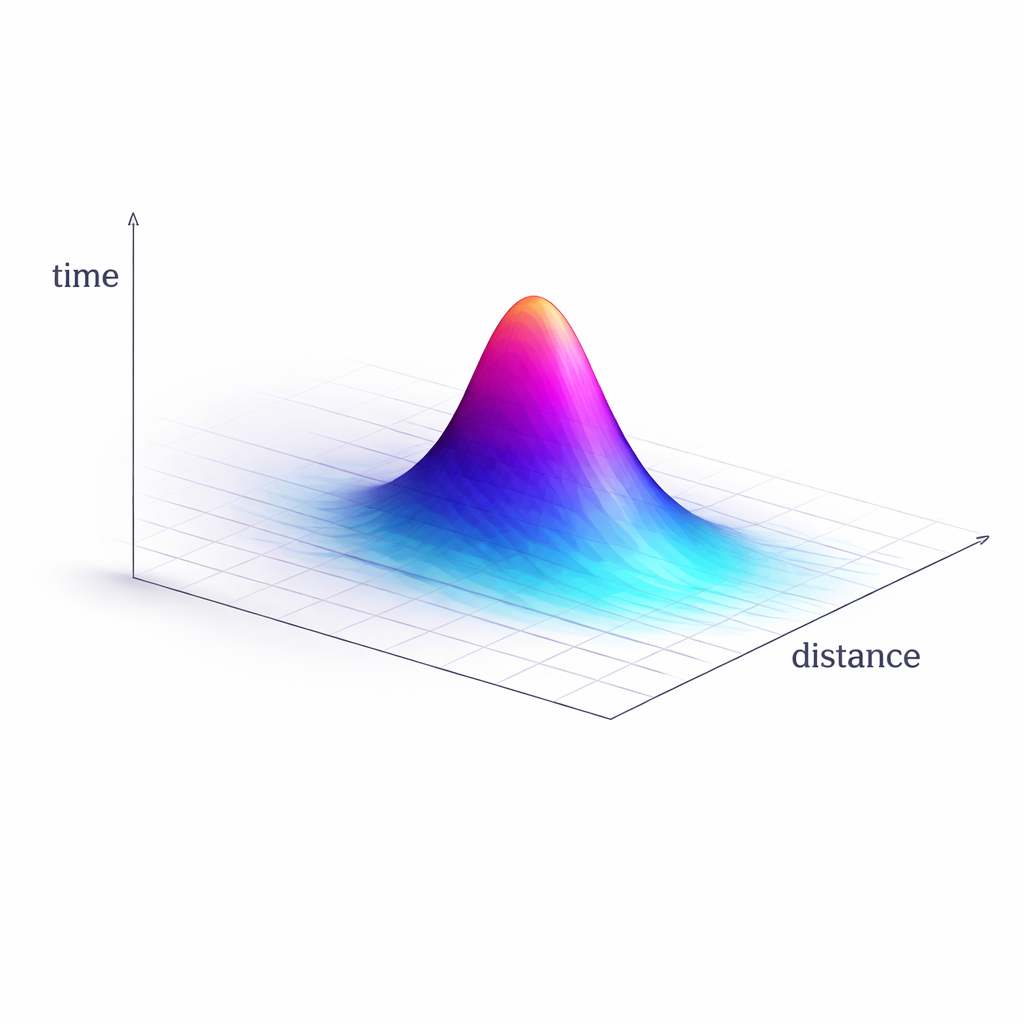
Beyond confirming known soliton types, the work maps out a surprisingly rich variety of wave forms that the pure-cubic Kerr model can support, depending on parameter choices such as dispersion strength, nonlinearity, and pulse speed. The authors present 2D slices, 3D surfaces, and contour plots illustrating how each solution looks and evolves. Some waves behave like robust information carriers for fiber-optic communication, preserving their height and width over long distances. Others mimic shock-like fronts, wedge-shaped patterns, or blow-up behaviors relevant to fluid turbulence, plasmas, and even optical “rogue waves.” By collecting many solution families within one unified framework, the paper provides a catalog and reference for future studies of more elaborate models, including higher dimensions, additional nonlinearities, and stochastic or fractional effects.
Why These Results Matter
For non-specialists, the main takeaway is that a relatively compact equation can capture a broad spectrum of behaviors for intense light in glass fibers—from smooth, stable pulses ideal for high-speed data transmission to extreme spikes that might damage equipment or be harnessed for specialized applications. The authors’ integrated analytical–numerical strategy not only proves that these exotic pulses are mathematically consistent, but also that they remain stable under realistic propagation. This deeper understanding of soliton dynamics under Kerr nonlinearity can guide the design of next-generation optical communication systems, ultrafast photonic devices, and other technologies that depend on controlling light in strongly nonlinear media.
Citation: Tariq, K.U., Khan, R., Alsharidi, A.k. et al. On certain novel numerical and analytical solutions for the pure-cubic Schrödinger equation in optical fibers with Kerr nonlinearity. Sci Rep 16, 7211 (2026). https://doi.org/10.1038/s41598-026-38498-4
Keywords: optical solitons, Kerr nonlinearity, nonlinear Schrödinger equation, fiber-optic communication, nonlinear wave dynamics