Clear Sky Science · en
Plasmonic artificial inspector for herbal medicines via surface-enhanced Raman spectroscopy and deep learning
Why checking herbs needs a high-tech helper
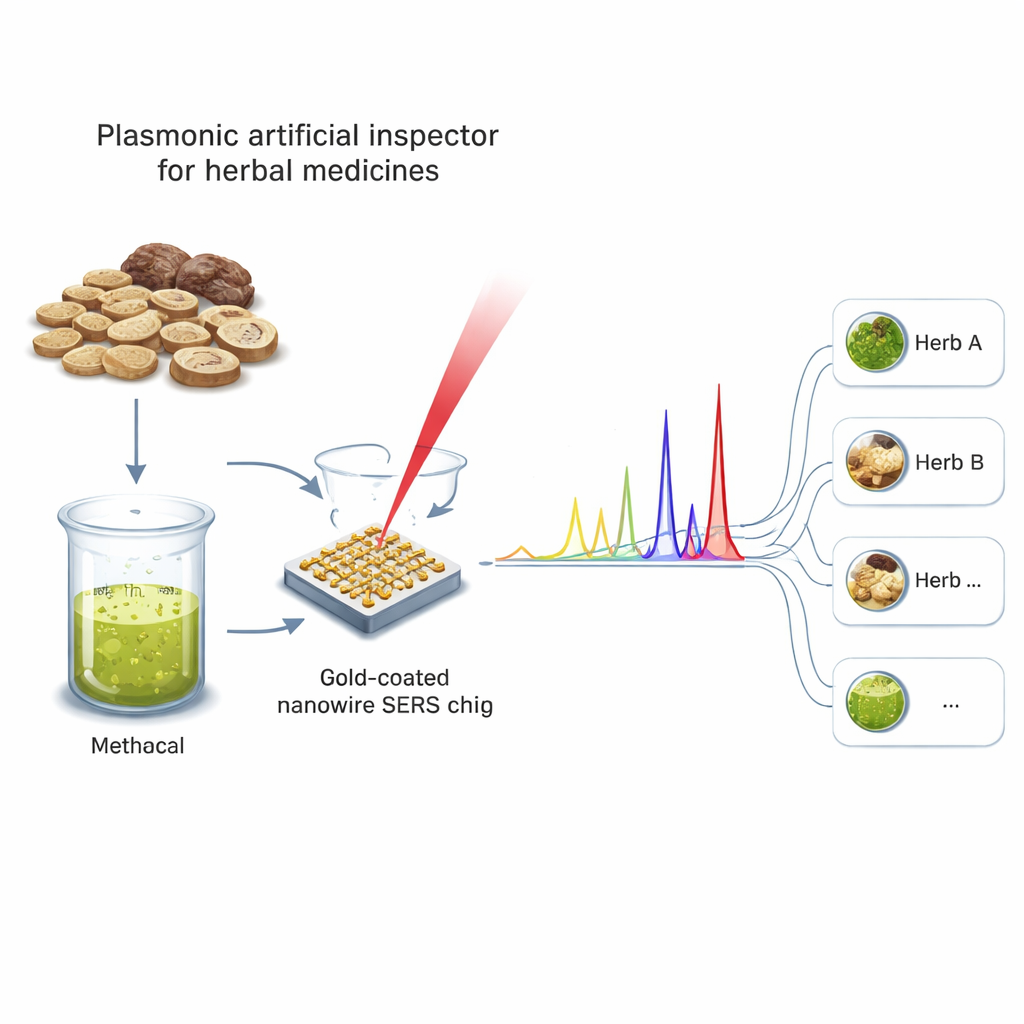
Herbal medicines are used around the world for ailments ranging from cancer to Parkinson’s disease, yet many dried roots, barks, and seeds look confusingly alike. Today, trained inspectors rely mostly on sight, smell, and taste to tell genuine remedies from harmless look‑alikes or dangerous substitutes. This approach is slow, subjective, and hard to scale to the hundreds of herbal products on the market. The article presents a new “artificial inspector” that reads the chemical fingerprints of herbs in seconds and uses deep‑learning software to decide which plant is which.
From human senses to chemical fingerprints
Traditional herb inspection, called organoleptic testing, depends on human senses to judge features like color, shape, and aroma. With more than 500 official herbal categories in South Korea alone, even experts can be overwhelmed, and closely related species or similar‑looking pieces are easy to mix up. Laboratory techniques such as thin‑layer chromatography and mass spectrometry can identify ingredient molecules more objectively, but they are often slow, require elaborate preparation, and are difficult to apply routinely to large numbers of samples. What is needed is a tool that is fast, highly selective for chemical composition, and simple enough to complement the experts at the inspection desk.
A fast optical test for herbal chemistry
The researchers turned to surface‑enhanced Raman spectroscopy, or SERS, a laser‑based method that measures tiny vibrations of chemical bonds. When a herbal extract is placed on a specially structured metal surface and illuminated, it produces a spectrum—an array of peaks that acts like a fingerprint of the molecules present. To get strong, reliable signals from complex herbal mixtures, the team first extracted active compounds into methanol and then used a gold‑coated forest of nanowires that concentrates light into nanoscale hotspots. Comparing spectra from several herbs to the spectra of their known components showed that many of the peaks lined up, confirming that SERS captures genuine chemical features rather than random noise.
Teaching a neural network to read spectra
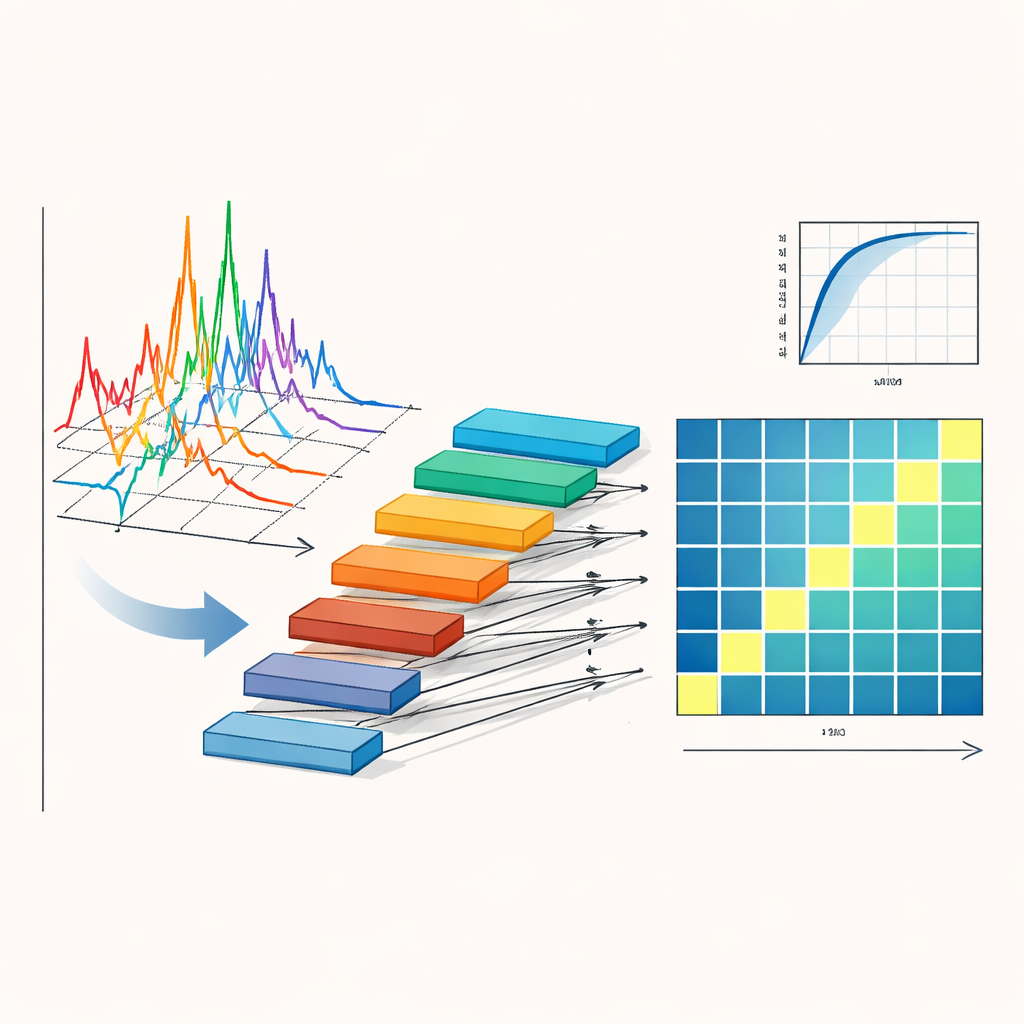
Although each SERS spectrum is rich in information, manually picking out patterns from thousands of slightly noisy curves is extremely challenging. The authors therefore fed the spectra into a deep‑learning model based on a one‑dimensional version of a residual neural network, a type of architecture commonly used for image recognition. They collected about 370,000 spectra from 35 herbal species and artificially varied them—by adding noise, shifting peak positions, and altering baselines—to train the model to cope with the imperfections of real‑world measurements. Herbs were organized into three difficulty levels: clearly different in appearance, similar in appearance but from different plant groups, and similar in both appearance and botanical genus.
High accuracy even for look‑alike herbs
For the easiest group of eight visually distinct herbs, the artificial inspector correctly identified species in roughly 99.5 percent of test cases, even when the same herb came from growing regions the network had never seen before or was measured on different Raman instruments. The tougher challenge involved 29 herbs arranged in confusing subsets whose pieces look nearly identical to the human eye. Here, the system still achieved about 96 to 97 percent overall accuracy. Interestingly, herbs from the same botanical genus—expected to have very similar chemistry—were often classified more accurately than some unrelated yet visually similar herbs. This suggests that the method can detect subtle but robust chemical differences that are not obvious from outward appearance alone.
Toward smarter safety checks for natural remedies
Rather than replacing human inspectors, the authors envision their SERS‑deep‑learning system as a partner that rapidly cross‑checks visual judgments with objective chemical data. Because a single spectrum can be acquired in a few seconds and the trained model runs quickly, the approach could be extended to larger herbal catalogues and combined with other techniques such as imaging or chromatography to build rich, multimodal databases. In simple terms, the study shows that shining a laser on a tiny droplet of herbal extract and letting a neural network read the resulting fingerprint can tell us, with high confidence, which herb is which—helping make traditional remedies safer and more reliably labeled for consumers.
Citation: Kim, H., Lee, J., Kim, S.W. et al. Plasmonic artificial inspector for herbal medicines via surface-enhanced Raman spectroscopy and deep learning. Sci Rep 16, 7425 (2026). https://doi.org/10.1038/s41598-026-38497-5
Keywords: herbal medicine, Raman spectroscopy, deep learning, quality control, chemical fingerprinting