Clear Sky Science · en
High-resolution forecasting of soil thermal regimes using different deep learning frameworks under climate change
Why the warmth underground matters
Most of us think about climate change in terms of hotter summers and shrinking snowpacks, but the quiet shifts happening just a few centimeters below our feet may matter just as much. Soil temperature shapes how crops grow, how much food we can produce, how much water landscapes can hold, and how much carbon the land releases back to the air. This study looks beneath the surface in a mountainous, semi‑arid region of western Iran and asks: how will different climate futures warm — or even temporarily cool — the ground we depend on, and how quickly will those changes unfold?
Taking a closer look at a rugged landscape
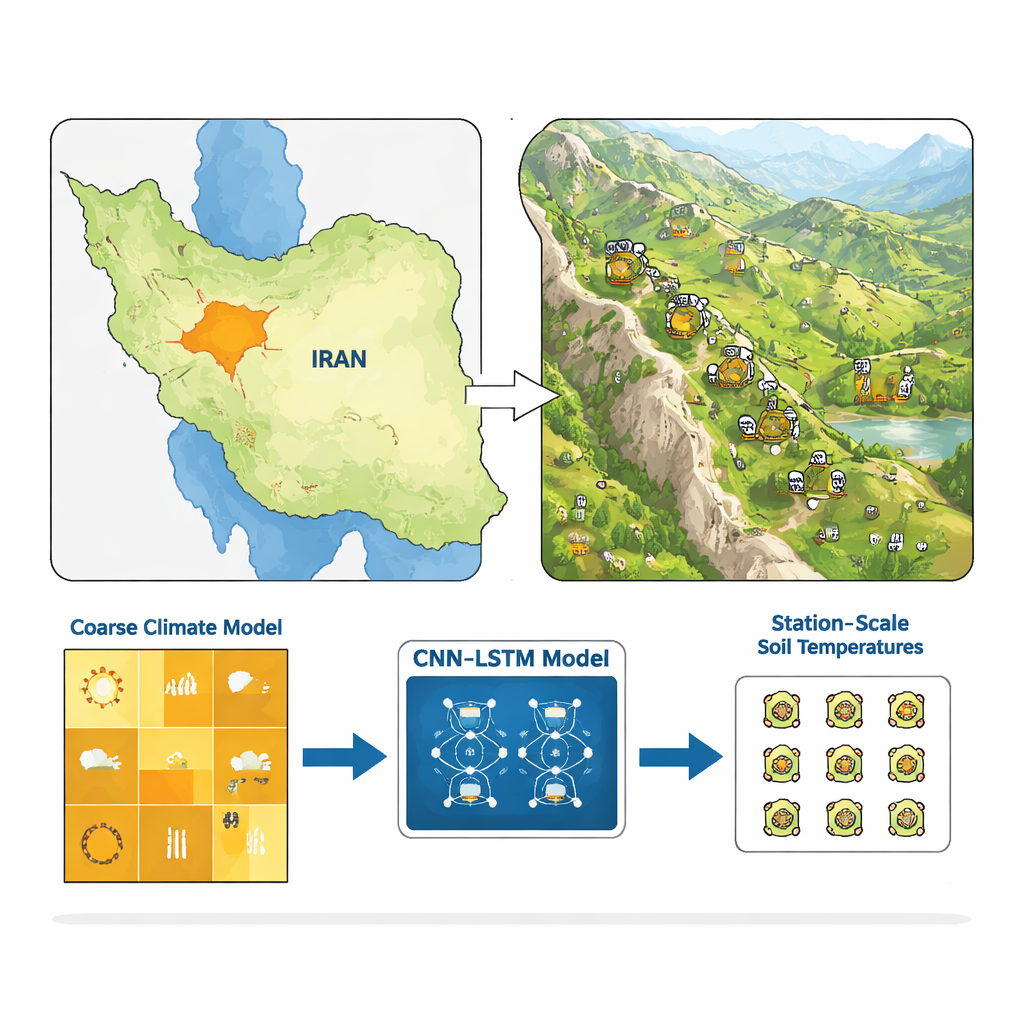
The researchers focused on Lorestan Province, a region of dramatic peaks and valleys along the Zagros Mountains. Here, temperatures swing from bitter winter cold to scorching summer heat, and farmers rely heavily on groundwater to support crops and livestock. Ten weather stations have recorded daily soil temperatures at a depth of just 5 centimeters over several decades. To glimpse the future, the team paired these local records with projections from a global climate model that describes the atmosphere in broad, low‑resolution strokes. Their challenge was to translate these blurry, planet‑scale projections into sharp, station‑scale forecasts that would be meaningful for local land managers.
Teaching computers to read the climate
Instead of using traditional, relatively simple statistical formulas, the team turned to deep learning — the same family of methods behind modern speech recognition and image search. They tested four neural‑network designs that are especially good at handling patterns over space and time: a convolutional network (CNN), two sequence‑oriented designs (LSTM and GRU), and a hybrid that combines CNN and LSTM layers. Before training these models, they sifted through 26 different atmospheric variables from the Canadian Earth System Model, such as air temperature, pressure patterns, winds, and humidity, using three complementary techniques to find which ones best track observed soil temperatures. Surface air temperature and mid‑level atmospheric pressure emerged as linchpin predictors across nearly all stations.
Sharper underground forecasts from hybrid deep learning
With the best predictors in hand, the researchers trained and tuned each neural network on daily data from 1980 to 2014, carefully checking performance on held‑out years. The hybrid CNN‑LSTM model generally came out on top. It captured both the large‑scale weather patterns and the daily ups and downs of soil temperature, achieving high skill scores and keeping typical errors to a few degrees Celsius. Tests against recent observations from 2015 to 2020 showed that the model could reproduce real‑world behavior under several climate storylines, known as “Shared Socioeconomic Pathways,” which range from strong emissions cuts to fossil‑fuel‑heavy development. Interestingly, the scenarios that best matched recent soil trends varied with elevation and location: cooler mountain stations tended to align with low‑emissions futures, while warmer lowland sites matched moderate to higher‑emissions pathways.
Surprising twists in future soil heating
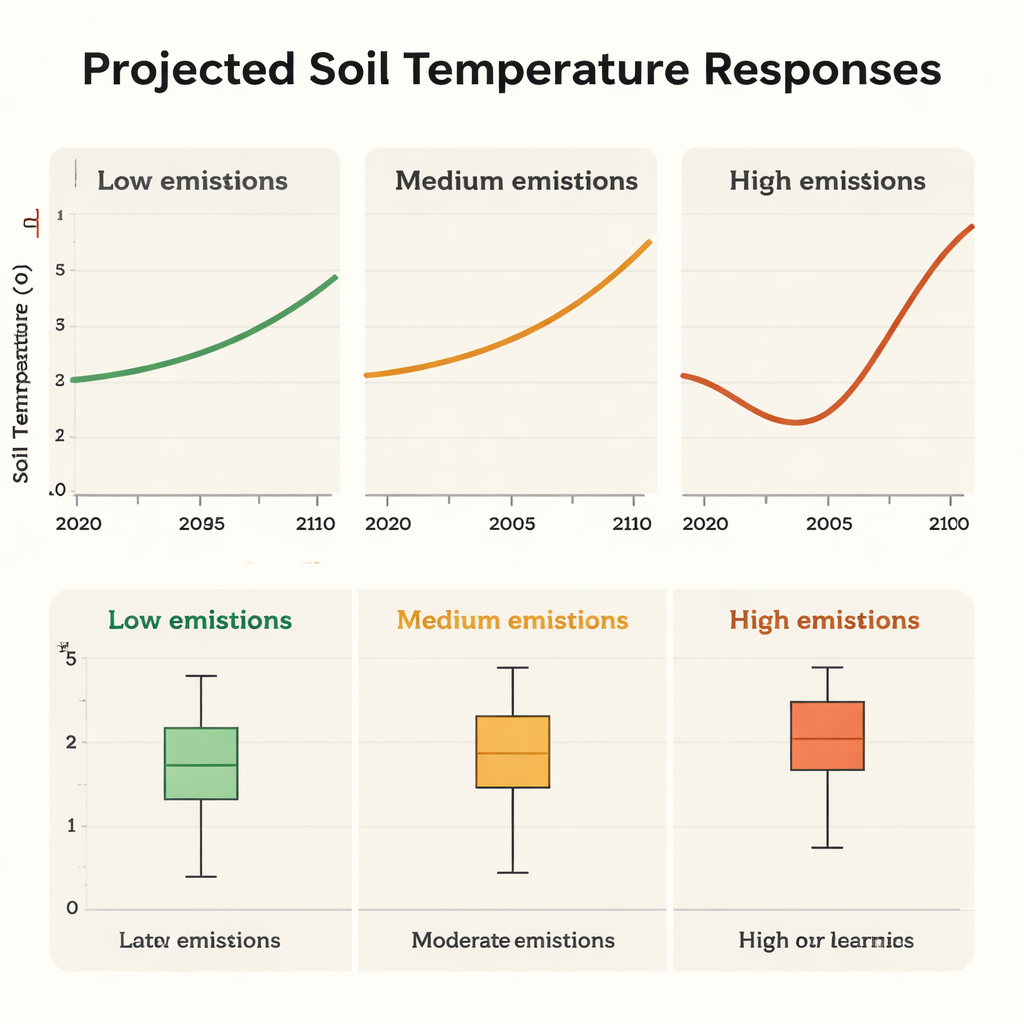
Armed with their best‑performing model, the team projected daily soil temperatures out to 2100 under three representative futures: low, medium, and high greenhouse‑gas emissions. All scenarios eventually lead to warmer soils, but not in the same way or at the same pace. Under low and medium emissions, soil temperatures rise modestly and then level off, adding roughly a couple of degrees Celsius above today by late century. Under the high‑emissions pathway, however, the story is more dramatic. In the next couple of decades the upper soil layer actually cools in many locations, probably because thicker clouds, altered rainfall, and moister soils shield the ground from sunlight even as the air above slowly warms. After mid‑century, this temporary cooling flips into accelerated heating, leaving the high‑emissions world with the warmest soils by far and a fundamentally altered pattern of year‑to‑year variability.
What it means for farms, water, and ecosystems
For non‑specialists, the message is both cautionary and practical. This work shows that what happens at the soil surface is not a simple mirror of air temperature; local geography and changes in clouds, rain, and moisture can briefly mask warming before amplifying it. Farmers and water managers in places like Lorestan could face a confusing sequence of cooler soils followed by rapid, hard‑to‑adapt‑to warming if emissions stay high. In contrast, strong climate action — futures closer to the low‑emissions scenarios — appears to lock in slower, steadier soil warming that ecosystems are more likely to cope with. By harnessing advanced deep‑learning tools, this study offers a sharper underground view of our climate choices, translating abstract global scenarios into concrete risks and timelines in the very layer of earth that feeds us.
Citation: Saeidinia, M., Haghiabi, A.H., Nazeri Tahroudi, M. et al. High-resolution forecasting of soil thermal regimes using different deep learning frameworks under climate change. Sci Rep 16, 7377 (2026). https://doi.org/10.1038/s41598-026-38496-6
Keywords: soil temperature, deep learning, climate change, downscaling, agriculture