Clear Sky Science · en
Job satisfaction as a catalyst mechanism transforming knowledge competence and intrinsic motivation into sustained lecturer performance in higher education
Why happy lecturers matter for everyone
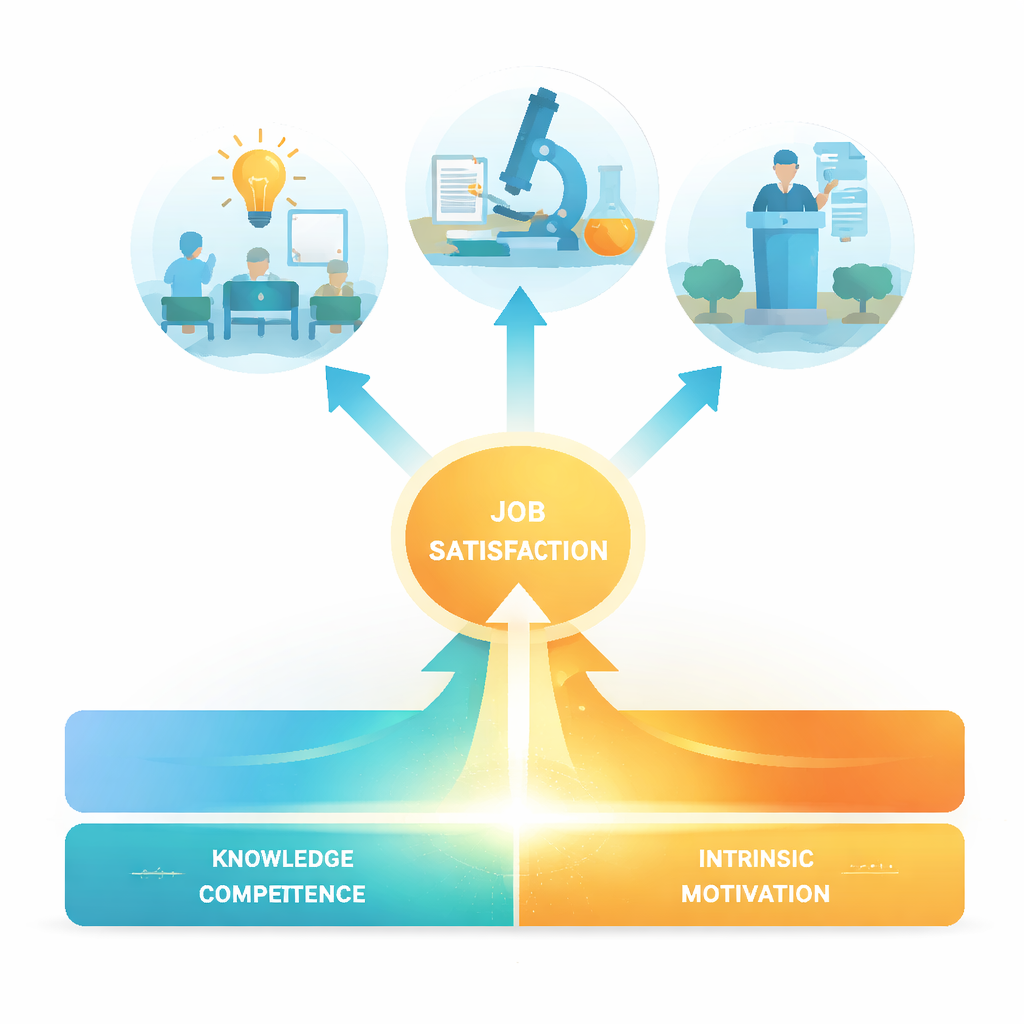
Parents, students, and policymakers all want great teaching and inspiring universities, yet the people at the center of this—lecturers—are under growing pressure. This study asks a deceptively simple question with big consequences: what really keeps lecturers performing at a high level over the long term? Instead of treating knowledge, motivation, and job satisfaction as separate ingredients, the authors show that job satisfaction acts like a psychological “catalyst” that turns lecturers’ expertise and inner drive into consistently strong teaching, research, and service.

The challenge of lasting excellence in universities
Universities worldwide struggle to maintain lecturer quality amid heavier workloads, rising competition, and constant changes in how teaching is expected to happen. Past research has shown that lecturers who are satisfied with their jobs, knowledgeable in their fields, or strongly motivated tend to perform better. But most studies looked at these factors one by one, or treated satisfaction as just another link in a straight line from cause to effect. The key missing piece has been understanding how these elements interact over time, and whether satisfaction simply sits in the middle—or powerfully amplifies how knowledge and motivation translate into performance.
A new way to see satisfaction: from outcome to catalyst
The authors propose a fresh perspective: job satisfaction is not just a byproduct of good working conditions or a passive middleman between inputs and results. Instead, they argue it behaves more like a catalyst in a chemical reaction. Lecturers may have deep subject knowledge and strong inner motivation, but if they feel frustrated, undervalued, or worn down, those strengths may never fully show up in their classroom and research performance. When lecturers feel satisfied—because they have autonomy, support, recognition, and a good fit between their skills and their roles—the same knowledge and motivation are far more likely to be converted into high-quality teaching, productive research, and meaningful service to their institutions.
How the study tested this idea
To examine this catalyst role, the researchers surveyed 468 lecturers from private universities in three different countries. They measured two personal resources—knowledge competence (both factual understanding and practical teaching skills) and intrinsic motivation (doing academic work out of interest and enjoyment)—alongside overall job satisfaction and performance across teaching, research, and service. Using an advanced statistical approach designed to capture both indirect paths and interactions, they built and tested a “triple-mediation” model: knowledge and motivation feed into satisfaction, which in turn feeds into performance, while also allowing the two inputs to interact with each other.
What the numbers reveal about happy, skilled, and motivated lecturers
The results are striking. Together, the model explained about 71% of the differences in lecturers’ performance—an unusually high figure in social science research. Job satisfaction emerged as the strongest direct predictor of performance. Knowledge competence and intrinsic motivation were both linked to higher satisfaction, and their effects on performance flowed mainly through that satisfaction. For knowledge, part of its impact was direct, but a large share was still channeled through satisfaction. For intrinsic motivation, the direct link to performance was weak and not clearly reliable on its own; almost all of its helpful effect worked by raising how satisfied lecturers felt. Crucially, the study found that when high knowledge and high intrinsic motivation occurred together, satisfaction and performance rose more than would be expected by simply adding their individual effects—an amplifying, multiplicative pattern rather than a simple sum.
What this means for universities and students
For a layperson, the main takeaway is straightforward: smart and passionate lecturers do their best work when they are also genuinely satisfied with their jobs. Knowledge and inner drive are necessary but not sufficient; the day-to-day experience of work—autonomy, support, recognition, fair workload, and a sense of fit—determines whether those strengths fully show up in the classroom and in research labs. This study suggests that universities seeking lasting excellence should not only hire capable and motivated people, but also design jobs and policies that nurture satisfaction. When they do, the combined effect can be much greater than treating training, motivation programs, and working conditions as separate, unrelated efforts.
Citation: He, P., Aluvalu, R. & Tejani, G.G. Job satisfaction as a catalyst mechanism transforming knowledge competence and intrinsic motivation into sustained lecturer performance in higher education. Sci Rep 16, 7915 (2026). https://doi.org/10.1038/s41598-026-38488-6
Keywords: job satisfaction, lecturer performance, intrinsic motivation, higher education, faculty development