Clear Sky Science · en
Sustainable walkability around green, blue, and spiritual spaces in a semi-urban district of coastal Karnataka, India
Why the Places We Walk Matter
From seaside promenades to leafy parks and temple streets, many of us enjoy walking in beautiful surroundings. Yet whether we actually can walk safely and comfortably in these places depends on how our towns are built. This study looks at walkability – how easy and pleasant it is to get around on foot – in a semi-urban district of coastal Karnataka, India. Focusing on green spaces (forests and parks), blue spaces (beaches) and spiritual spaces (temple corridors), the researchers ask a simple question with big implications: are these much-loved places truly walkable for everyday life, or do they still push people into cars?

Three Ways to Look at Walking
To answer this, the team studied five locations in and around Udupi: two beaches, two green areas and one busy temple corridor. They examined walkability from three angles. First, they used an online tool called Walk Score, which estimates how easy it is to reach shops, schools, clinics and other essentials on foot. Second, trained investigators walked the streets with action cameras, later rating what they saw in terms of sidewalks, crossings, lighting and traffic. Third, they asked 45 local residents how walkable their own neighborhoods felt, using a simplified questionnaire about access, safety, appearance and basic facilities. By combining digital data, expert observation and everyday experience, the researchers tried to capture the full story of walking in these mixed urban–rural settings.
Car‑Dependent Streets in Scenic Settings
The digital assessment painted a sobering picture. None of the five locations scored as “high walkability” on Walk Score; all were classed as car dependent. Even Maruthi Veethika, the temple corridor with the best access to shops, schools and banks, scored only 40 out of 100. The two beaches did especially poorly, with almost no essential services within a one‑kilometer radius. The green spaces – the Agumbe Ghat forest area and a tree park – also had few nearby amenities. In practical terms, this means that while people might visit these places for recreation, most daily errands still require a car or motorbike, which undermines health, air quality and the promise of more sustainable travel.
What the Street-Level View Reveals
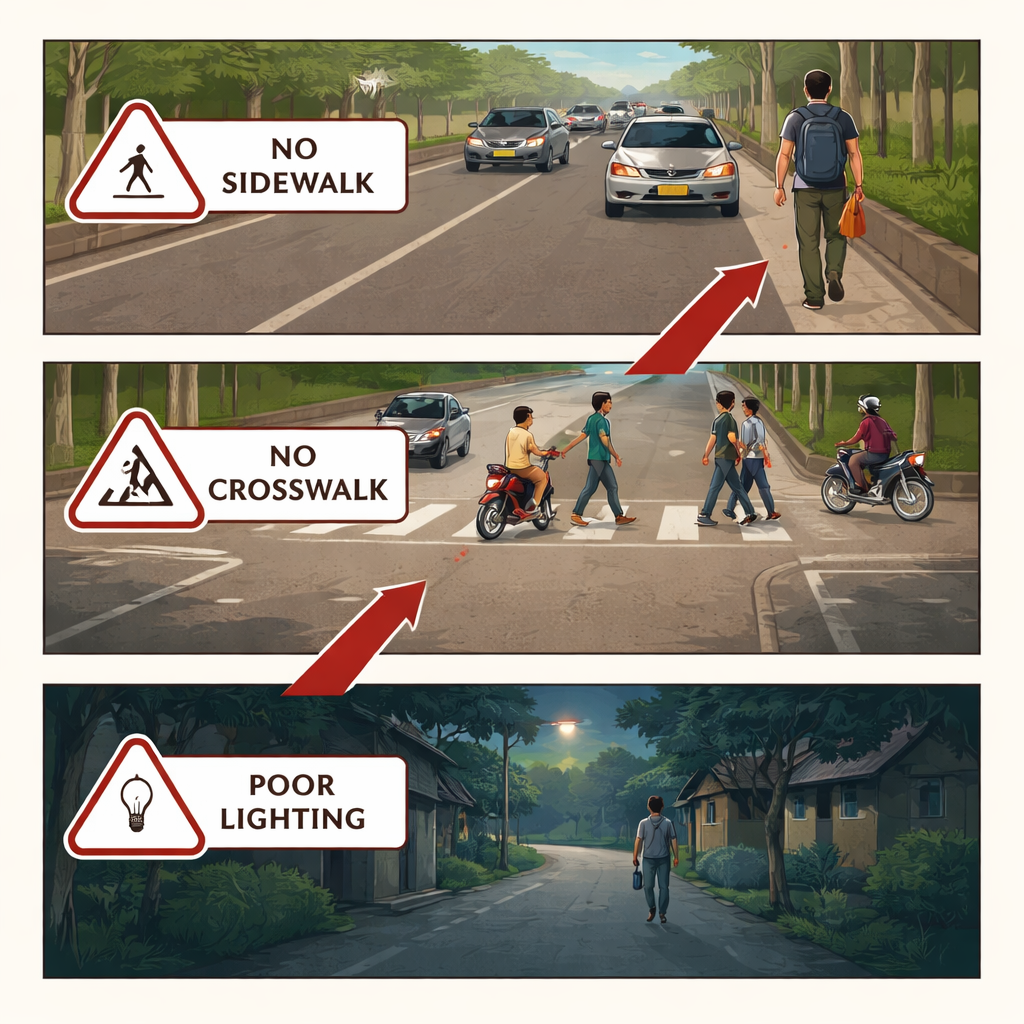
The investigator-led walk-throughs showed why these settings remain hard to walk in, despite their natural appeal. Across all sites, observers found missing or narrow footpaths, a lack of zebra crossings and pedestrian‑only lanes, poor or absent street lighting, and weak enforcement of traffic rules. In the beaches and forested areas, houses and shops were scattered, making it difficult to find help in an emergency. Experts gave particularly low marks to access to amenities, street connectivity and basic infrastructure such as continuous sidewalks. Even the relatively better spiritual corridor suffered from heavy traffic and crowded, uneven paths. In short, the physical environment around blue and green spaces – and even busy religious streets – has not been designed with walkers in mind.
How Residents See the Same Streets
Residents, however, told a more optimistic story. When locals were asked about walkability, most locations scored in the “moderate” range, around 70 percent, even where objective measures were poor. People living near the temple corridor praised the close-packed shops and temples, though they worried about traffic. Those near the beaches and green areas liked the scenery and felt generally safe from crime, but still noticed problems such as speeding vehicles, uneven paths and dimly lit streets. The gap between residents’ higher ratings and the lower scores from online tools and investigators suggests that people adapt to their surroundings – changing their routes, walking at safer times of day or simply lowering their expectations – and may come to see difficult walking conditions as normal.
What This Means for Everyday Life
Bringing these three views together, the study reaches a clear conclusion: in this part of coastal Karnataka, beautiful natural and spiritual settings do not automatically translate into safe, convenient walking. All five sites were effectively dependent on cars, with serious shortcomings in sidewalks, crossings, lighting and access to everyday services. At the same time, residents’ relative satisfaction shows that statistics alone cannot capture how people feel about the places they move through. For planners and policymakers, the message is twofold. First, investment is urgently needed in basic pedestrian infrastructure and nearby amenities, especially around beaches and forest edges. Second, any plan should listen carefully to local experiences, so that walkable streets support not just movement, but also culture, tourism and a fairer, healthier urban life.
Citation: Anas, M., Piramanayagam, S. & Chandrasekaran, B. Sustainable walkability around green, blue, and spiritual spaces in a semi-urban district of coastal Karnataka, India. Sci Rep 16, 7346 (2026). https://doi.org/10.1038/s41598-026-38486-8
Keywords: walkability, urban mobility, public health, coastal India, green and blue spaces