Clear Sky Science · en
Enhancing start-up and torque in Darrieus VAWTs through a novel plain gurney flap design
Making Wind Power Work in Gentle Breezes
Many communities, especially in rural areas, live with winds that are too weak or too changeable for today’s standard wind turbines to work well. This paper explores a simple add-on to a lesser-known type of turbine, the vertical-axis wind turbine, to help it start spinning more easily and produce more power in light winds. By carefully reshaping the back edge of each blade, the authors show that small, passive devices can noticeably boost performance without motors, sensors, or complex controls.
Why Vertical Turbines Struggle to Get Going
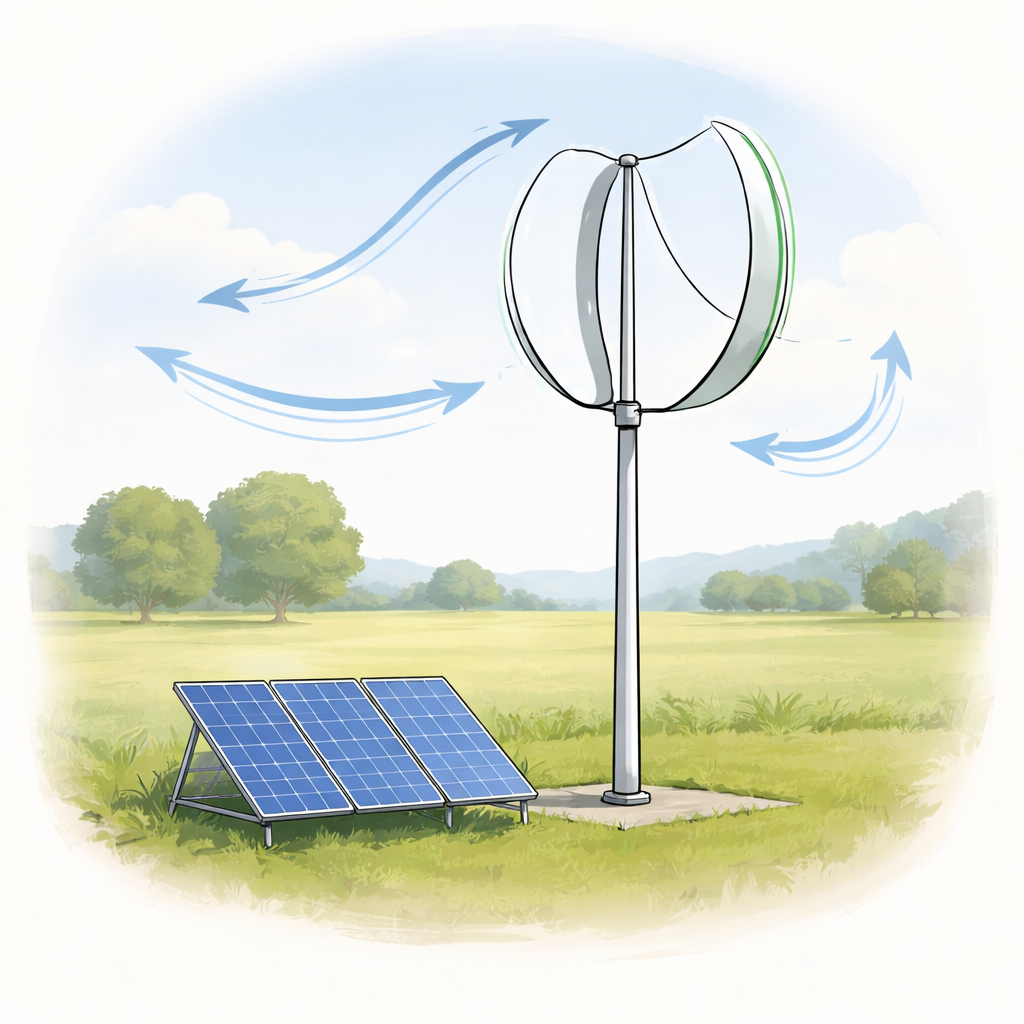
Unlike the familiar propeller-style turbines that face directly into the wind, vertical-axis turbines spin like a merry-go-round and can catch the breeze from any direction. This makes them attractive for crowded cities, small farms, and hybrid solar–wind systems where the wind often shifts. Their weakness, however, is poor self-starting: in low or gusty winds, they can sit motionless unless something gives them an initial push. The study focuses on a widely used blade shape, called NACA 0015, and asks how simple tweaks to its trailing edge can improve the turbine’s ability to start on its own and keep producing power efficiently over a wide range of wind speeds.
Small Hinges and Tabs with Big Effects
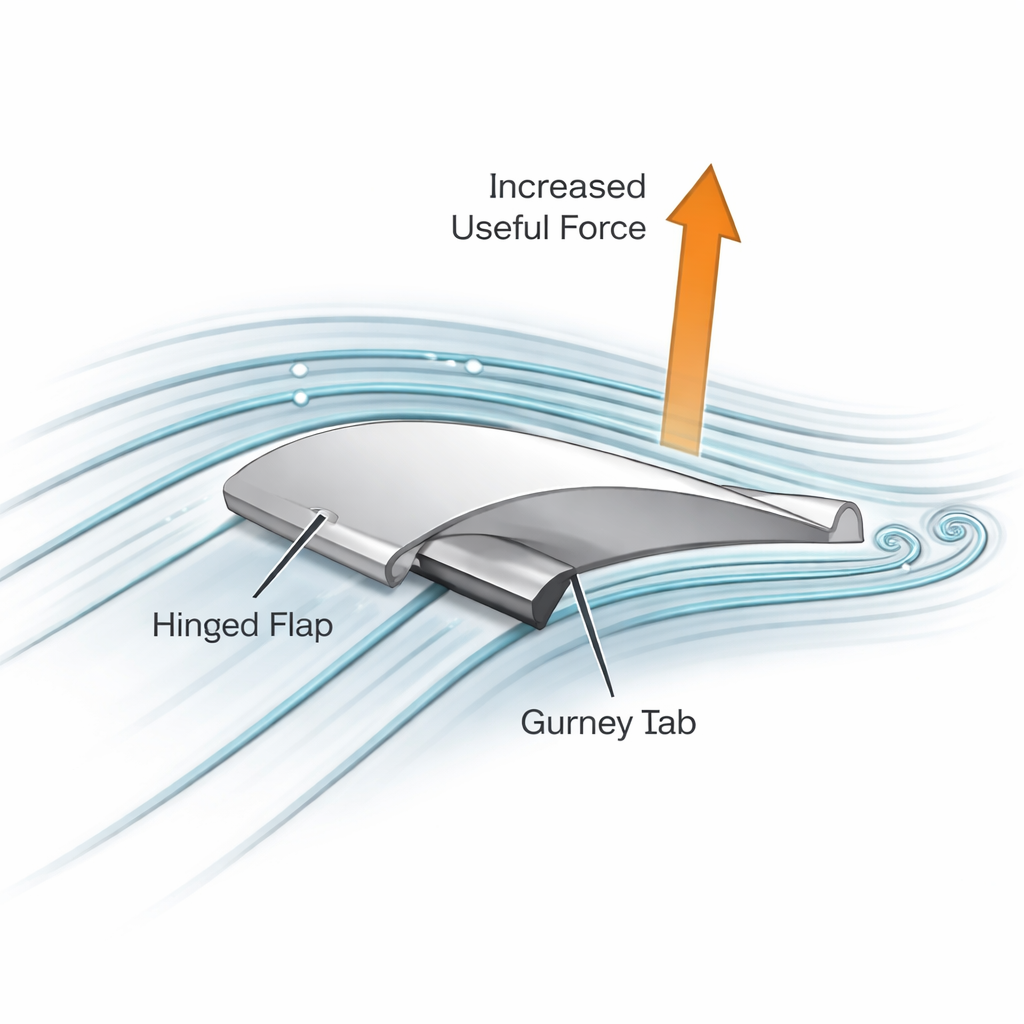
The researchers tested three types of trailing-edge add-ons: a plain flap (a small hinged extension), a Gurney flap (a tiny fixed tab at the back of the blade), and a hybrid that combines both. Using advanced computer simulations of air flowing around the turbine, and then building a one‑meter prototype, they examined how these devices change torque (the twisting force that turns the shaft) and power output. By trying different flap positions and angles, and different tab sizes and orientations, they searched for a layout that would work reliably in both gentle and stronger winds, all without moving parts or electronic controls.
The Winning Design for Everyday Use
Among all the options, the standout was a plain flap placed halfway along the blade’s chord (essentially mid-depth) and tilted by 10 degrees. This modest bend makes the blade behave as if it were more curved, pulling harder on the passing air and delaying the point where the flow breaks away and stalls. At very low tip-speed ratios—conditions typical of start-up in light winds—this configuration increased the average twisting force by roughly 30–40 percent and the power output by about 40 percent compared with an unmodified blade. Crucially, it did this while keeping drag, the unwanted resistance that slows rotation, under control even when the turbine spun faster.
When Extra Complexity Stops Helping
The hybrid flap–tab design produced some eye-catching numbers at first glance: at certain low-speed operating points it pushed efficiency gains slightly higher than the plain flap alone. But those gains came with a cost. At higher rotational speeds, the extra tab generated stronger swirling wakes behind the blade, increasing drag and cutting into performance. The simulations showed that beyond a moderate speed range, the hybrid design’s efficiency fell off, sometimes underperforming even the simpler baseline blade. In contrast, the mid‑chord plain flap kept delivering stable, predictable improvements across nearly the entire operating range tested.
From Computer to Field Test
To see whether the simulated gains would show up in real air, the team 3D‑printed blades with and without the optimized flap and mounted them on a small vertical-axis turbine. Outdoor tests in natural wind showed that, at a wind speed of 5.5 meters per second, the flap-equipped turbine spun about 51 percent faster than the unmodified version. While these experiments were designed to check trends rather than measure absolute power, the consistent increase in rotation speed strongly supports the simulation results and suggests that the design is ready for practical use in small, off‑grid systems.
What This Means for Everyday Energy Users
For readers outside aerodynamics, the key message is straightforward: by adding a small, fixed bend to the back edge of each blade, the authors have found a low-cost way to help vertical-axis turbines start by themselves and make better use of gentle, shifting winds. The recommended design—a flap halfway along the blade, tilted by 10 degrees—offers a good balance of stronger start-up, higher efficiency, and ease of manufacturing. More intricate flap-and-tab combinations can help in very specific conditions, but the simple flap stands out as the most robust and practical choice for small rural turbines and hybrid solar–wind installations that must work reliably without constant attention.
Citation: Eltayeb, W., Somlal, J., SirElkhatim, M. et al. Enhancing start-up and torque in Darrieus VAWTs through a novel plain gurney flap design. Sci Rep 16, 7136 (2026). https://doi.org/10.1038/s41598-026-38485-9
Keywords: vertical axis wind turbine, self-starting wind turbine, trailing edge flap, rural wind energy, small-scale wind power