Clear Sky Science · en
Genetic variation analysis and comprehensive evaluation of multiple traits among Larix olgensis families
Why better trees matter to everyday life
From power poles and railroad ties to bridges and houses, strong and fast-growing timber underpins modern infrastructure. In northeastern China, one of the workhorse species is Larix olgensis, a larch valued for its straight trunk, decay‑resistant wood, and ability to thrive in harsh climates. This study explores how scientists can choose and breed the best family lines of this tree by looking at many characteristics at once—such as growth, wood quality, and leaf function—so forests can produce more and better timber while still supporting healthy ecosystems.
Measuring forests like living laboratories
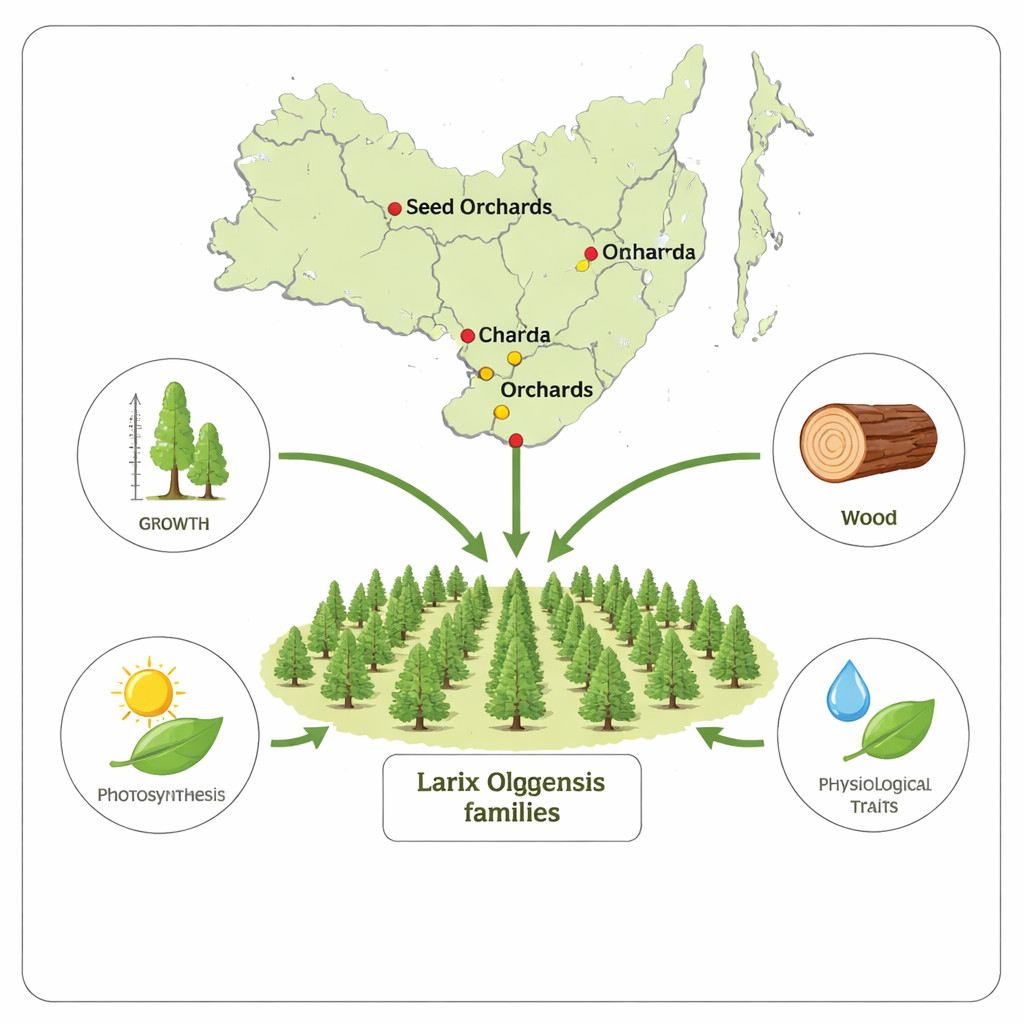
Researchers followed 40 “half‑sib families” of L. olgensis, meaning groups of trees that share the same mother but may have different fathers. Seeds came from four seed orchards across Heilongjiang Province, then were planted together in a single test forest and grown for about ten years. The team measured 21 traits. These included basic growth (height, trunk thickness, and volume), tree shape (crown width, straightness, branch angles, and branch thickness), wood properties (density and main chemical components), and leaf‑level processes related to photosynthesis and basic physiology. By treating the plantation as a controlled experiment, they could tease apart how much of the observed variation was genetic rather than just due to local conditions.
Finding which traits truly run in the family
Using standard statistical tools, the scientists tested whether families really differed from each other and calculated “heritability”—a measure of how strongly genes, rather than the environment, control a trait. Sixteen of the 21 traits showed clear differences among families, and most growth, shape, and wood traits had moderate to high heritability. For example, crown width had especially strong genetic control, and all growth traits (height, trunk diameter, and volume) were highly heritable. In contrast, traits like leaf chlorophyll content and soluble proteins, which respond quickly to the environment, were less tightly governed by genetics. This pattern suggests that breeding programs will get the biggest long‑term payoff by focusing on growth, form, and wood features.
Balancing fast growth with solid wood
The families varied widely: some were much taller and thicker than average, while others produced denser or more chemically robust wood. When the researchers examined how traits moved together, they found that growth traits and form traits were strongly and positively linked—a tree that grows fast also tends to have a broader crown and better form. Wood traits, however, often showed negative links with growth and form. In particular, some components of the wood cell wall were higher in families that grew more slowly or had smaller crowns. This points to a trade‑off: pushing growth too hard can slightly weaken wood characteristics, while emphasizing wood quality alone could sacrifice yield. The analysis also showed that leaf‑level photosynthesis traits connected logically to growth and water use, helping explain why certain families outperform others.
Choosing winners with many traits at once
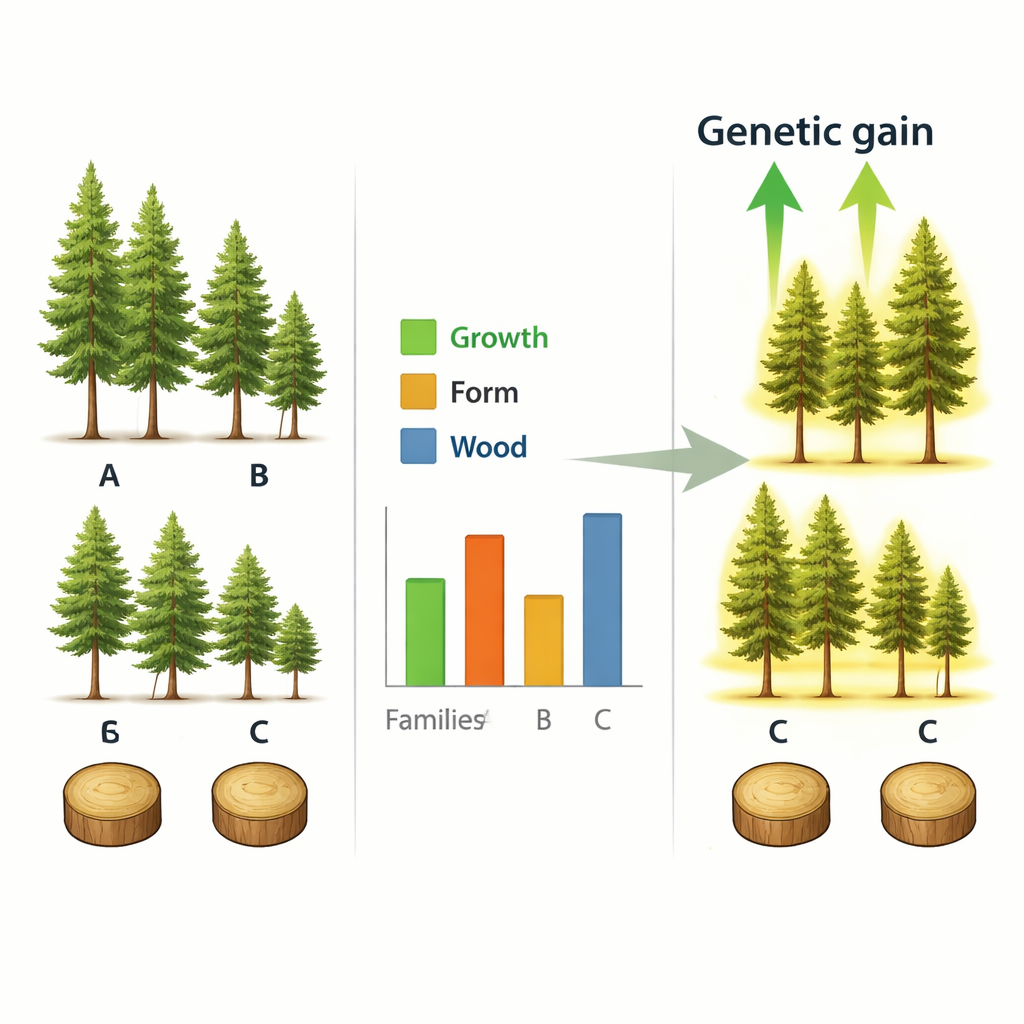
Rather than picking families based on a single trait, the team compared four multi‑trait selection methods. These techniques compress many measurements into combined scores or predicted “breeding values” that estimate how good a family’s offspring will be. All methods agreed on several standout families, and all suggested that substantial improvements are possible. One approach—estimating breeding value using a statistical method called BLUP—stood out because it gave positive gains across growth, form, and wood traits at the same time and better filtered out environmental noise. Using this method and a selection intensity of 20 percent, the researchers chose eight superior families. Across these, average gains included about 6 percent taller trees, 8 percent thicker trunks, more than 20 percent higher volume, and roughly 11 percent thicker branches, while wood density and key chemical components also improved slightly.
What this means for future forests
For non‑specialists, the main message is that careful measurement and smart statistics allow foresters to “design” better forests without genetic engineering. By tracking family lines of Larix olgensis and weighing multiple traits together, breeders can identify tree families that grow quickly, stand straight, and still produce solid, durable wood. The eight superior families identified in this study are now prime candidates for planting in Heilongjiang and similar regions, helping to deliver more timber from the same land area while maintaining wood quality. Over time, combining this multi‑trait breeding with modern DNA tools could further shorten breeding cycles and support more sustainable, productive forests.
Citation: Wang, J., Xing, X., Yan, P. et al. Genetic variation analysis and comprehensive evaluation of multiple traits among Larix olgensis families. Sci Rep 16, 7791 (2026). https://doi.org/10.1038/s41598-026-38477-9
Keywords: Larix olgensis, forest tree breeding, genetic variation, wood quality, multi-trait selection