Clear Sky Science · en
Retrieval-augmented patch generation for geosynchronous satellite status forecasting
Why Watching Quiet Satellites Matters
Thousands of satellites circle Earth, quietly relaying TV, internet, and weather data. Many sit in geosynchronous orbit, 36,000 kilometers up, appearing almost motionless in the sky. Yet even these “stationary” machines fire small thrusters, change modes, or perform close approaches to other spacecraft. Being able to predict what they will do next is vital for avoiding collisions, understanding unusual behavior, and maintaining space security. This study introduces a new way to forecast the future status and possible intent of geosynchronous satellites from observation data, making sense of complex motion patterns that often look noisy and irregular to traditional methods.
From Messy Signals to Meaningful Patterns
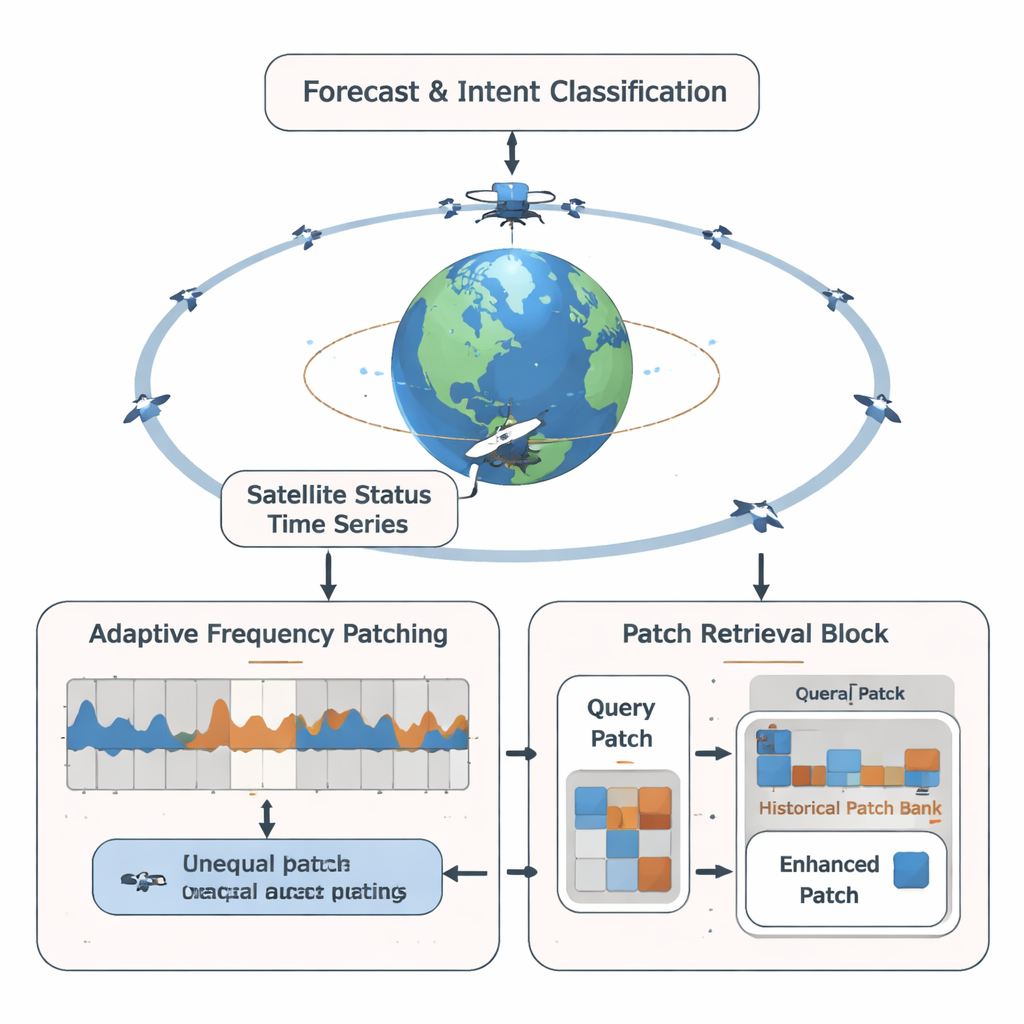
High‑orbit satellites are tracked from the ground by telescopes and other remote‑sensing instruments. These sensors record long streams of numbers describing where a satellite is, how fast it is moving, and how it is oriented in space. In theory, such time‑stamped records should allow us to forecast a satellite’s future path and detect unusual maneuvers. In practice, the data are messy. Short thruster burns, micro‑adjustments, and gaps in measurement break up smooth or repeating patterns. Many standard forecasting tools expect regular, nearly repeating behavior, so they struggle when the motion changes abruptly or slowly drifts over weeks and months. The authors argue that a successful system must cope with both steady, predictable motion and rare but important surprises.
Breaking Time into Smarter Pieces
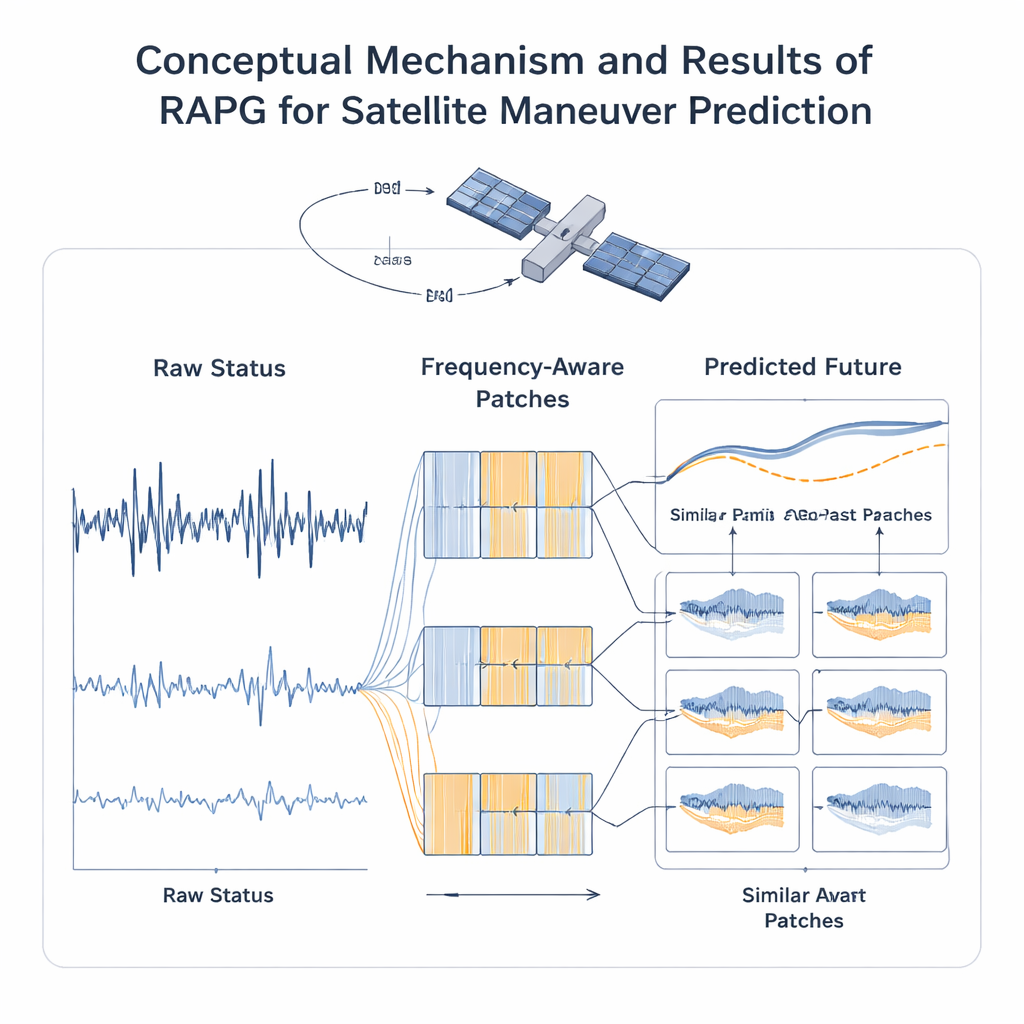
To tackle this, the researchers propose RAPG, short for Retrieval‑Augmented Patch Generation. The first key idea is to stop treating the data as one long, uniform sequence. Instead, RAPG examines the signal in the frequency domain—essentially looking at how often certain wiggles and cycles occur—and then cuts the timeline into “patches” whose lengths match the dominant rhythms it finds. Stable periods are grouped into longer patches, while more rapidly changing segments are sliced more finely. Each patch is turned into a compact numerical token and fed to a Transformer‑style neural network, an architecture well suited to capturing relationships across long time spans. This adaptive patching lets the model zoom in on sudden maneuvers without losing the broader orbital trends that unfold more slowly.
Learning from the Past to Explain the Future
The second idea is to give the model an explicit memory of what has happened before. For every patch of satellite behavior in the training data, the researchers store a pair: a “key” patch describing a slice of recent history and a “value” patch showing what happened next. When RAPG encounters a new patch during forecasting, it searches this library for the most similar past cases. It then blends the outcomes of these look‑alike histories to form a retrieval‑augmented hint about the future. This hint is combined with the model’s own prediction, and the system is trained to keep not just individual points accurate, but also the overall shape, variability, and average level of each patch. In effect, the model is encouraged to mimic the way an experienced operator would say, “I’ve seen this kind of motion before—here is what usually comes next.”
Putting the Method to the Test
To see how well RAPG works, the authors evaluated it on three datasets: a large set of simulated satellite maneuvers, a real‑world collection of mode changes from active geosynchronous satellites, and a synthetic dataset representing close‑approach operations between spacecraft. Across all three, RAPG produced more accurate forecasts than nine state‑of‑the‑art competitors, including popular recurrent networks, convolutional models, and modern Transformer designs. On the real satellite dataset, its prediction error dropped to a fraction of that of the next‑best method. In the close‑approach scenario, RAPG not only forecasted future motion with very low error but also correctly classified the satellite’s intent—such as approach, retreat, or inspection—achieving an F1‑score above 0.94. Tests that removed either the adaptive patching or the retrieval memory showed clear performance losses, underscoring that both components are crucial.
What This Means for Space Safety
For non‑experts, the main message is that RAPG offers a more reliable way to read and anticipate the “body language” of satellites in high orbit. By cutting observation streams into smarter chunks and comparing current behavior with a rich archive of past examples, the method can forecast where a satellite is headed and what it is likely trying to do, even when the data are noisy and the motion is not strictly regular. This capability can strengthen space‑traffic management, help detect unusual or risky maneuvers earlier, and support long‑term monitoring of crowded geosynchronous highways. As satellites grow more numerous and their interactions more complex, tools like RAPG could become essential for keeping our shared orbital environment safe and transparent.
Citation: Tian, SH., Fang, YQ. & Zhang, YS. Retrieval-augmented patch generation for geosynchronous satellite status forecasting. Sci Rep 16, 6916 (2026). https://doi.org/10.1038/s41598-026-38475-x
Keywords: geosynchronous satellites, space situational awareness, time series forecasting, satellite maneuver detection, machine learning in space