Clear Sky Science · en
Life cycle assessment of electric and gasoline vehicles considering grid differences and cold climate in China
Why this matters for everyday drivers
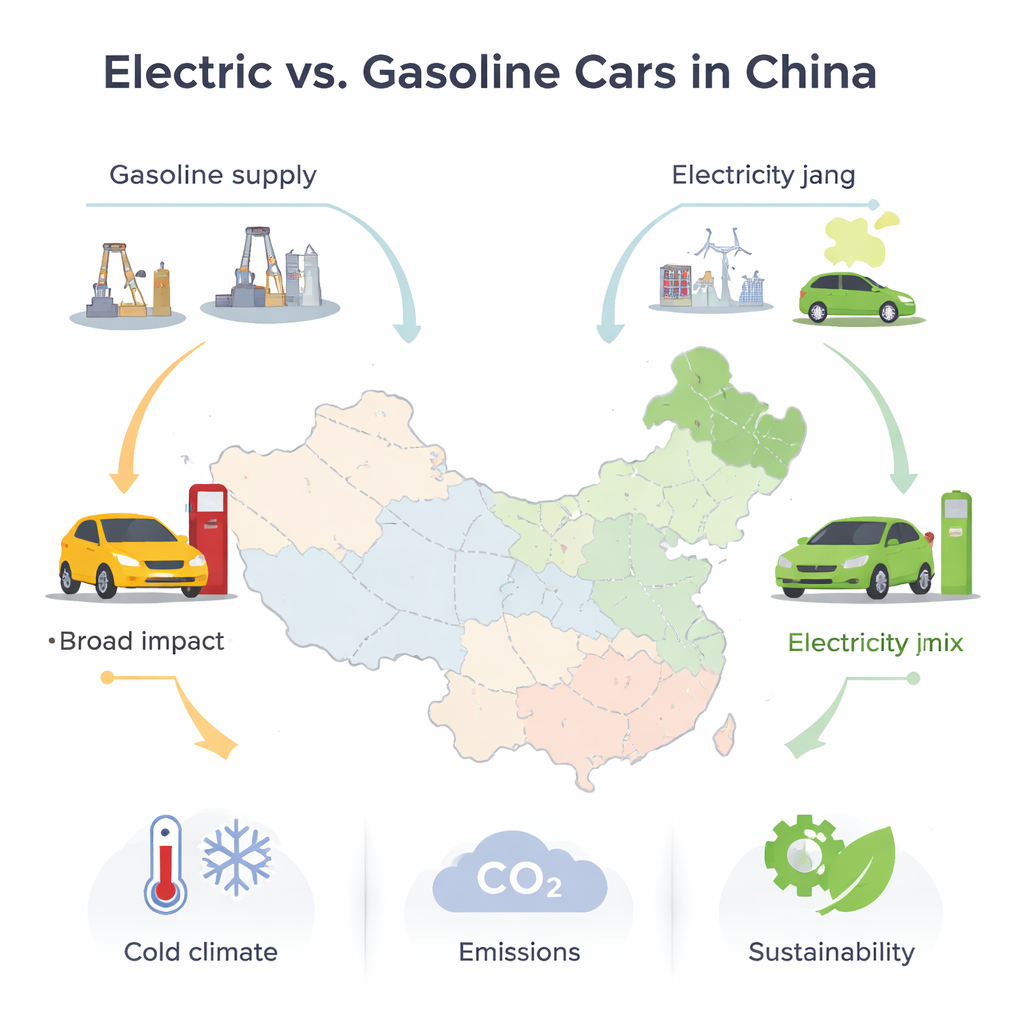
As more people consider switching from gasoline cars to electric models, a simple question arises: do electric vehicles always help the climate? This study looks closely at that question in China, where electricity often comes from coal and winters in the far northeast are brutally cold. By tracking pollution over the full "use phase" of cars—while they are being driven and refueled or recharged—the researchers show when battery electric vehicles truly cut emissions, and when dirty power grids and freezing weather eat into those gains.
Looking at cars from plug or pump to tailpipe
The researchers use a method called life cycle assessment, which, in plain terms, adds up all the energy use and pollution linked to using a car over many years. Instead of stopping at the exhaust pipe, they include what happens at the power plant for electric cars and at the refinery for gasoline cars. They compare two popular models with similar prices in China: the BYD Dolphin (electric) and the Volkswagen Lavida (gasoline). For both, they assume 20,000 kilometers of driving each year over 15 years, a typical pattern for private cars in the region they study.
Electric vs. gasoline in a coal-heavy region
The focal point is Heilongjiang, a province in Northeast China with very cold winters and an electricity grid dominated by coal. In this tough setting, electric cars still come out ahead on climate pollution, but not by as much as many might expect. Over a year of driving, the electric car emits about 25 percent less greenhouse gases than the gasoline car. It also causes much lower strain on oil and gas resources, translating into roughly 90 percent lower future resource depletion costs. However, because much of the electricity still comes from big power projects—including hydro with pumped storage—the electric car triggers about 2.6 times more "land transformation" impacts, meaning more land changes connected to energy production.
How cold weather and seasons change the picture
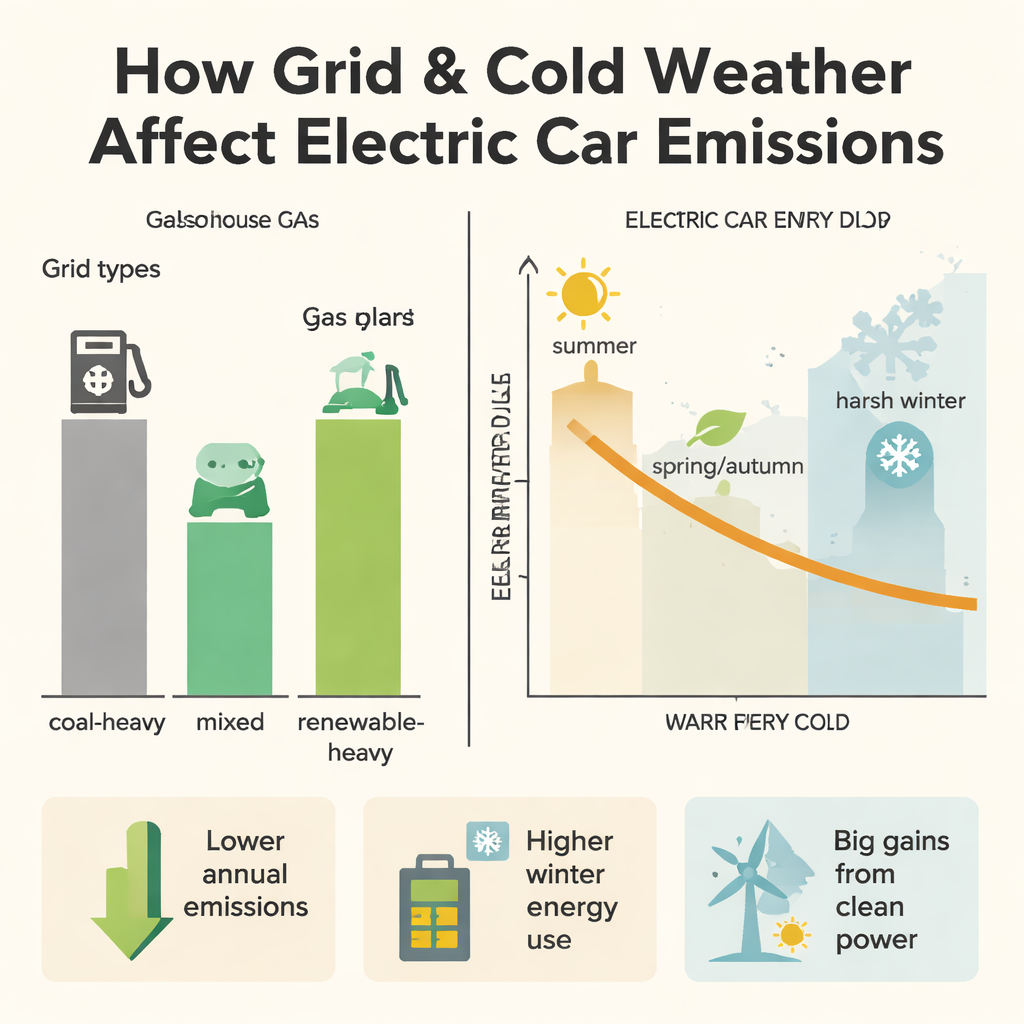
Freezing temperatures add another twist. In Heilongjiang, winter averages about −16 °C, which makes electric car batteries less efficient and increases electricity use for cabin heating. The study finds that in winter, charging efficiency can drop to around 59 percent, pushing the electric car’s seasonal emissions up by as much as 70 percent. In the coldest months, its greenhouse gas emissions can even temporarily exceed those of the gasoline car. When the researchers add up all four seasons, though, the electric car still offers an annual climate advantage—about 14 percent lower fossil-based emissions than the gasoline car in this harsh region. Spring and autumn sit in the middle, while summer, with mild temperatures, is where electric cars perform best.
Different power grids, different outcomes
China does not have a single, uniform power system. Instead, it has six major regional grids, some with more coal, others with more water, wind, or nuclear power. The team runs scenarios across all six grids and discovers a consistent pattern: electric cars beat gasoline cars everywhere, but the size of the benefit depends heavily on how clean the electricity is. In the Southwest Grid, where renewable and low-carbon power are more common, the electric car’s advantages for human health, ecosystems, and resources are strongest. In the Northeast Grid, where coal dominates, the gains are smaller, and some impact categories—like land change—are worse for the electric option. This shows that simply counting electric cars is not enough; what fuels the grid matters just as much.
What happens if the grid gets cleaner?
To explore the future, the researchers test what would happen if coal in the Northeast Grid were gradually replaced by cleaner sources such as wind, solar, natural gas, and nuclear power. Their sensitivity and uncertainty analyses show that increasing clean electricity cuts health-related damage by about 15 percent and slashes resource depletion costs by more than 90 percent for electric cars. In other words, as the grid decarbonizes, electric vehicles become steadily more attractive—not only for the climate but also for long-term resource use and public health. For gasoline cars, only big improvements in fuel efficiency bring similar gains, and even then they remain more polluting overall.
What this means for drivers and policymakers
For everyday drivers, the core message is that electric cars are generally better for the climate than gasoline cars, even in places with coal-heavy power and freezing winters. However, their edge is slimmer in such regions and can temporarily disappear in the coldest months. The study concludes that to achieve truly "zero-emission" driving, promoting electric vehicles must go hand-in-hand with cleaning up the power grid and improving battery performance in low temperatures. Policies that expand wind, solar, nuclear, and other low-carbon sources, along with technologies that keep electric batteries efficient in winter, are crucial if electric cars are to deliver on their promise of cleaner, more sustainable transport.
Citation: Ma, S., He, Z., Sharaai, A.H. et al. Life cycle assessment of electric and gasoline vehicles considering grid differences and cold climate in China. Sci Rep 16, 7010 (2026). https://doi.org/10.1038/s41598-026-38471-1
Keywords: electric vehicles, greenhouse gas emissions, cold climate, power grid mix, life cycle assessment