Clear Sky Science · en
A case study assessing energy-exergy-economic (3E) performance in solar air heaters with different winglet geometries and air flow rates
Warming Buildings with Smarter Sun Collectors
Keeping homes and workplaces warm without burning fossil fuels is a growing priority around the world. One promising option is the solar air heater—a simple rooftop box that uses sunshine to warm air and blow it indoors. This study looks at how small tweaks to the metal plate inside these heaters can make them not only hotter, but also cheaper to run and better for the environment over their lifetime.
Why the Shape Inside the Box Matters
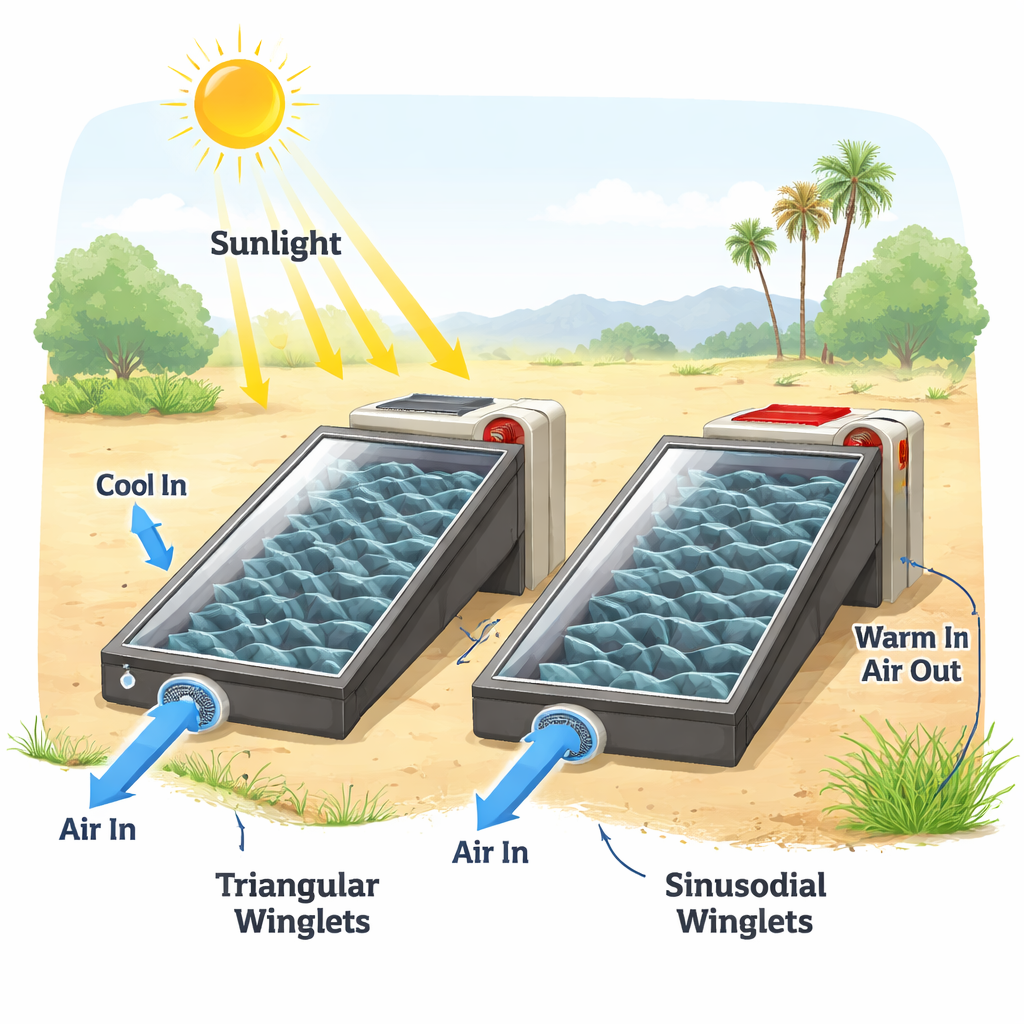
A solar air heater is basically a shallow, insulated box with a dark metal plate under a glass cover. Sunlight passes through the glass, heats the plate, and a fan pushes air across it to carry the heat away. The catch is that ordinary designs do not transfer heat very efficiently, so much of the captured warmth is lost before it can be used. To fix this, engineers roughen or “texture” the plate with small ribs, fins, or winglets that stir the air and improve heat pickup. The authors of this study focused on two such plate designs: one covered with many small inclined triangular winglets, and another using inclined sinusoidal (smooth wavy) winglets. Both were tested outdoors in South India under real weather conditions.
Testing Two Designs in Real Sunlight
The team built two full-scale heaters, identical except for the internal plate geometry, and mounted them side by side according to international testing standards. A blower pushed air through each unit at three different flow rates, representing gentle, moderate, and stronger ventilation. Over many clear days, the researchers carefully recorded sunlight levels, inlet and outlet air temperatures, plate and glass temperatures, and the pressure drop caused by air moving through the heaters. From these readings they calculated how much useful heat each design delivered, how much electrical power the fan consumed, and how much heat leaked out through the top glass. They also combined these measurements into an overall “thermo-hydraulic” score that balances heat output against the extra resistance to airflow created by the internal winglets.
Hotter Air, More Heat, and Less Waste
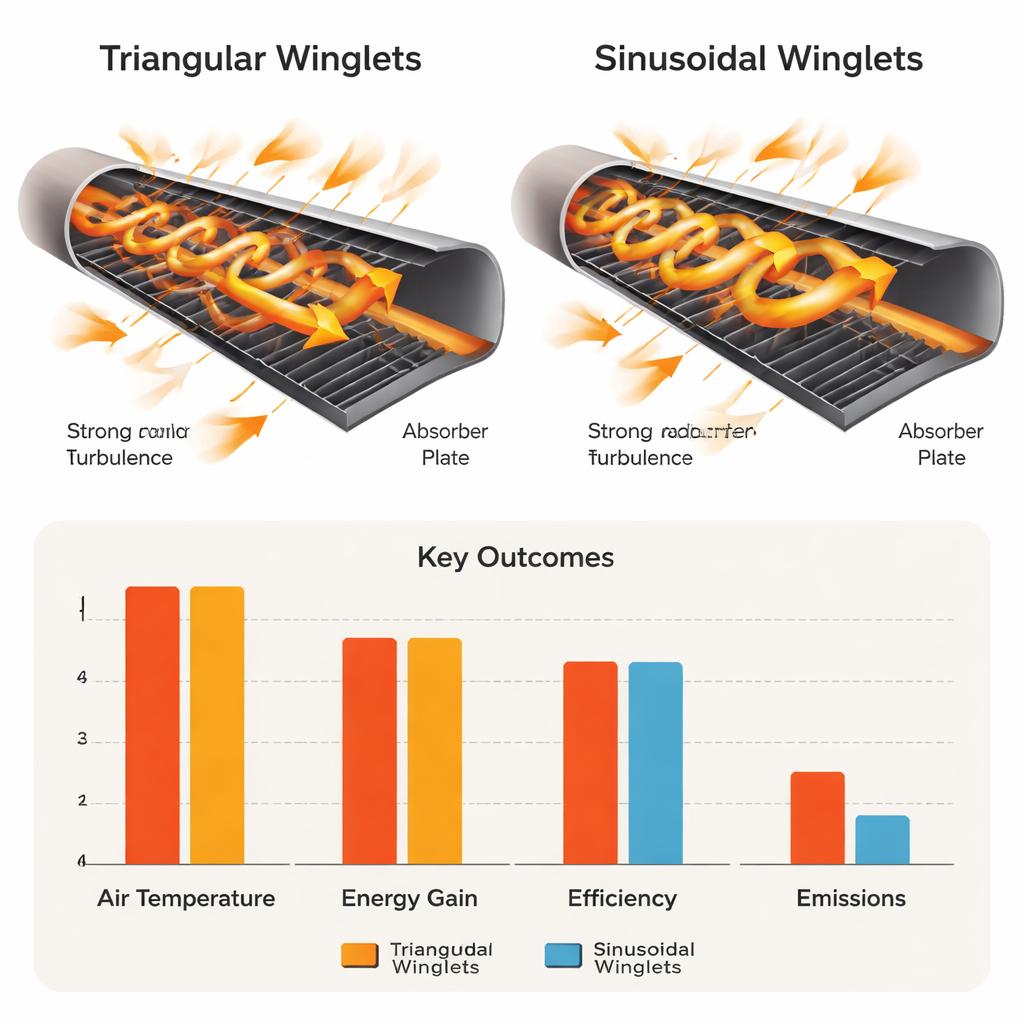
Across all operating conditions, the heater with inclined triangular winglets produced slightly hotter outlet air than the wavy-winglet design—up to about 83 °C at the lowest airflow. On average, its outlet air temperature was a few percent higher, and its heat transfer coefficient (a measure of how quickly heat jumps from metal to air) was about 12% better. As the airflow increased, both heaters delivered more total heat per hour, but the triangular design consistently pulled ahead, providing roughly 4–6% more useful power at each flow rate. It also lost less heat through the glass cover, by about 8–10%, because the internal turbulence helped sweep heat into the air rather than letting it leak back out. Crucially, when fan power was taken into account, the triangular-winglet heater showed a wider advantage in overall thermo-hydraulic efficiency, meaning it made better use of every watt of electricity used to move air.
Counting Cost and Climate Benefits
The researchers went beyond simple temperature and power measurements to ask: over its full life, which design pays off better financially and environmentally? Assuming a 20-year service life, typical interest rates, and realistic manufacturing and maintenance costs, they computed the energy payback time (how long it takes the heater to generate as much energy as was used to make it), the energy production factor (how much energy it yields over its life relative to that initial investment), and the life cycle conversion efficiency (how effectively it turns incoming sunlight into useful heat over decades). The triangular-winglet heater came out ahead on every count. It recovered its “embodied” energy in about 1.3 years instead of 1.6, produced more lifetime energy, and turned a higher fraction of the sun’s input into usable heat. Because it needs less backup power from conventional sources, it was also linked to slightly lower lifetime emissions of carbon dioxide, nitrogen oxides, and sulfur dioxide, while offering a lower annualized cost to the user.
What This Means for Everyday Use
For a non-specialist, the message is straightforward: small internal shapes you never see can make a noticeable difference in how well a solar air heater works. The triangular-winglet design tested here warms air a bit more, wastes less heat, and does so with lower fan effort than its wavy-winglet rival. Over the system’s lifetime, that translates into faster payback, lower running costs, and slightly cleaner air. While both designs represent an improvement over conventional flat plates, the study suggests that carefully engineered turbulence—created by simple metal “teeth” on the absorber plate—can help solar air heaters play a bigger, more economical role in comfortable, low-carbon buildings.
Citation: Rajendran, V., Aruldoss, W.J., Selvaraj, V.K. et al. A case study assessing energy-exergy-economic (3E) performance in solar air heaters with different winglet geometries and air flow rates. Sci Rep 16, 7658 (2026). https://doi.org/10.1038/s41598-026-38467-x
Keywords: solar air heater, renewable heating, building energy, energy efficiency, winglet design