Clear Sky Science · en
A hybrid temporal convolutional attention model for water filter remaining useful life prediction
Why the Life of a Water Filter Matters
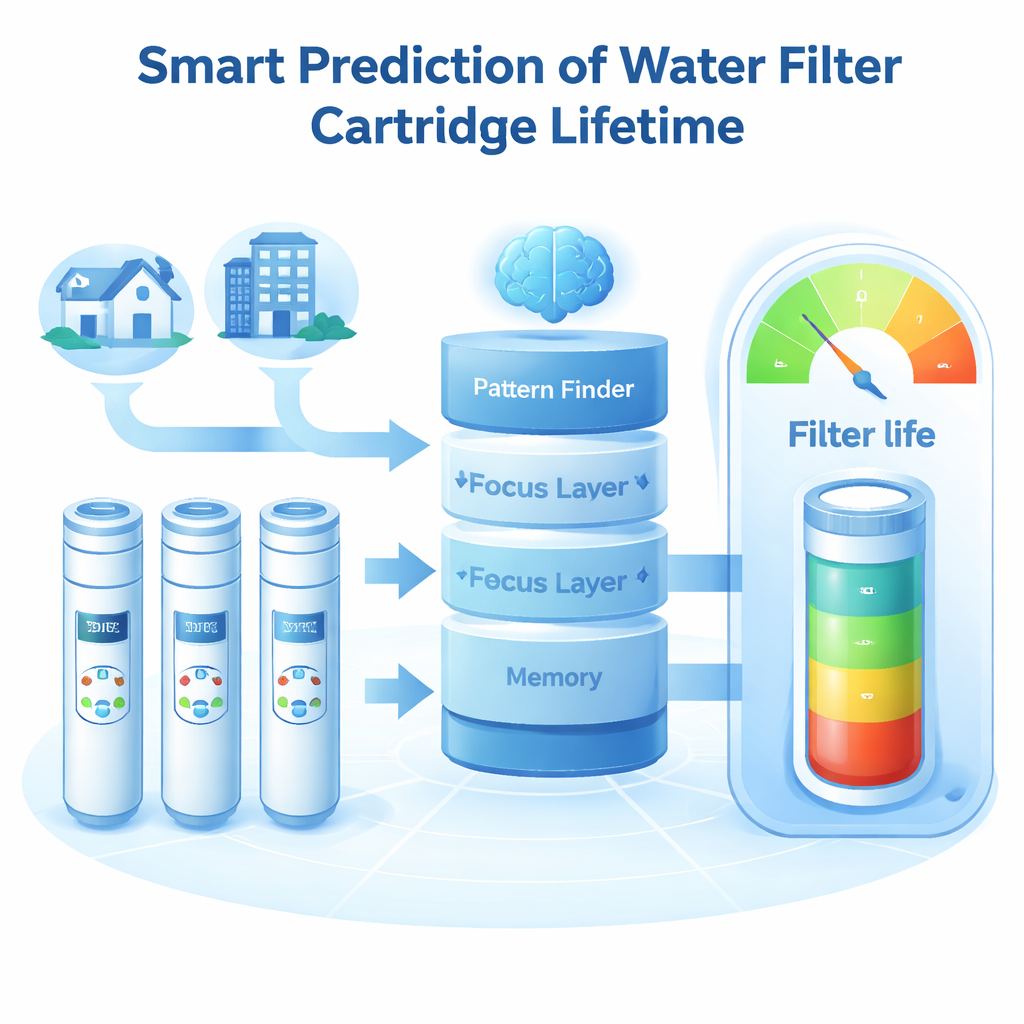
Every glass of clean water from a tap filter depends on a small cartridge packed with membranes and materials that quietly trap pollutants. If that cartridge is used for too long, it can no longer remove contaminants effectively; if it is replaced too early, money and materials are wasted. This study explores a new way to "listen" to the data coming from smart water purifiers and accurately predict how much useful life remains in each filter, without taking anything apart or running chemical tests.
From Dirty Water to Smart Data
Modern water filters face a tough job. They must deal with bacteria, heavy metals, organic pollutants, and varying amounts of dissolved solids that change from city to city and even from home to home. Traditional methods for estimating when a filter should be replaced rely on physical or chemical measurements and expert judgment, which can be slow, costly, and hard to adapt to new situations. The authors argue that connected water purifiers, already equipped with sensors and internet links, offer a better path: use the continuous stream of operational data to learn how filters age in the real world, across many locations and usage patterns.
Building a Real-World Filter Lifespan Library
To do this, the team assembled a large dataset of 9,837 complete filter lifecycles from smart water purification devices used between 2020 and 2023 in several Chinese cities, including Guangzhou, Chongqing, Shandong, Shaanxi, and Wuhan. Each device recorded daily values such as total dissolved solids (TDS, a measure of water quality), days in use, total purified water volume, membrane type and size, flow rate, inlet pressure, pH, heating time, and how often the system performed self-cleaning rinses. By examining correlations across these variables, the researchers found that the remaining life of a filter was most strongly linked to how many days it had been operating, how much water it had processed, and the level of dissolved solids in the source water; frequent rinse cycles, which signal wear and fouling, were strongly associated with shortened lifespan.
A Triple-Layer Digital Judge of Filter Health
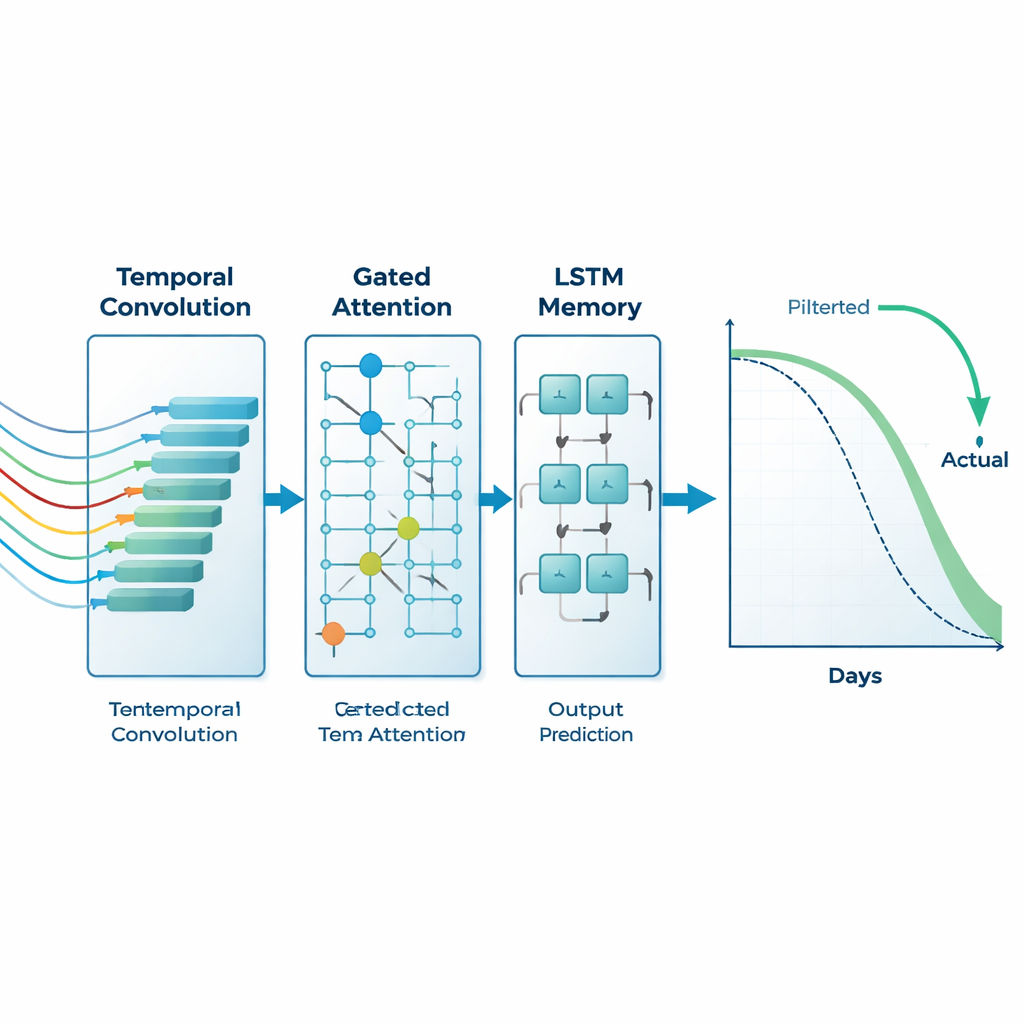
The heart of the study is a new predictive model called HTCA-LSTM, designed specifically for long, multi-sensor time series like those produced by smart filters. The model works in three stages. First, a temporal convolution module scans across the historical data, using a trick called "dilated" convolution to see both short-term and long-term patterns—like how bursts of heavy use or weeks of high-TDS water influence wear. Second, a gated attention layer acts as a spotlight, learning which time points carry the most information about impending failure and downplaying noisy or unimportant periods. Third, a long short-term memory (LSTM) module behaves like a digital notebook, updating its internal state over time to track how the filter’s condition evolves and to turn the refined features into a concrete remaining-life prediction.
Does This Smart Model Actually Work Better?
To test the model, the authors compared HTCA-LSTM with several advanced forecasting approaches that are widely used in other fields, such as energy demand and weather prediction. They evaluated performance on three prediction horizons—roughly short, medium, and long look-ahead steps—and measured how closely the model’s estimates matched reality. Across all horizons, HTCA-LSTM consistently produced lower prediction errors than competing methods, cutting average error by about 7–12 percent compared with strong baselines and outperforming more traditional transformer-style architectures by even larger margins. The model also proved stable in long-range forecasts and generalized well when tested on public datasets from power systems, building energy use, and weather stations, suggesting that the design is useful beyond water filters.
What This Means for Everyday Water Safety
For non-specialists, the key takeaway is simple: by combining three complementary data-driven techniques into one hybrid model, the researchers created a digital tool that can more reliably tell when a water filter is nearing the end of its useful life. Instead of relying on fixed calendar schedules, rough volume estimates, or intrusive lab tests, smart purifiers could use this approach to adapt replacement times to actual water quality and usage. That could mean safer drinking water, fewer unexpected failures, and more efficient use of filter materials in homes, schools, and businesses.
Citation: Chen, J., Yang, Y. & Su, L. A hybrid temporal convolutional attention model for water filter remaining useful life prediction. Sci Rep 16, 7289 (2026). https://doi.org/10.1038/s41598-026-38459-x
Keywords: water filtration, remaining useful life, time series forecasting, deep learning, predictive maintenance