Clear Sky Science · en
Determination of hydrocortisone and cortisone in artificial saliva by spray assisted fine droplet formation liquid phase microextraction coupled to LC–MS/MS
Why Spit Can Tell a Stress Story
Our bodies constantly release stress hormones that help us wake up in the morning, fight infections, and cope with daily challenges. Two closely related hormones, hydrocortisone (often called cortisol) and cortisone, carry much of this load. Doctors increasingly want to track both of them in saliva, because it is easy and painless to collect. This study introduces a highly sensitive way to measure very tiny amounts of these two hormones in saliva-like fluids, offering a glimpse of future stress tests that could be simpler and more reliable.
The Two Sides of a Stress Hormone
Hydrocortisone is the active “go” signal of the stress system, while cortisone is its quieter partner, formed when the body temporarily switches that signal off. Enzymes in different tissues constantly convert one into the other, fine-tuning blood pressure, blood sugar, immunity, and day–night rhythms. Because of this delicate balance, doctors often need not just the level of each hormone, but also their ratio. Shifts in this pair can help diagnose conditions like adrenal insufficiency, hormone overproduction, and inherited problems in hormone processing, as well as side effects of certain drugs.
Why Measuring These Hormones Is So Hard
Despite their importance, hydrocortisone and cortisone are surprisingly difficult to measure accurately, especially in saliva. Their natural levels in spit are extremely low—often just a few billionths of a gram per milliliter—and saliva is thick with proteins and other substances that can hide or distort the signal. Older blood and urine tests either lack precision or require complex preparation steps. Even advanced laboratory techniques can struggle because the two hormones look and behave so similarly that they easily overlap during analysis, blurring the critical ratio between them.
A Gentle Spray That Supercharges Detection
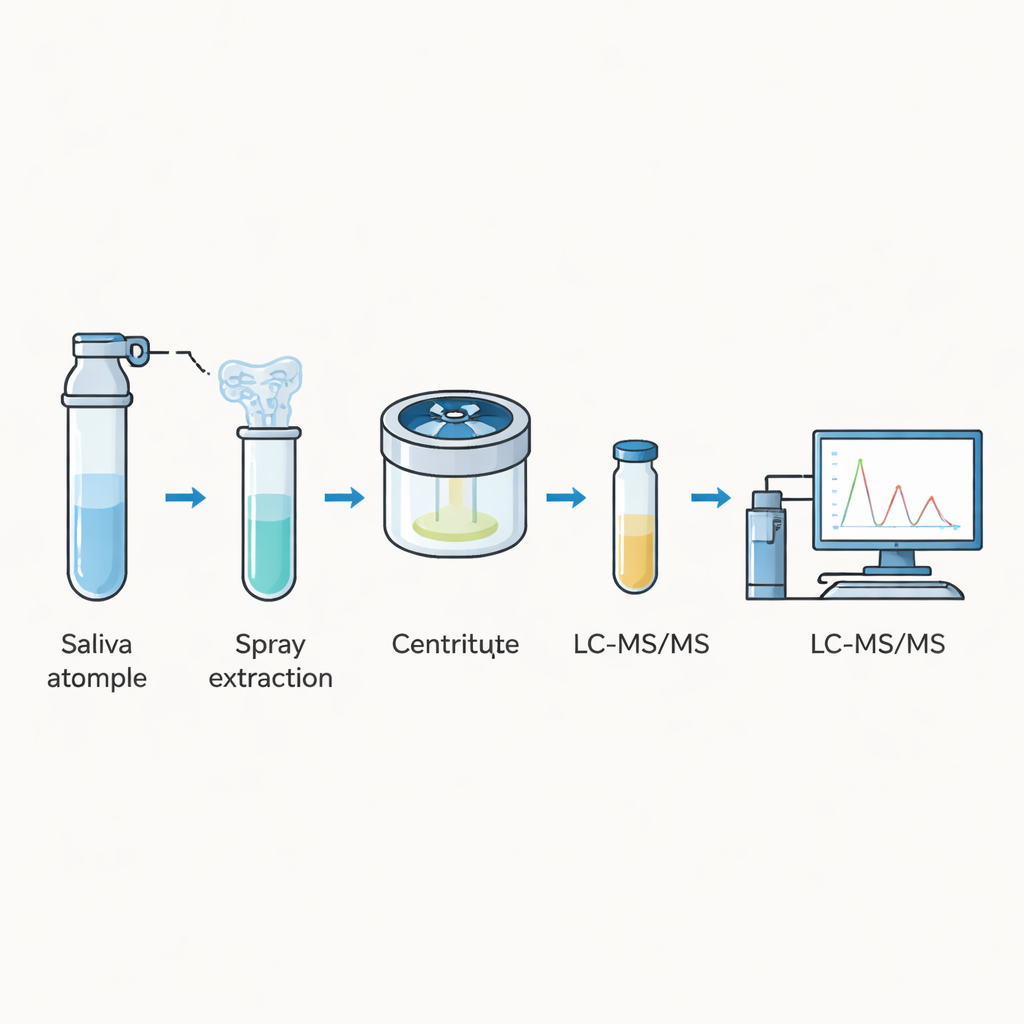
The researchers tackled this problem by combining a powerful measuring device, liquid chromatography–tandem mass spectrometry, with a clever sample-preparation step called spray-assisted fine droplet formation liquid-phase microextraction. In simple terms, they first create an artificial saliva that closely mimics real saliva, then add a small amount of organic solvent using a nasal-style sprayer. This sprayer turns the solvent into a mist of tiny droplets that briefly mix with the saliva, pulling the hormones into a separate liquid layer. After a short spin in a centrifuge and gentle evaporation, the concentrated hormones are redissolved in a tiny volume and injected into the measuring instrument.
Fine-Tuning for Clarity and Sensitivity
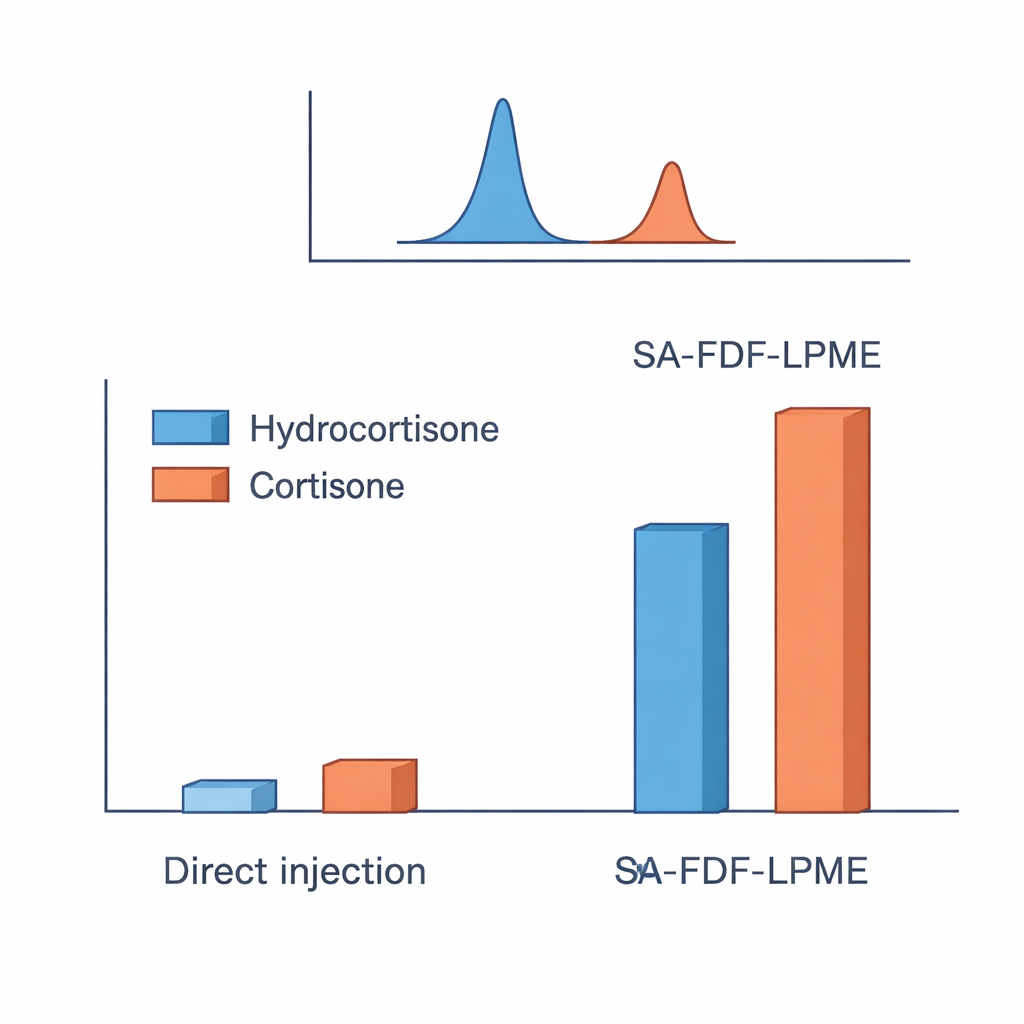
To make this workflow truly reliable, the team systematically adjusted many details: which solvent to spray, how much sample to use, how many spray bursts to apply, how long to mix, and how much solvent to use for the final re-dissolving step. They also optimized the instrument settings so that hydrocortisone and cortisone appear as clean, separate peaks with stable signals. Under the best conditions, the new method could detect levels far below those usually found in saliva—up to 64 times more sensitively for cortisone and 11 times for hydrocortisone compared with direct measurement without the spray step. Tests in two different artificial saliva recipes showed that, when calibration was properly matched to the saliva background, the measured amounts closely agreed with the true added amounts.
What This Means for Future Stress Testing
In everyday terms, this study delivers a highly tuned laboratory method that can “hear” the whisper-quiet signals of stress hormones in saliva-like fluids. While the current work used artificial saliva to avoid ethical and practical issues, the results suggest that the approach could be adapted to real human saliva in future clinical studies. If confirmed, such a method could help doctors monitor stress-related disorders, tailor hormone replacement therapies, and study how new drugs affect hormone balance—all from a simple saliva sample.
Citation: Gürsoy, S., Bodur, S., Atakol, A. et al. Determination of hydrocortisone and cortisone in artificial saliva by spray assisted fine droplet formation liquid phase microextraction coupled to LC–MS/MS. Sci Rep 16, 7064 (2026). https://doi.org/10.1038/s41598-026-38457-z
Keywords: salivary cortisol, cortisone, stress hormones, microextraction, mass spectrometry