Clear Sky Science · en
First abundance estimate for greater Caribbean manatees (Trichechus Manatus Manatus) in Belize
Why These Gentle Giants Matter
Along the warm, shallow shores of Belize lives one of the Caribbean’s most iconic yet elusive animals: the manatee. These slow‑moving, plant‑eating "sea cows" are favorites of snorkelers and boaters, but scientists have long struggled to answer a basic question: how many are left? This study delivers the first statistically grounded population estimates for greater Caribbean manatees in Belize—a country believed to be their last stronghold in the region—and explains how that knowledge can guide smarter protection in the face of tourism growth, boat traffic, and climate change.
Counting What You Can’t Always See
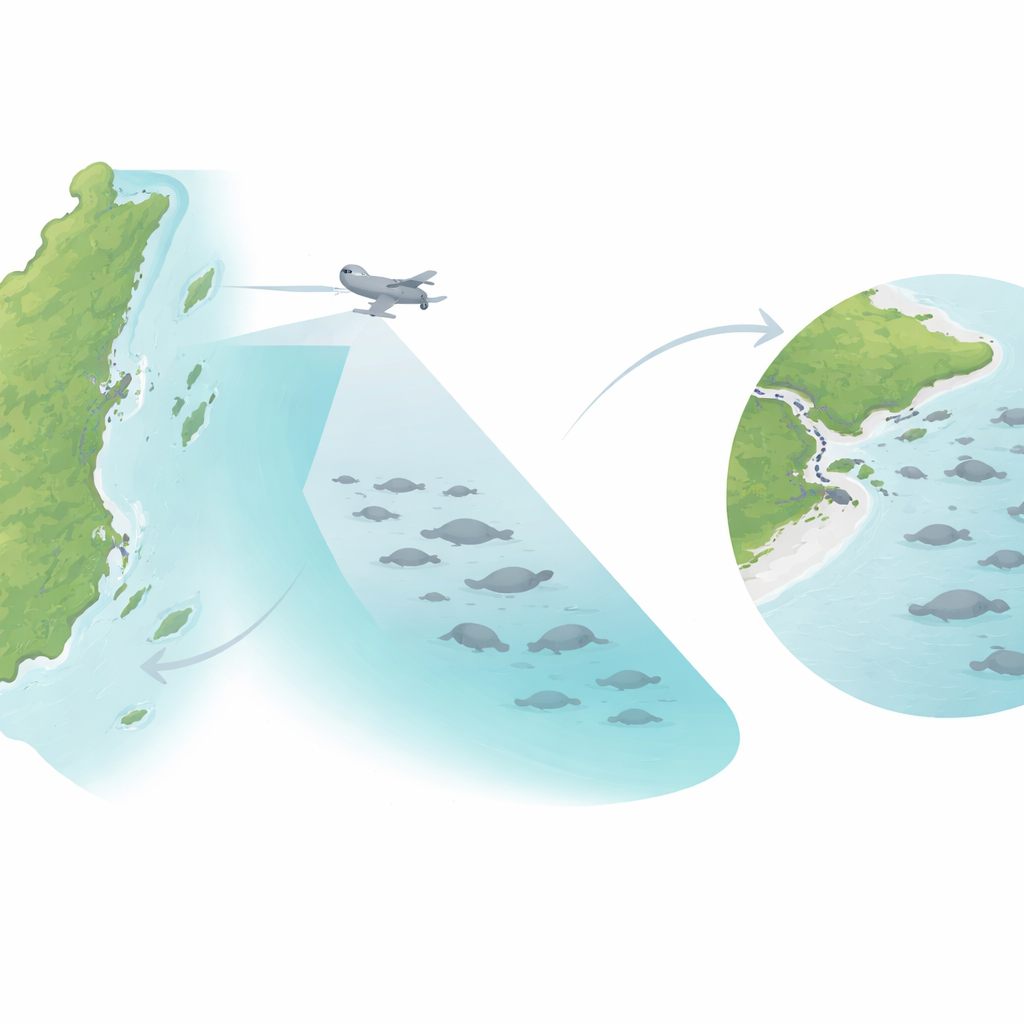
Manatees spend much of their time underwater, often in murky lagoons or rivers, which makes them hard to spot from the air. Past surveys in Belize and nearby countries typically relied on simple head counts from planes or boats. Those numbers gave a rough sense of where manatees were found, but they almost certainly missed many animals and did not measure how large the true population might be. This study set out to change that by combining aerial surveys with modern statistical tools that correct for animals hidden by water depth, poor visibility, or human error.
Taking to the Skies Over Belize
Researchers flew along most of the Belizean coastline in small aircraft during two survey periods, in 2014 and 2022. Observers looked out one side of the plane and recorded every manatee or group they saw within about half a kilometer. Two observers worked independently so the team could estimate how often a manatee that was visible at the surface was actually noticed. At the same time, they logged how clear the water was and how the flight path overlapped with features like rivers, seagrass beds, and water depth. These details later allowed the scientists to correct the raw counts and to understand which types of habitat manatees prefer.
Turning Patchy Sightings into a Clearer Picture
To account for the many manatees that likely went unseen, the team borrowed information from earlier work in Florida that tracked how long tagged manatees spend near the surface, and how easily a life‑sized model can be spotted from above in different water conditions. Combining this with the double‑observer data, they calculated the chance that a manatee in any given patch of water would both be at the surface and be detected. They then used a flexible mapping approach that links manatee counts in one‑kilometer squares to nearby habitat features such as distance from the coast, proximity to freshwater, seagrass cover, and water depth. This allowed them not only to estimate abundance along the flight path, but also to show how numbers rise and fall across the coastline.
How Many Manatees and Where They Gather
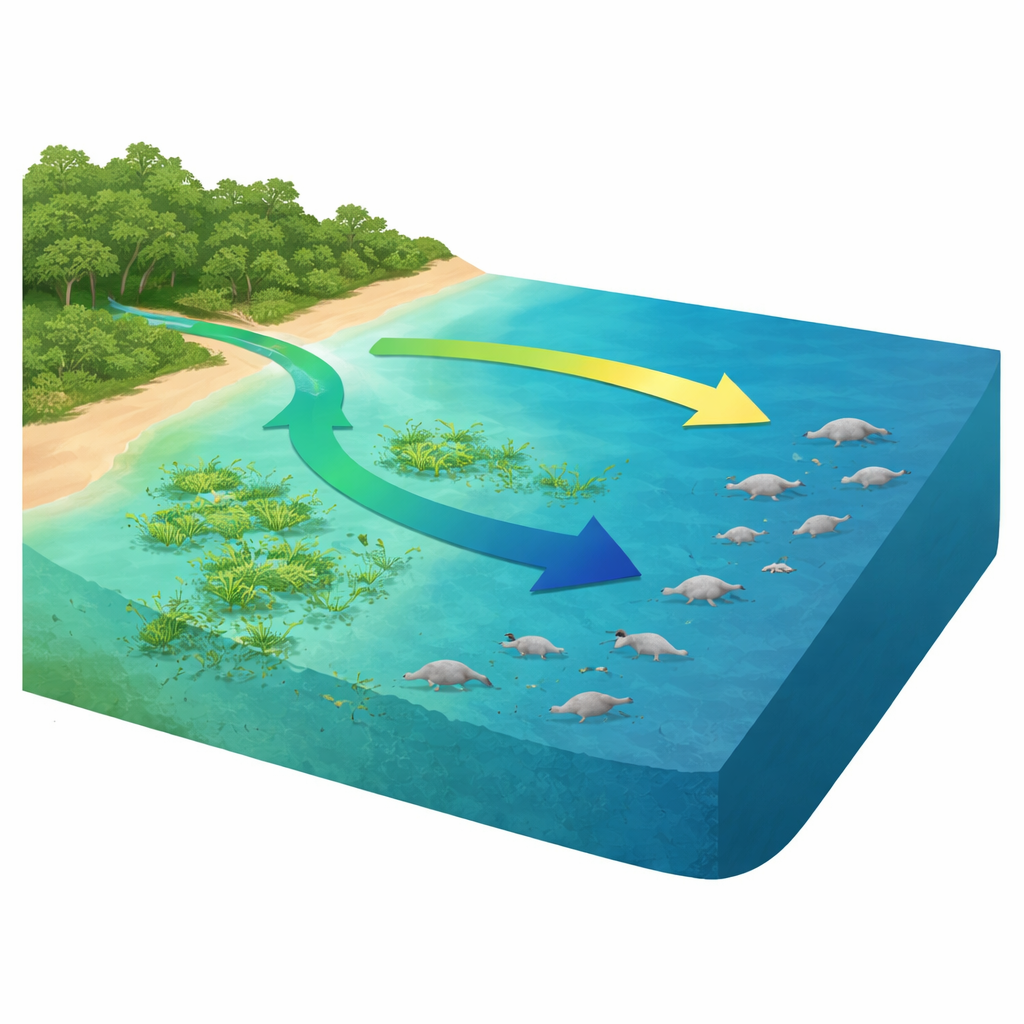
After correcting for missed animals and environmental differences, the researchers estimated that within 500 meters of the flight tracks there were about 479 manatees in 2014 and 555 in 2022, with fairly wide but overlapping uncertainty ranges around each estimate. In other words, there is no strong sign of a major increase or decline over that period. Manatees were most numerous near the coast, in shallow water, and closer to freshwater sources such as rivers and lagoons, especially in areas with moderate seagrass coverage. When the model was cautiously extended to all suitable waters in Belize, it suggested there might be roughly two thousand manatees in the wider region, although the authors stress this broader figure is likely on the high side because surveys focused mainly on prime habitat.
What This Means for Protecting Manatees
For policymakers and local communities, these findings provide a long‑needed baseline: Belize still appears to hold a sizeable, but vulnerable, manatee population that has not obviously crashed in recent years. At the same time, the study highlights growing threats from boat collisions, tourism, and changing coastal conditions. By pinpointing where manatees are most likely to gather—near shallow coastal waters, seagrass, and freshwater inlets—managers can better place protected areas, design safe boating zones, and plan development that minimizes harm. In essence, this work turns scattered sightings into a reliable head count, giving Belize and its neighbors a clearer starting point for keeping these gentle giants in Caribbean waters for generations to come.
Citation: Edwards, H.H., Moore, J.F., Gomez, N.A. et al. First abundance estimate for greater Caribbean manatees (Trichechus Manatus Manatus) in Belize. Sci Rep 16, 8860 (2026). https://doi.org/10.1038/s41598-026-38453-3
Keywords: manatees, Belize, aerial wildlife surveys, marine conservation, Caribbean coast