Clear Sky Science · en
Ecological water replenishment effects on groundwater recovery in the largest shallow groundwater depression cone of the North China Plain
Why refilling hidden water matters
Across much of the world, underground water reserves that support cities and farms are being pumped faster than nature can replace them. The North China Plain is one of the most extreme examples: decades of heavy irrigation have lowered groundwater levels by tens of meters, threatening crops, rivers, and even the stability of the land. This study explores whether deliberately sending water back into dry riverbeds—a practice called ecological water replenishment—can help refill these hidden reserves beneath Shijiazhuang, home to the region’s largest groundwater “bowl” of depletion.
A thirsty plain under pressure
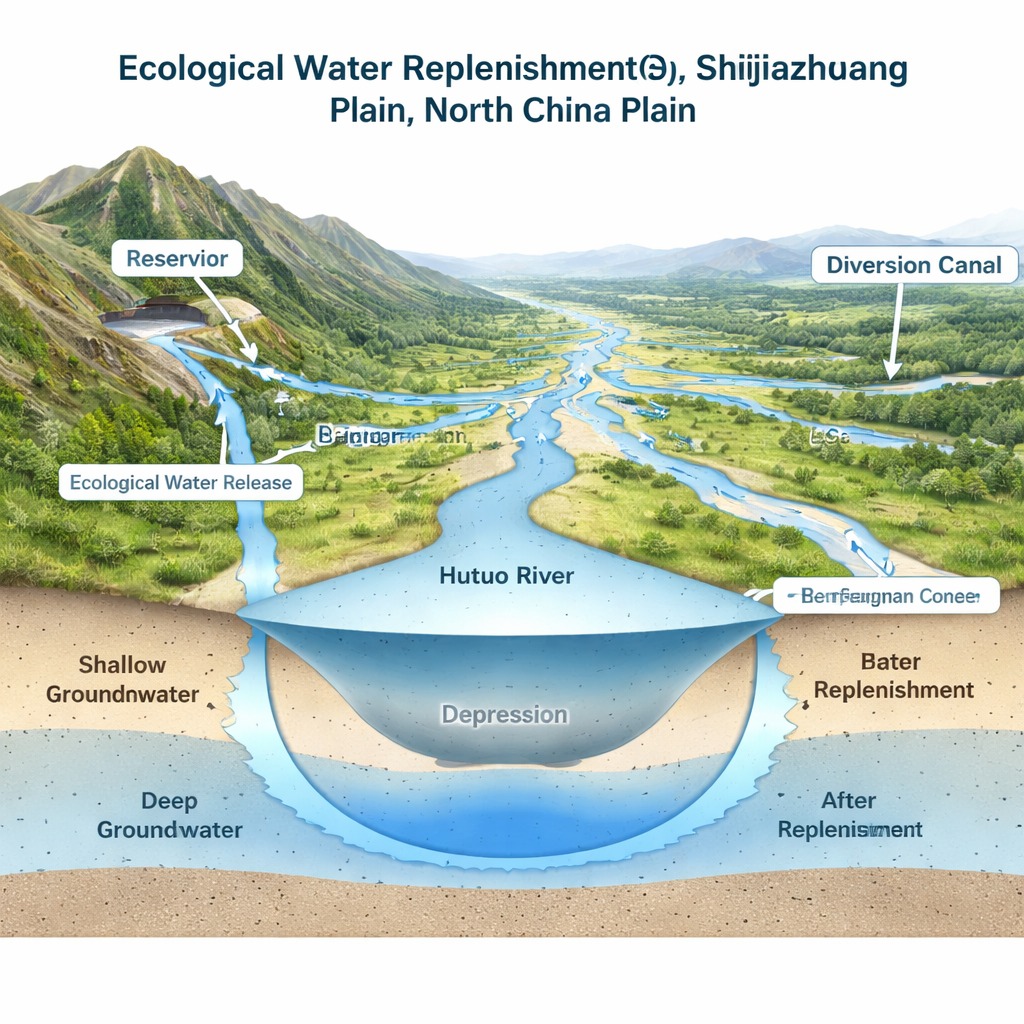
The Shijiazhuang Plain sits at the foot of mountains in Hebei Province, sloping gently eastward across a vast farming region. More than 70 percent of the land is cropland, and over 80 percent of pumped groundwater is used to irrigate grain. For years, rainfall has been too low and too uneven to balance this extraction, so water levels in the shallow aquifers have sunk by 20 to 60 meters across the wider North China Plain. As wells deepen and rivers dry, the risks grow: land can subside, ecosystems deteriorate, and the cost of water rises for both farmers and cities.
Turning rivers into recharge systems
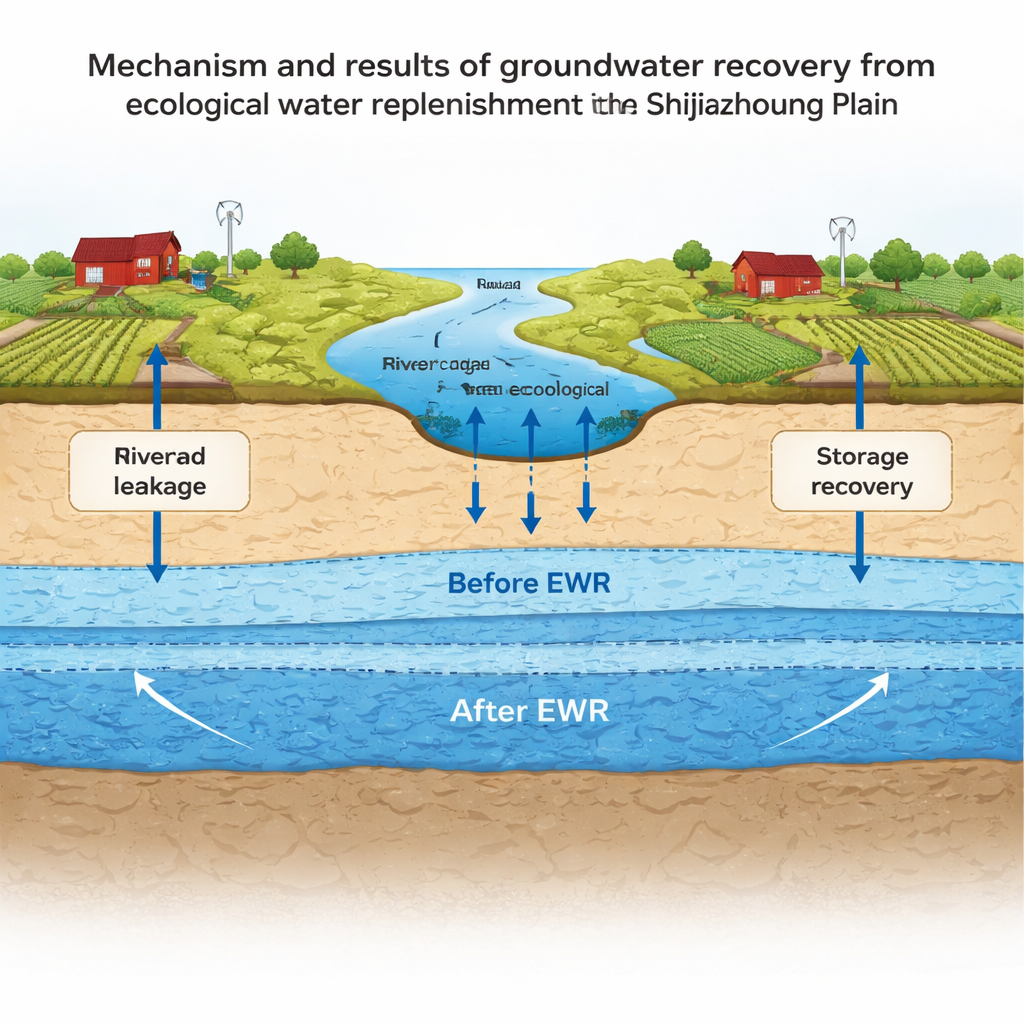
To fight this decline, China has begun routing additional water into once-dry or weakened rivers. This ecological water replenishment combines releases from mountain reservoirs with transfers from the South-to-North Water Diversion canal. When these boosted flows run along permeable riverbeds, a portion seeps downward and slowly refills the aquifers below. In the Shijiazhuang Plain, five main rivers—including the long Hutuo River and the shorter Sha–Zhulong River—have received more than 5 billion cubic meters of such flows since late 2018, making the area a major test case for whether this strategy can reverse groundwater losses.
Simulating an invisible recovery
Because many factors influence groundwater—rainfall, pumping, canals, and river flows—the researchers turned to a detailed computer model, called MODCYCLE, that links surface water and underground water in a single framework. They divided the region into hundreds of subbasins and a grid of one‑kilometer cells, fed the model with real data on weather, river flows, irrigation, and geology, and checked it against measurements from dozens of wells and stream gauges. Once the model reliably reproduced recent conditions, they ran “what‑if” scenarios that removed replenishment in all rivers or in specific rivers, revealing how much of the observed groundwater rebound could truly be credited to ecological water replenishment.
How much water came back—and from where
The simulations show that from September 2018 to the end of 2022, ecological water replenishment turned a small ongoing loss of groundwater into a substantial gain. Instead of a slight net decline, the plain gained about 1.76 billion cubic meters of stored groundwater, and the average water table rose by nearly 2 meters—about 0.45 meters per year. The vast majority of this recovery, roughly 82 percent, came from water added to the Hutuo River, which is long, well connected to the aquifer, and has a permeable riverbed. The Sha–Zhulong River contributed about 12 percent, while several smaller rivers together supplied the remaining 5 to 6 percent. Around these rivers, especially along the Hutuo, the water table rose more than half a meter across over 60 percent of the plain, with the strongest gains extending up to roughly 25 kilometers from the channel.
Finding the sweet spot for replenishment
More river water does not automatically mean more efficient recharge. The study found that when replenishment flows were moderate and steady, a higher share of the added water actually leaked into the ground and stayed there. When flows were pushed higher, a growing fraction simply passed through the system and left the area, lowering efficiency. Model tests suggest that during dry years the Hutuo River can recharge groundwater very effectively at about 14.6 cubic meters per second, but extra water should then be directed to other rivers to spread the benefits. In normal‑rainfall years, about 8.4 cubic meters per second in the Hutuo River is enough to shift the balance from depletion to recovery; in very wet years, natural recharge alone can raise groundwater without additional releases.
What this means for water security
For non‑specialists, the key message is that carefully managed river flows can help refill overdrawn underground reservoirs, even in heavily farmed, water‑scarce regions. In the Shijiazhuang Plain, ecological water replenishment has already stopped ongoing losses and begun refilling the largest shallow groundwater “hole” in the North China Plain. The work also shows that where and how water is delivered matters as much as how much is delivered: long, well‑connected rivers like the Hutuo River are especially powerful recharge pathways, and moderate, sustained flows are more effective than occasional surges. These insights can guide water managers in China and other dry regions as they design river‑based strategies to stabilize, and eventually restore, depleted aquifers.
Citation: Lu, W., Lu, C., Jia, Y. et al. Ecological water replenishment effects on groundwater recovery in the largest shallow groundwater depression cone of the North China Plain. Sci Rep 16, 7583 (2026). https://doi.org/10.1038/s41598-026-38451-5
Keywords: groundwater recharge, river replenishment, North China Plain, agricultural water use, aquifer recovery