Clear Sky Science · en
Strategic niobium integration and thermomechanical processing in the advancement of novel CMnSiAlPMo TRIP-aided bainitic steel
Stronger, Safer Cars with Smarter Steel
Modern cars must be lighter to save fuel and reduce emissions, yet strong enough to protect passengers in a crash. This article explores a new kind of steel designed to meet both goals at once. By fine-tuning the steel’s ingredients and how it is squeezed and cooled in the mill, the researchers show how to create metal that is extremely strong, yet still able to absorb impact without breaking suddenly.
Why This New Steel Matters
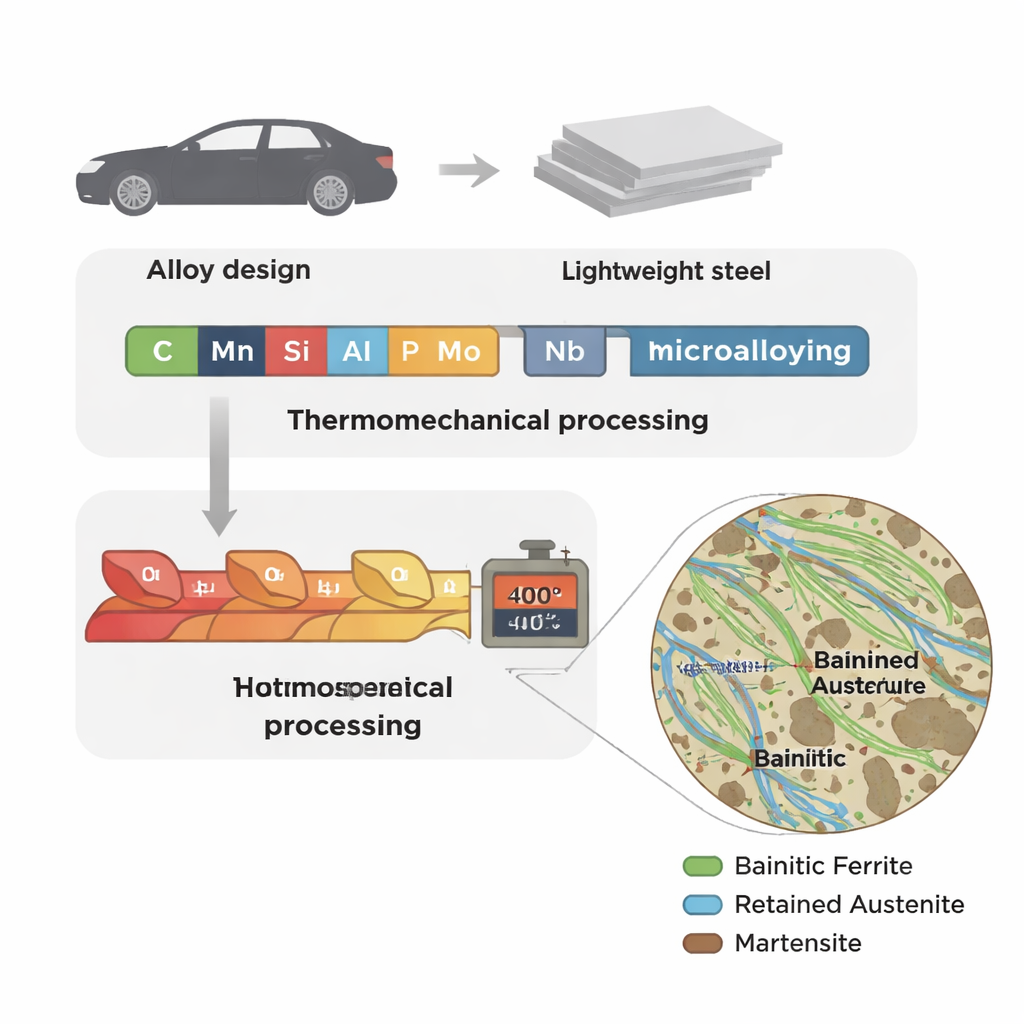
Automakers increasingly rely on so-called advanced high-strength steels to build pillars, bumpers, and other safety-critical parts. These materials allow thinner, lighter panels without losing crash performance. The steel studied here belongs to a promising “third generation” that balances cost and performance. It uses a clever trick: keeping a small amount of a softer phase, called retained austenite, inside a harder structure. Under impact, this softer phase can transform and help the metal stretch rather than snap, improving both strength and toughness.
Mixing the Right Ingredients
The team designed two closely related steels that contain carbon, manganese, silicon, aluminum, phosphorus, and molybdenum, all chosen to stabilize the useful phases and avoid brittle particles. The only difference between the two versions is the presence or absence of a tiny addition of niobium, a costly but powerful microalloying element. Computer simulations first predicted which crystal structures and carbides would appear at different temperatures, and how the metal would transform as it cooled. This helped identify heat-treatment windows that favor the desired mix of strong bainitic plates, thin films of retained austenite, and small regions of martensite.
Shaping Steel with Heat and Pressure
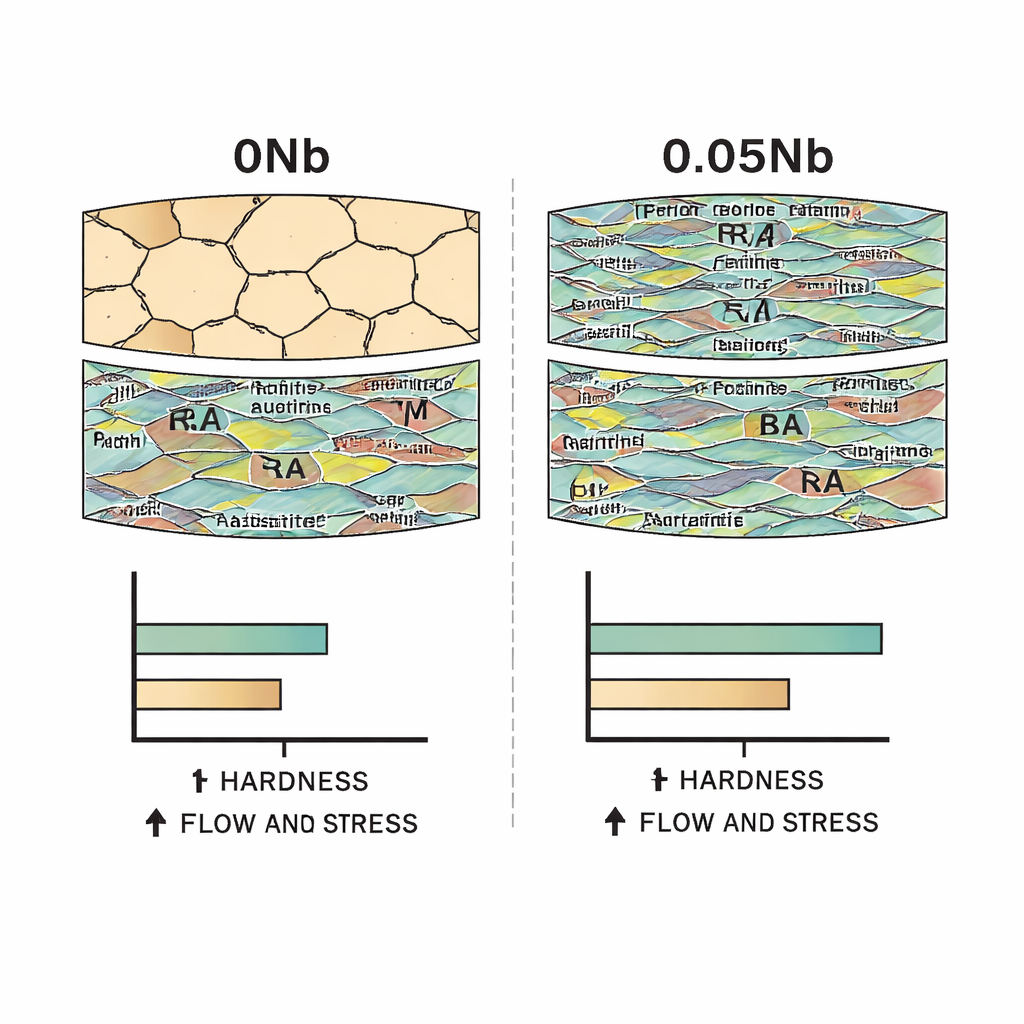
Next, the researchers used a thermomechanical simulator to mimic what happens in an industrial hot rolling mill. Both steels were heated to a fully hot, single-phase state and then compressed in one, two, three, or four passes at temperatures between 1150 °C and 850 °C, followed by a controlled hold at 400 °C and rapid cooling. Across all conditions, the metal showed “strain hardening”: the more it was deformed, the more resistance it built up to further shaping. Additional passes and lower finishing temperatures increased the peak flow stress and refined the grain structure. Detailed microscopy and X-ray measurements revealed how the size of the original high-temperature grains, the thickness of the bainitic plates, and the amount and shape of retained austenite all changed with the processing route and niobium content.
What Niobium Really Changes
Despite its very low level, niobium had a clear impact on the microstructure. It reduced the size of the prior austenite grains and encouraged a finer, more uniform arrangement of bainitic ferrite. In the niobium-free steel, larger grains and cooling after heavy deformation favored the formation of harder martensite islands and a relatively high share of retained austenite. The four-pass route at the lowest finishing temperature produced the highest hardness in this alloy, thanks mainly to strong grain refinement. In the niobium-bearing steel, by contrast, the best hardness was achieved with only two deformation passes at a higher finishing temperature. Here, the overall retained austenite fraction was lower, and its distribution more film-like, which shifted the balance between strength and ductility.
From Laboratory Findings to Real-World Use
By comparing many combinations of composition and processing, the study maps out how to “dial in” properties in this new TRIP-aided bainitic steel. The message for industry is that there is no single best recipe: a route with more passes and lower temperatures can give the highest hardness in a simple composition, while a steel microalloyed with niobium can reach similar or better performance with fewer steps. In everyday terms, this means lighter, safer car structures may be produced more efficiently, using less energy and fewer expensive alloying elements, by understanding and exploiting the subtle interplay between chemistry, heat, and deformation.
Citation: Refaiy, H., El-Shenawy, E., Kömi, J. et al. Strategic niobium integration and thermomechanical processing in the advancement of novel CMnSiAlPMo TRIP-aided bainitic steel. Sci Rep 16, 7509 (2026). https://doi.org/10.1038/s41598-026-38448-0
Keywords: advanced high-strength steel, automotive materials, thermomechanical processing, niobium microalloying, retained austenite