Clear Sky Science · en
Insights and implications of a dynamical systems approach to dengue transmission and epidemic behaviour
Why this matters for everyday life
Dengue fever has shifted from a seasonal scare to a near-constant threat in many tropical cities, including those in Bangladesh. This article looks under the hood of dengue outbreaks using the language of mathematics, turning the tangled interactions between humans and mosquitoes into a kind of "flight simulator" for epidemics. By doing so, it reveals which levers—such as biting rates, mosquito survival, and human recovery—matter most for tipping a community from safety into crisis, and how health officials can use those levers to keep dengue in check.
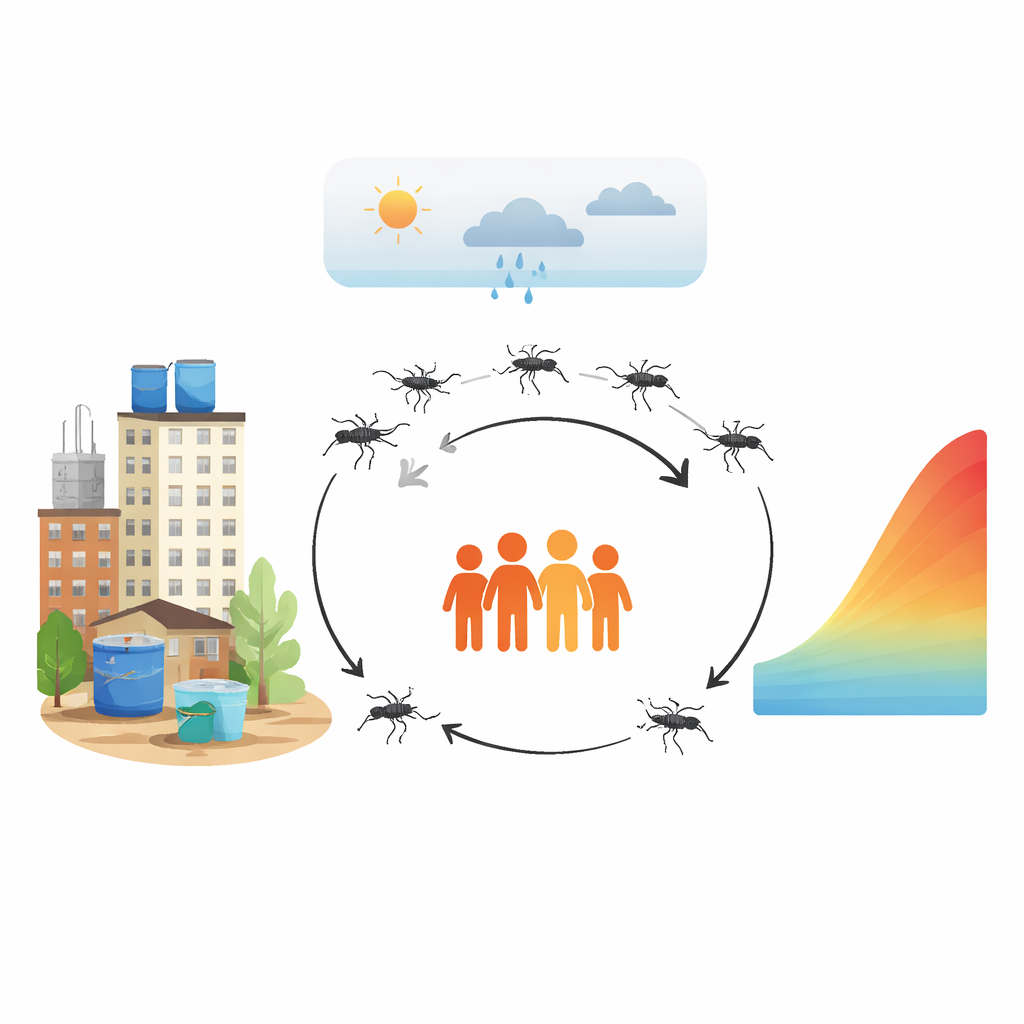
Turning dengue into a step-by-step story
The researchers build a detailed model that splits both people and mosquitoes into stages of infection. Humans move from being vulnerable, to recently bitten, to sick, and finally to recovered, while mosquitoes move from healthy to carrying the virus to fully infectious. Equations describe how quickly individuals flow between these stages and how often mosquitoes pass the virus to people and back again. This structured view captures the reality that dengue does not spread in one jump, but through a chain of silent and visible stages in both species.
A single number that signals danger
At the heart of the study is a quantity called the basic reproduction number, R0, which represents how many new infections one sick person (with the help of mosquitoes) will spark in an otherwise uninfected community. The authors show that when R0 is below 1, dengue infections eventually die out, but when it climbs above 1, the disease settles into a lingering presence instead of disappearing. Using tools from dynamical systems theory, they prove that this threshold is sharp and robust: cross it, and the system smoothly shifts from a dengue-free state to an ongoing endemic state, a change known as a forward bifurcation.
Finding the most important levers
To move beyond theory, the team tests how sensitive R0 and case numbers are to each model ingredient. They vary factors like how often mosquitoes bite, how likely a bite transmits the virus, how long people stay sick, and how quickly mosquitoes die, and then measure the impact on outbreak size using both simple indices and a technique called partial rank correlation. Three levers stand out as especially powerful in driving dengue spread: how frequently mosquitoes bite, how easily bites infect humans and mosquitoes, and how long mosquitoes survive. The death rate due to dengue and the pace of human recovery also matter: faster recovery and higher mosquito death push R0 downward, while slower recovery and longer-lived mosquitoes sustain transmission.
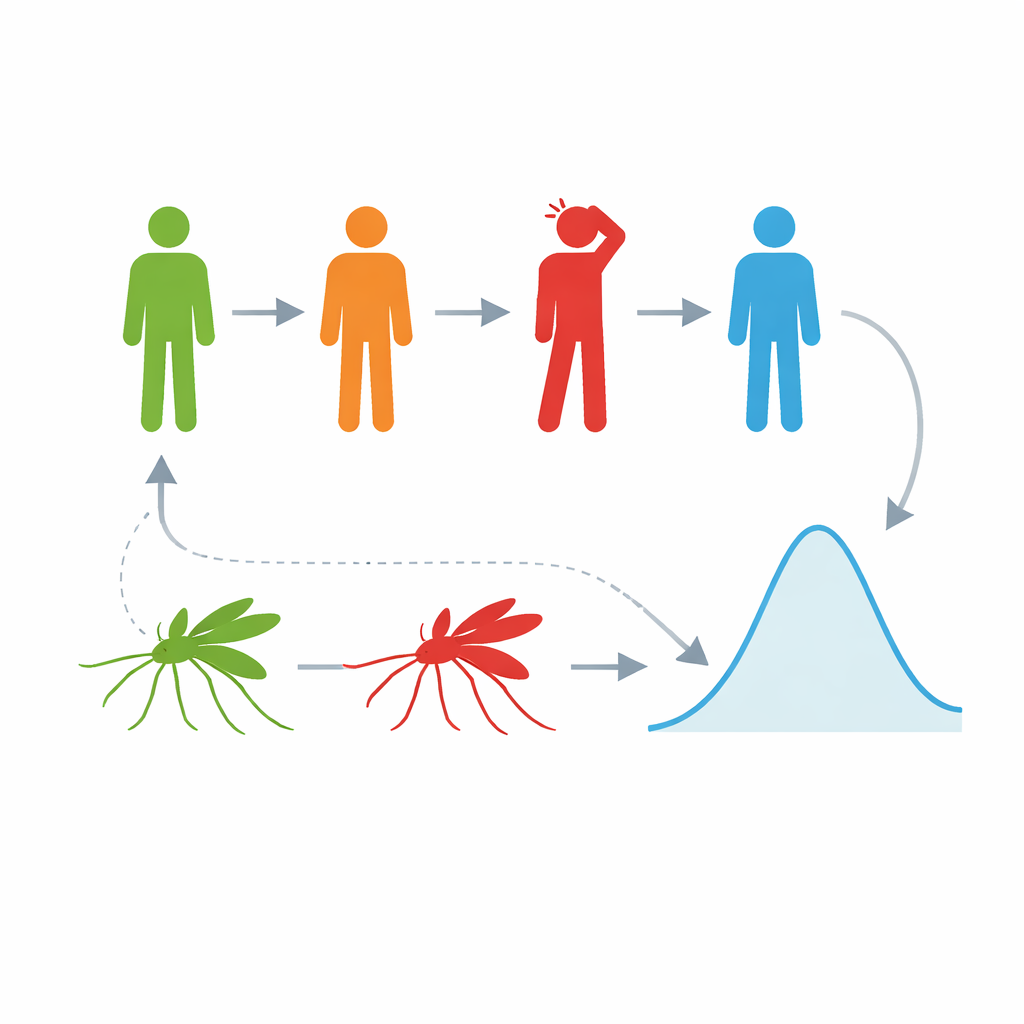
Matching the model to real outbreaks
The authors calibrate their equations using recent dengue data from Bangladesh, including the country’s record-breaking 2023 outbreak and detailed case reports from a 100-day period in 2024. By adjusting a handful of hard-to-measure values, such as how quickly people progress from exposure to illness and how often mosquitoes are infected, they achieve a close match between the model’s predicted case counts and the reported numbers. They then run scenarios that mimic changes in biting rates, mosquito survival, and human immunity. These experiments show, for example, that if mosquitoes bite frequently or live longer, exposed and infected groups in both humans and mosquitoes swell and remain high; if bites are rare or mosquitoes die faster, infections gradually fade away.
What this means for controlling dengue
The simulations point to practical strategies that do not rely on perfect vaccines or constant lockdowns. Reducing bites—by eliminating standing water, improving housing, or using repellents—directly lowers R0. Increasing mosquito death, through responsible insecticide use or better environmental management, can push the system into a dengue-free state when mosquito life spans become short enough. Strengthening human recovery, whether through better clinical care, early detection, or improved overall health, shortens the infectious period and makes it harder for the virus to keep circulating. Together, these findings translate complex mathematics into a clear message: dengue can be tamed when communities and health systems focus on fewer bites, shorter mosquito lives, and faster human recovery.
Citation: Rahman, M., Hye, M., Miah, M. et al. Insights and implications of a dynamical systems approach to dengue transmission and epidemic behaviour. Sci Rep 16, 8191 (2026). https://doi.org/10.1038/s41598-026-38445-3
Keywords: dengue transmission, mosquito control, epidemic modeling, Bangladesh outbreaks, vector-borne disease dynamics