Clear Sky Science · en
Fracture propagation characteristics in shale bedding planes within structurally complex zones
Cracks That Choose Their Own Path
When engineers fracture deep shale rock to release natural gas, they hope the cracks will spread in tall, clean sheets, opening up as much rock as possible. But in many real gas fields, especially in China’s giant Fuling shale, the fractures twist, stall, and turn sideways along thin internal layers in the rock. This paper explores why those fractures misbehave, and how understanding their hidden pathways can help produce more gas with fewer wells and less wasted water.
Layered Rocks With Hidden Weaknesses
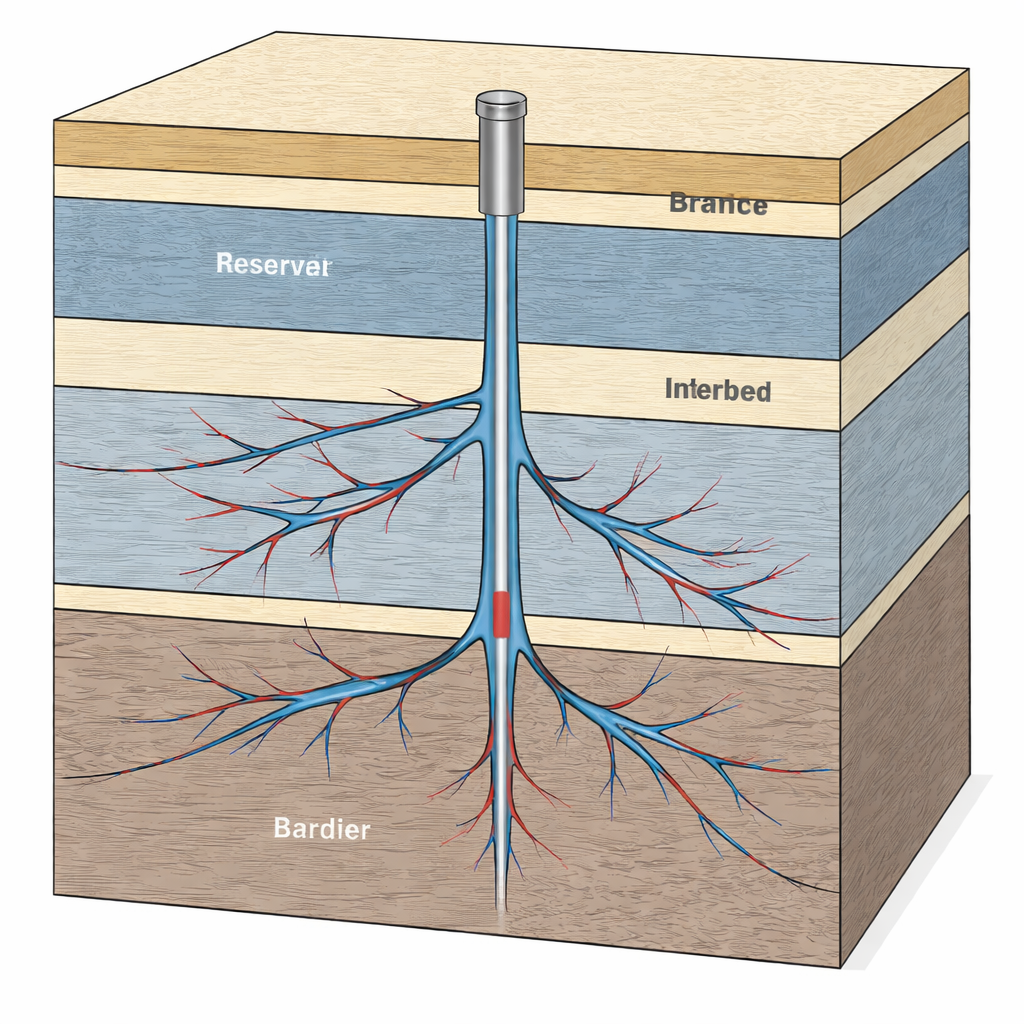
Shale is not a uniform block of stone. It is built from countless thin bedding planes—microscopic layers laid down over millions of years—interwoven with harder and softer rock bands. In complex structural zones, these tiny layers interact with thicker interbeds to form a geological maze. The authors focus on the Longmaxi Formation shale in southwest China, where these features are especially well developed. In places like the Fuling gas field, strong interlayers and bedding planes can halt vertical fracture growth, limiting how much rock one well can effectively drain. The central question is: under what conditions do hydraulic fractures cut straight through this maze, and when do they instead get steered sideways along weak planes?
Watching Cracks Grow in the Laboratory
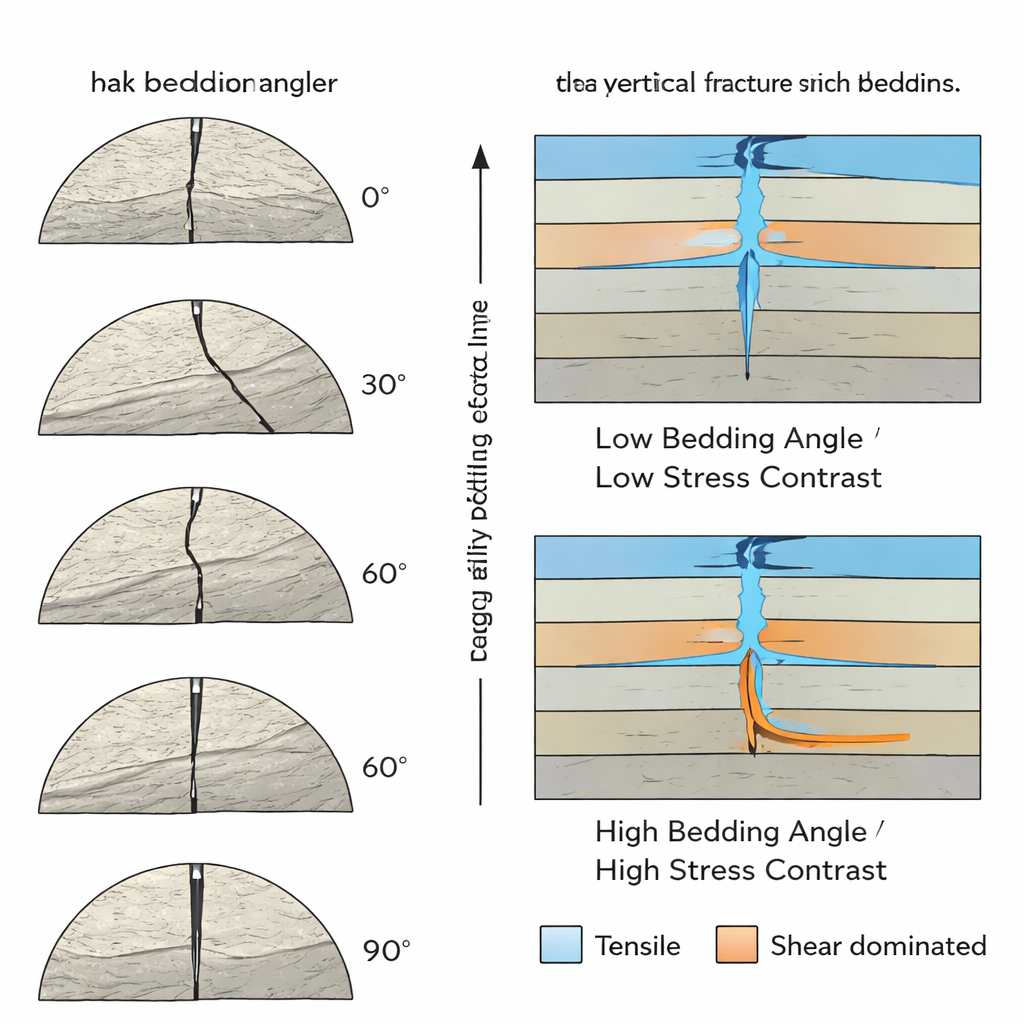
To study fracture behavior up close, the team ran controlled three-point bending tests on half-disc-shaped shale samples cut from outcrops. Each sample contained a small starter notch and bedding planes set at specific angles—0°, 30°, 60°, or 90°—relative to the direction of loading. Using a high-speed camera and a technique called digital image correlation, they tracked how tiny surface speckles moved as the rock deformed and finally cracked. The tests showed that shale fracture toughness—how hard it is to make a crack grow—can vary by a factor of about 2.4 depending on bedding orientation. When bedding planes were aligned as weak surfaces (90°), cracks tended to slide along them in shear; when bedding was less favorably oriented, the rock resisted cracking more strongly and failed in a more direct, tensile fashion.
Angles That Steer the Crack
The experiments also revealed that bedding angle acts like a steering wheel for crack paths. Cracks in samples with 0° bedding (layers horizontal, load vertical) showed minor zigzags but remained roughly straight. At 30°, fractures repeatedly kinked into bedding planes and then bent back toward the loading direction, producing complex local detours but only modest overall turning. At 60°, the bedding planes exerted the strongest guiding effect: cracks were channeled mainly along the layer direction, giving the largest net deviation from vertical. At 90°, with loading parallel to bedding, fractures again traveled almost straight. These behaviors were quantified using separate measures of the maximum local deflection and the overall change in direction, confirming that bedding between about 30° and 60° produces the most intense steering.
Simulating Fractures in Real Reservoirs
Laboratory tests capture small-scale behavior, but engineers need to know what happens in real reservoirs tens of meters tall. The researchers therefore built a numerical model of a layered shale system, including thin interbeds, stiffer barrier layers above and below, and bedding planes represented by special “cohesive” elements that can open, slip, and transmit fluid pressure. The model couples rock stress, fluid flow inside the fractures, and leakage into the surrounding rock. By systematically varying bedding angle and key in-situ stresses, they simulated how hydraulic fractures initiate at an injection point, grow vertically, and then either cross layers or turn and run along bedding planes.
Stress Differences That Help or Hurt
The simulations show that bedding angle and stress contrasts jointly control fracture height and deflection. When bedding is nearly horizontal (0°), fractures can grow to the full reservoir height with little turning. As bedding tilts toward 45°–75°, fractures become strongly deflected along the layers, and their vertical reach shrinks, meaning less rock is connected. Increasing the difference in vertical stress between reservoir and interlayer tends to straighten fractures, suppressing shear slip and simplifying their shape. In contrast, boosting the horizontal stress contrast makes it harder for fractures to cross interbeds: cracks become narrower, are trapped more easily, and often spread sideways along bedding instead of upwards. Changes in the stiffness of the interbeds also matter—moderately stiffer layers can help fractures climb higher, but very stiff ones build up pressure and resist further growth.
Practical Lessons for Gas Production
For non-specialists, the key takeaway is that hydraulic fractures in shale do not simply follow the line of least resistance; they respond in subtle ways to the angles of internal layering and to how stresses differ between rock units. In the Longmaxi Formation and similar reservoirs, bedding angles around 45°–60° and strong horizontal stress contrasts are especially effective at trapping fractures within narrow vertical zones. By recognizing these conditions and adjusting well placement, pumping schedules, and treatment designs, engineers can better predict where fractures will go, avoid wasting effort on layers that will not open, and more efficiently harvest shale gas from complex, layered rocks.
Citation: Liu, X., Zhao, L., Li, S. et al. Fracture propagation characteristics in shale bedding planes within structurally complex zones. Sci Rep 16, 7593 (2026). https://doi.org/10.1038/s41598-026-38432-8
Keywords: shale gas, hydraulic fracturing, bedding planes, fracture propagation, layered reservoirs