Clear Sky Science · en
Degree of conduction transfer through incomplete interphases controlling the conductivity of carbon nanofiber composites
Why smarter plastics matter
From flexible phone screens to medical sensors, many modern devices rely on plastics that can also carry electricity. Adding tiny carbon nanofibers to plastics can turn them from insulators into useful conductors, but the details of how charge moves through these mixtures are surprisingly complex. This paper explores why some carbon‑nanofiber plastics conduct very well while others barely conduct at all, and offers a new way to predict and control that behavior.
Building a highway for electrons
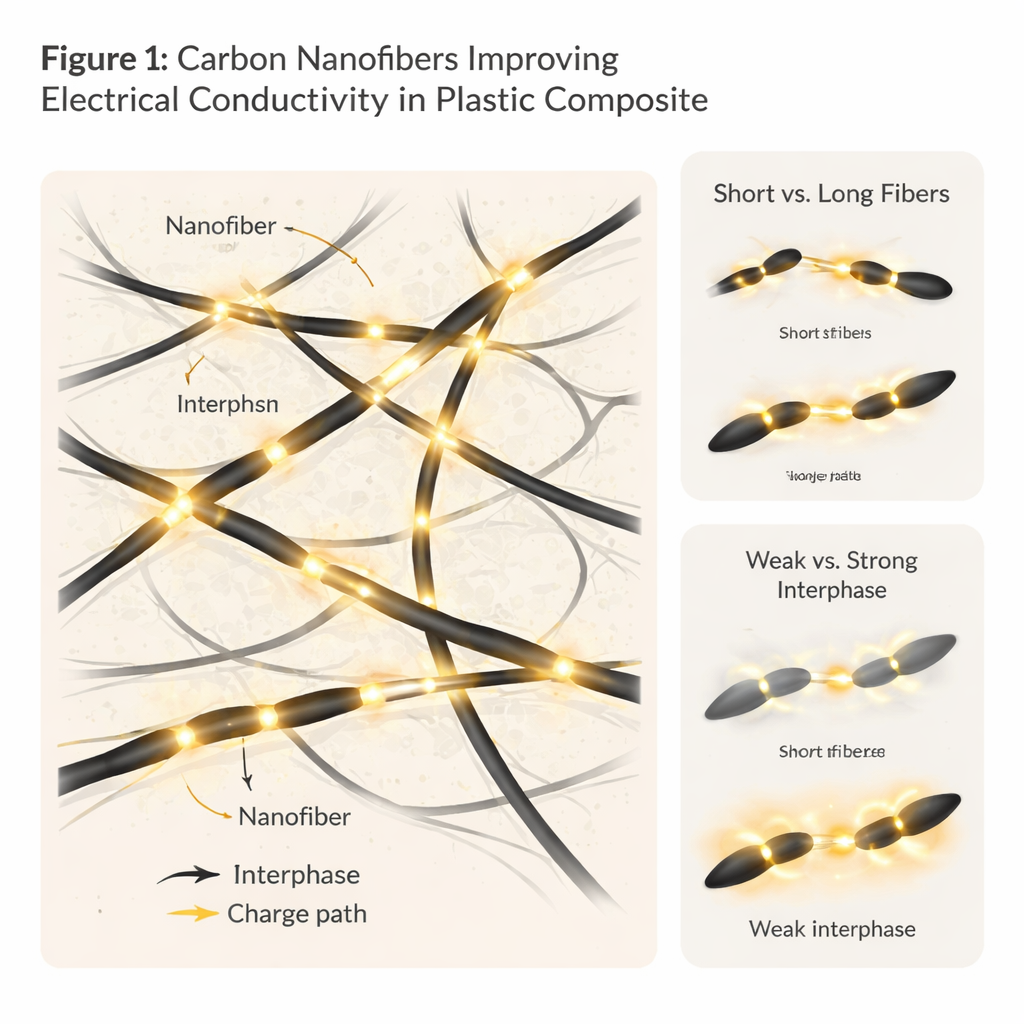
In a pure plastic, electrons are largely stuck; the material acts like an electrical dead end. When carbon nanofibers are mixed in, they can form a connected network, creating paths for electrons to travel. Scientists call the critical filler amount needed to form this network the percolation threshold. Once this threshold is reached, conductivity can jump by many orders of magnitude. Carbon nanofibers are especially promising because they are long and thin, so relatively few are needed to form a network. Yet experiments show big differences among otherwise similar composites, raising the question: what hidden features are controlling the flow of charge?
The blurry border that makes or breaks performance
Between each nanofiber and the surrounding plastic there is a thin region, called the interphase, where the properties are neither quite fiber nor quite polymer. If this border region conducts well, it can help bridge gaps, bring fibers “closer” in an electrical sense, and strengthen the overall network. If it conducts poorly or is patchy, much of the fiber’s natural conductivity never reaches the plastic. The authors focus on this imperfect interphase and introduce a single parameter, Y, to describe how effectively conduction is transferred from each nanofiber into the surrounding material. Y depends on how long and thin the fibers are, how wavy they become inside the plastic, and how conductive and thick the interphase layer is.
From microscopic details to overall behavior
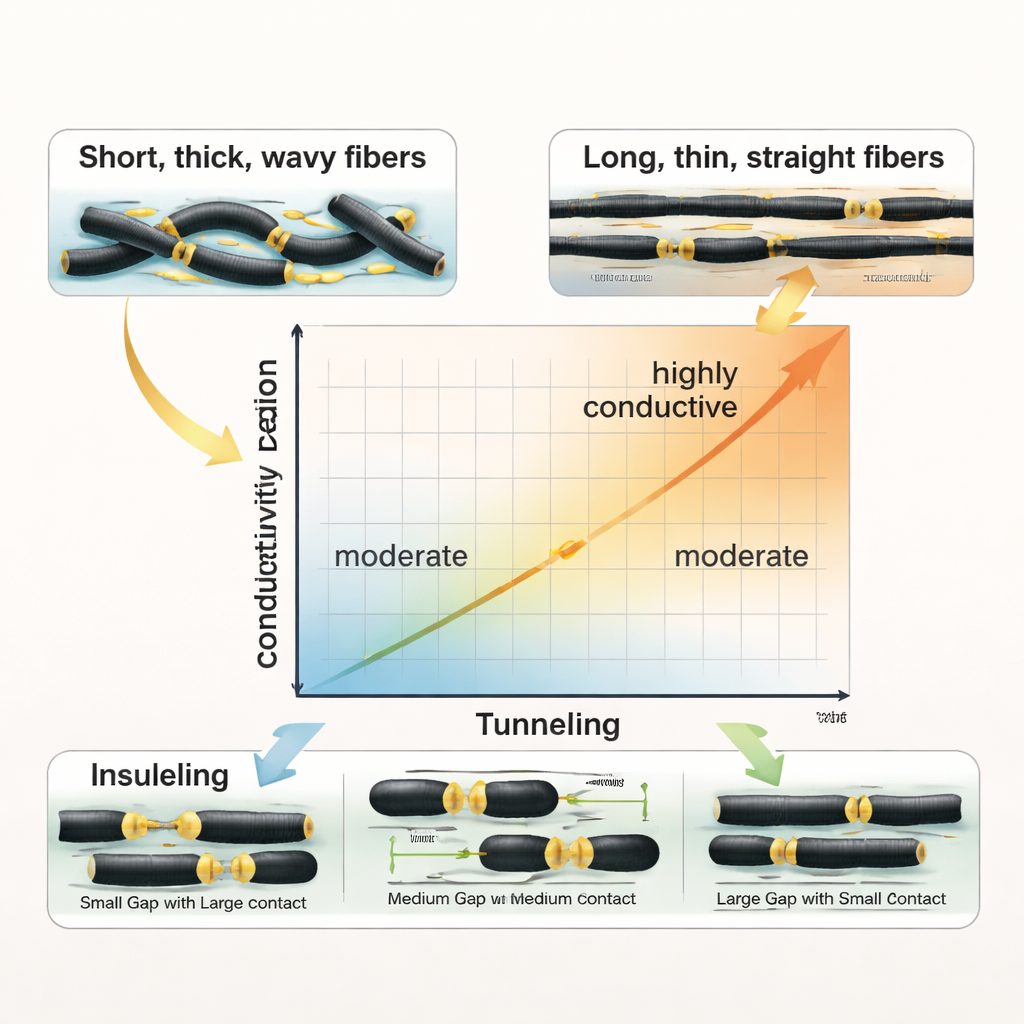
Using Y, the researchers redefine several key quantities that determine whether a good network forms: the effective shape of the fibers, the real amount of fiber that actually participates in conduction, the percolation threshold, and the size of the conducting network. They then upgrade an existing mathematical model of conductivity to include not only the fiber network and the interphase, but also quantum tunneling—electrons hopping across tiny polymer-filled gaps between neighboring fibers. In this picture, both the size of the tunnels (how wide the contact area is and how far electrons must jump) and the resistance of the polymer in those gaps strongly influence how easily charge can move through the composite.
What the model reveals about design choices
With the improved model, the team systematically explores how changing design knobs alters conductivity. Higher Y—achieved with longer and slimmer fibers, straighter alignment, a thicker and more conductive interphase, and shorter minimum transfer length—lowers the percolation threshold and increases the fraction of fibers that belong to the conducting network. This, together with a higher nanofiber loading, boosts the composite’s electrical conductivity from nearly zero up to about 0.13 siemens per meter under realistic conditions. Further gains come from making the contact areas between fibers wider and the tunneling distances shorter, which can raise conductivity to roughly 0.55 siemens per meter. In contrast, thick, wavy fibers, a thin or poorly conducting interphase, small contact zones, long tunnels, or highly resistive polymer in the gaps can leave the material effectively insulating, even when plenty of nanofiber has been added.
Matching theory with real materials
To test their ideas, the authors compare their predictions with measured conductivities from several common plastics filled with carbon nanofibers, including epoxy, polycarbonate, and other polymers. By fitting the model to experimental percolation thresholds, they extract realistic values for interphase thickness, its conductivity, and the tunneling characteristics. The predicted curves line up well with lab data, suggesting that Y and the associated network and tunneling parameters capture the underlying physics of these complex materials.
What this means for future devices
For non-specialists, the takeaway is that turning plastic into a useful conductor is not just a matter of sprinkling in more carbon fibers. The quality of the border region around each fiber and the nanometer-scale gaps between fibers are just as important as the overall amount of filler. By providing a roadmap that links these hidden nanoscale features to real-world conductivity, this work can help engineers design lighter, cheaper, and more reliable conductive plastics for sensors, flexible electronics, energy devices and other technologies where traditional metals are too heavy or rigid.
Citation: Zare, Y., Munir, M.T., Choi, JH. et al. Degree of conduction transfer through incomplete interphases controlling the conductivity of carbon nanofiber composites. Sci Rep 16, 7544 (2026). https://doi.org/10.1038/s41598-026-38427-5
Keywords: conductive polymer, carbon nanofibers, nanocomposite, percolation threshold, tunneling conductivity