Clear Sky Science · en
The astrocyte marker ALDH1L1 also identifies a stromal cell population in the lymph node
Why a Brain Cell Marker Matters Beyond the Brain
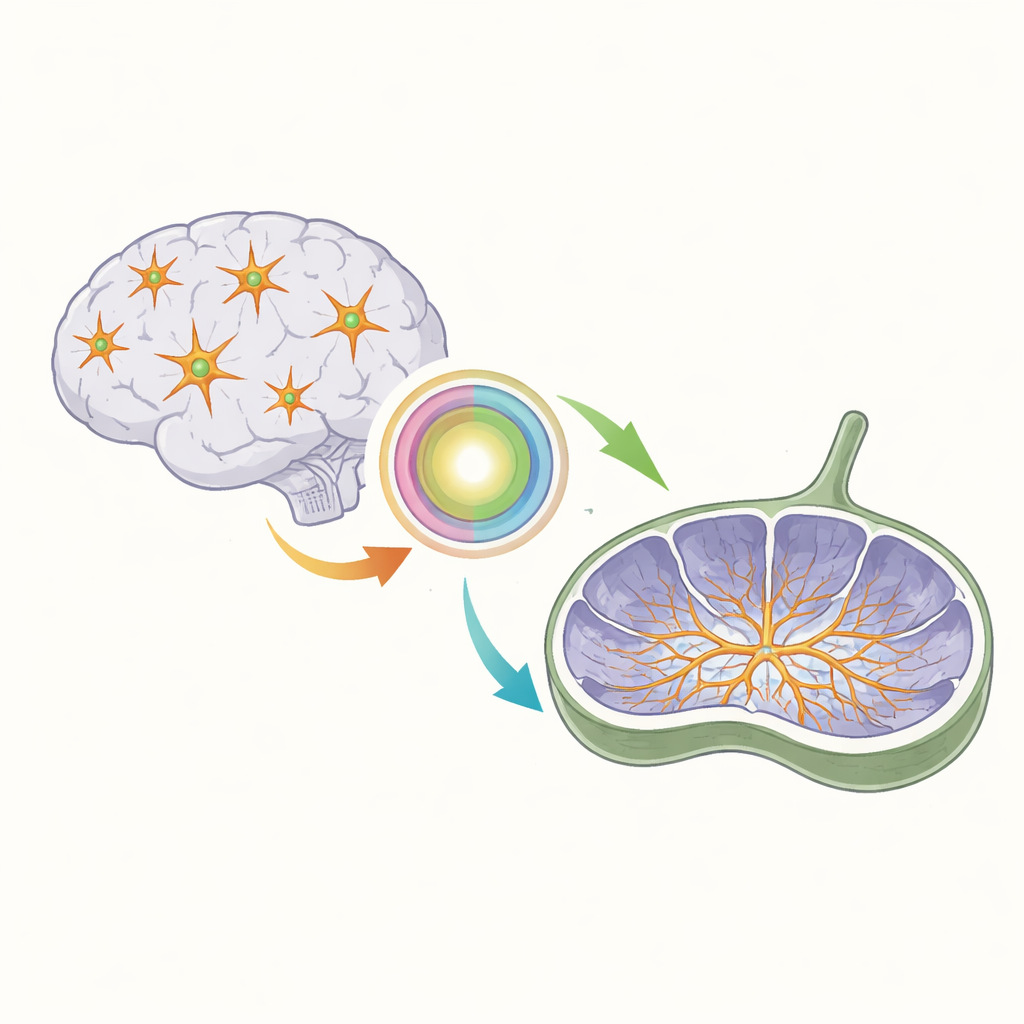
Many modern experiments in neuroscience rely on genetic tags that switch genes on or off in very specific cell types. One such tag uses a molecule called ALDH1L1, long treated as a reliable flag for astrocytes, the star-shaped support cells in the brain and spinal cord. This study asks a deceptively simple question with big consequences: when researchers use this same flag in the rest of the body, especially in lymph nodes that orchestrate immune responses, exactly which cells are they targeting?
Tracing a Familiar Marker in an Unexpected Place
The research team began with mice engineered so that any cell turning on the ALDH1L1 gene would glow red. First, they confirmed in brain and peripheral nerves that the glowing cells overlapped with classic astrocyte and glial markers, as expected. Then they turned to lymph nodes, small bean-shaped hubs where immune cells meet and communicate. Surprisingly, about five to nine percent of lymph node cells carried the ALDH1L1 tag, meaning a non-trivial portion of this tissue was being marked by what scientists usually consider a brain-specific tool.
Ruling Out Nerve and Immune Cell Identities
To figure out who these ALDH1L1-positive cells really were, the authors tested them against a wide panel of known cell markers. They looked for signs of astrocytes and other glia, such as GFAP, ACSA-2, and Sox10, but found virtually no overlap in the lymph node. Next they turned to immune cells. Using both high-resolution microscopy and flow cytometry, they checked T cells, B cells, dendritic cells, and several types of myeloid cells. Again, the glowing ALDH1L1-positive population barely overlapped with these immune groups, indicating that the tagged cells were neither typical nerve support cells nor standard members of the immune army.
Homing In on a Hidden Support Network
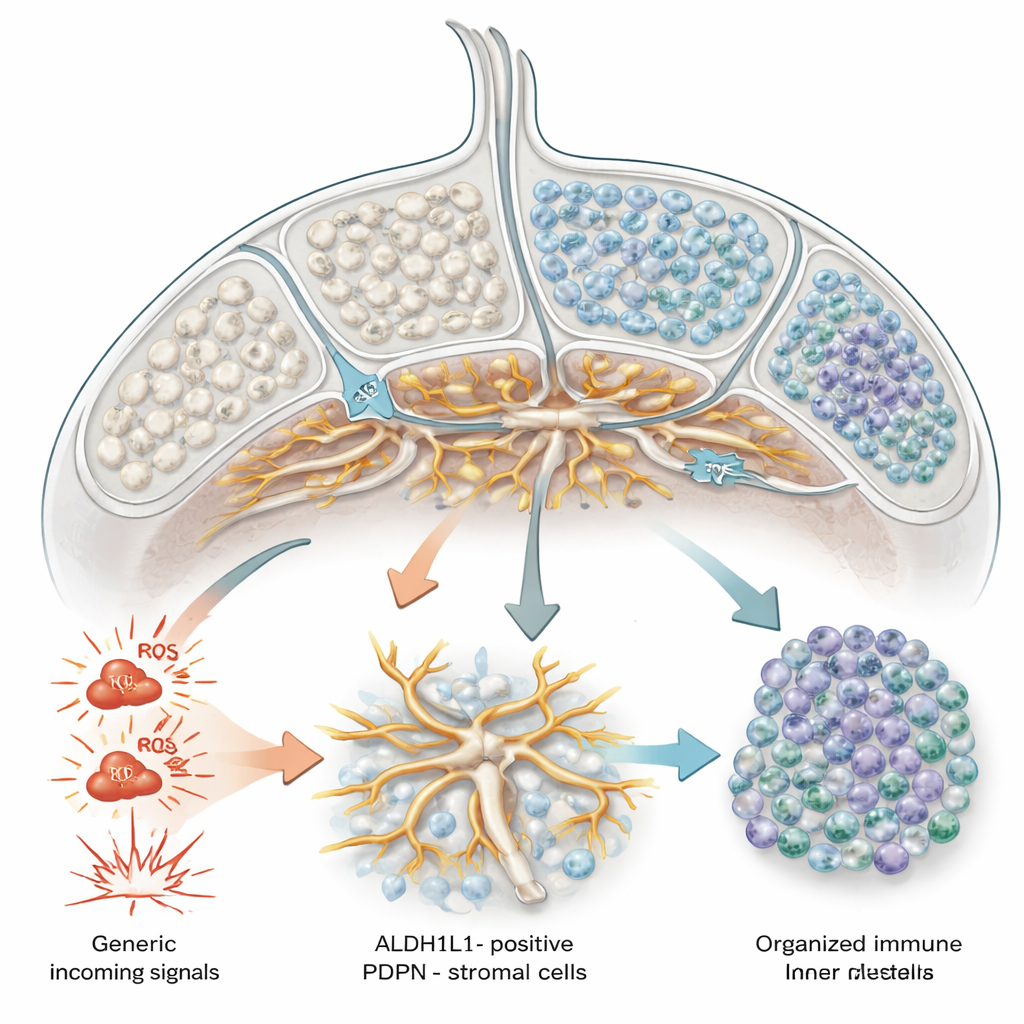
The researchers then investigated whether ALDH1L1 might instead be labeling structural support cells. Lymph nodes contain an intricate framework of so-called stromal cells that shape their internal architecture, guide immune cells to the right neighborhoods, and help sustain them with growth and survival factors. Tests for blood and lymph vessel markers (CD31 and LYVE1) and a broad reticular marker (ER-TR7) showed little overlap with ALDH1L1. However, when the team examined podoplanin (PDPN), a hallmark of fibroblastic reticular cells, the match was striking: many ALDH1L1-positive cells were also PDPN-positive. Only a minority of all PDPN-positive cells carried the ALDH1L1 tag, suggesting that ALDH1L1 marks a distinct subset within this broader stromal network.
Where These Cells Live and What They Might Do
Mapping their locations revealed that ALDH1L1-and-podoplanin-positive cells were concentrated in the paracortex and medulla, regions rich in T cells and other immune interactions, but they were scarce in B cell follicles and near the capsule of the node. Gene expression data from previous large-scale studies supported this picture, linking Aldh1l1 to particular stromal subtypes that produce chemokines like CCL19 and CCL21—molecules that help position immune cells. Because ALDH1L1 participates in folate metabolism and helps generate antioxidant power, the authors speculate that these stromal cells may be especially important for coping with oxidative stress and fueling the energy-intensive remodeling that lymph nodes undergo during infection and aging.
What This Means for Future Research
The study concludes that, while ALDH1L1 remains a faithful marker of astrocytes in the brain, in lymph nodes it actually defines a specialized subset of fibroblastic reticular cells rather than nerve or immune cells. For non-specialists, the key takeaway is that a widely used genetic tool thought to be “brain-only” also targets an important support network in immune organs. This insight not only cautions neuroscientists to consider off-target effects in peripheral tissues, but also opens up a new way to selectively study stromal cells that help organize and energize immune responses inside lymph nodes.
Citation: Smith, B.C., Nasrallah, M.J. & Williams, J.L. The astrocyte marker ALDH1L1 also identifies a stromal cell population in the lymph node. Sci Rep 16, 7981 (2026). https://doi.org/10.1038/s41598-026-38426-6
Keywords: astrocytes, lymph node stroma, fibroblastic reticular cells, cell markers, immune microenvironment