Clear Sky Science · en
Association between physical performance and cognitive frailty in middle-aged and older adults undergoing maintenance hemodialysis: a cross-sectional study
Why strength and speed matter for dialysis patients
For people whose failing kidneys require regular hemodialysis, everyday tasks like getting out of a chair or walking down the hall can reveal more than just physical fitness—they may also hint at how well the brain is functioning. This study explores a simple idea with big implications: can quick, low-cost tests of muscle strength and movement help doctors spot early signs of combined physical and mental decline, known as cognitive frailty, in middle-aged and older adults on long-term dialysis?
A closer look at body and mind on dialysis
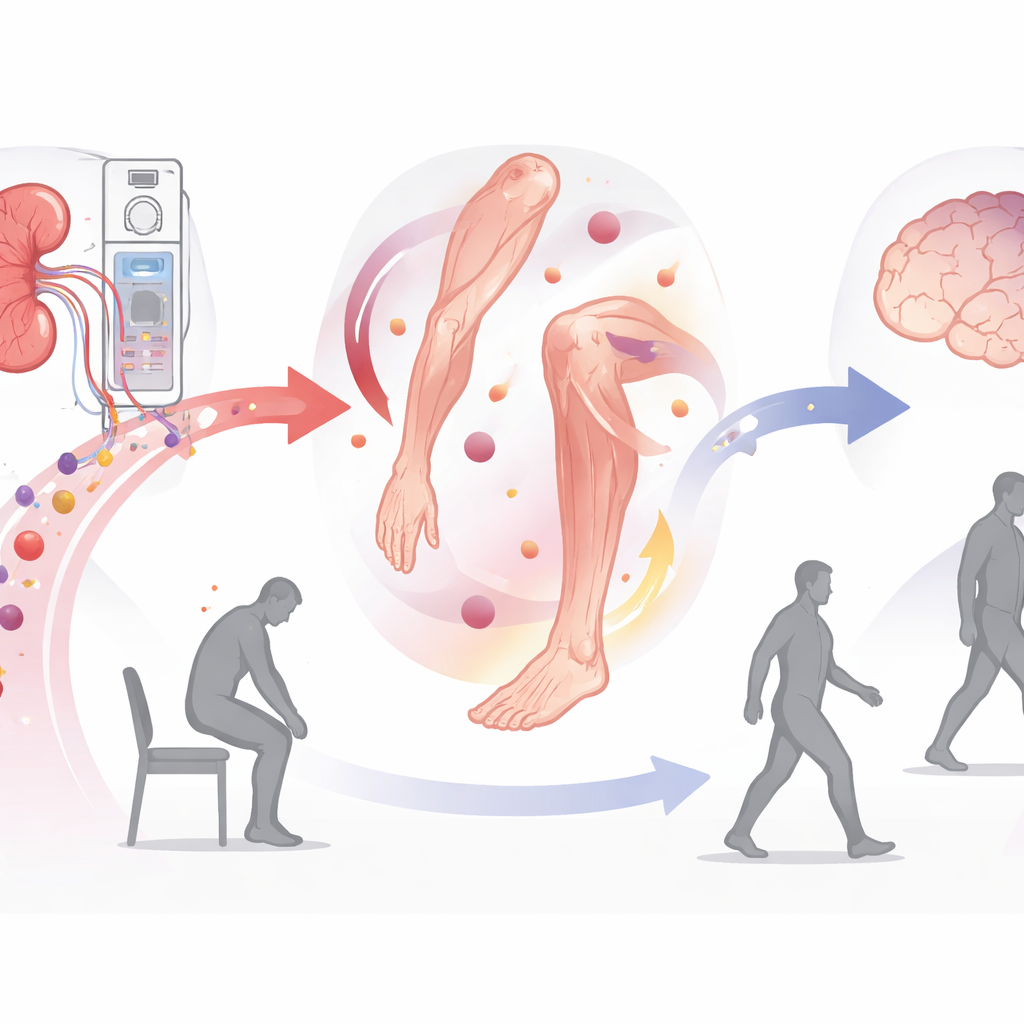
Chronic kidney disease affects hundreds of millions of people worldwide, and many with end-stage disease depend on maintenance hemodialysis to survive. These patients are at high risk for cognitive frailty, a condition where physical weakness and mild thinking problems occur together, even though full-blown dementia is not yet present. Cognitive frailty raises the chances of falling, being hospitalized, losing independence, and dying sooner. Dialysis patients may be especially vulnerable because ongoing inflammation, toxic waste products that the kidneys can no longer clear, and repeated drops in blood pressure during treatment can damage both muscles and the brain.
Simple tests of everyday movement
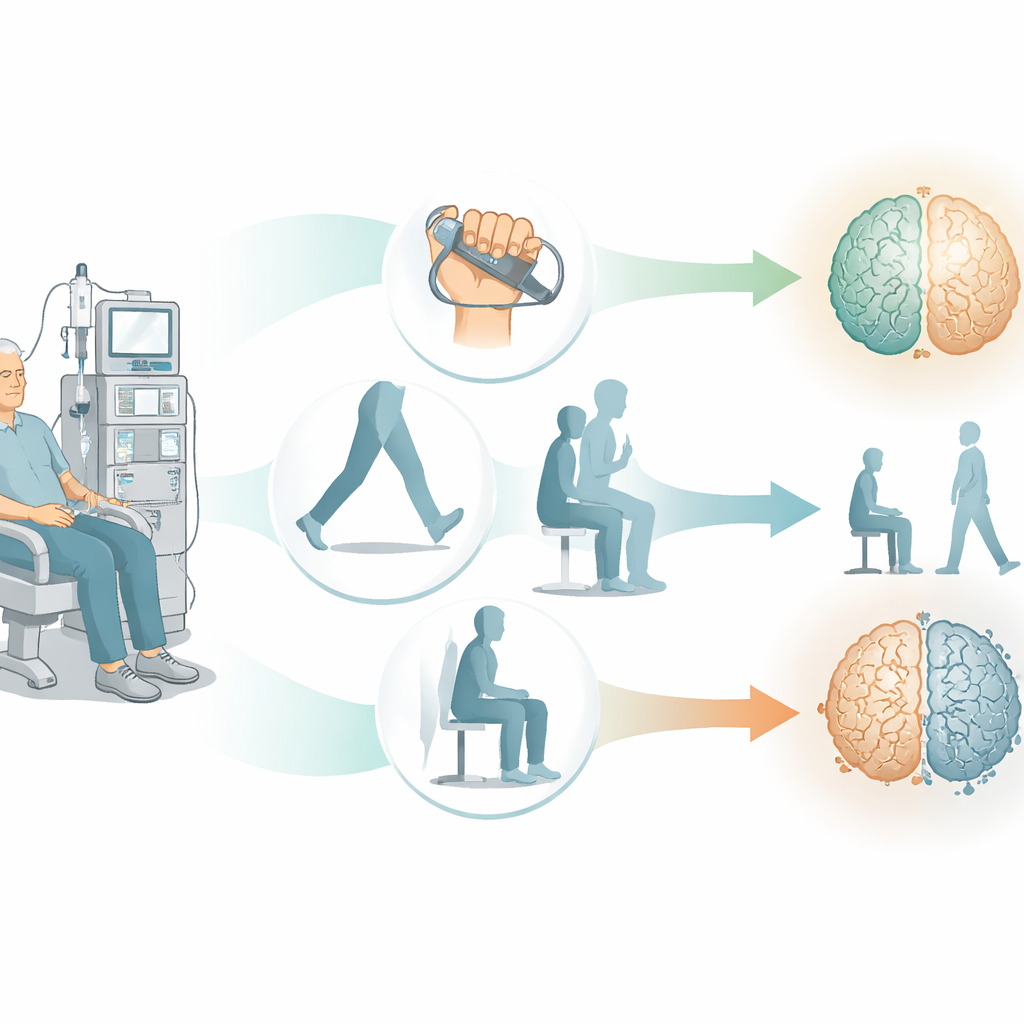
To investigate the link between physical performance and cognitive frailty, researchers studied 282 adults aged 45 and older receiving regular hemodialysis at a hospital in Deyang, China. They used standard tools to evaluate memory and thinking, and a widely used checklist to rate physical frailty. People who were both physically frail and mildly cognitively impaired, but not demented, were classified as having cognitive frailty; 44 patients (about 1 in 6) met this definition. The team then measured four straightforward aspects of physical performance: handgrip strength (how hard someone can squeeze a device), gait speed (usual walking speed over 4.6 meters), the time needed to stand up from a chair and sit back down five times, and the timed up-and-go test, which involves rising from a chair, walking three meters, turning, and sitting down again.
What the tests revealed about hidden risk
Patients with cognitive frailty were older, more often had poor vision, smaller calf size, more depressive symptoms, and more signs of muscle loss. They also showed clear deficits on the physical tests: weaker grip, slower walking, and longer times to complete both sit-to-stand and up-and-go tasks. After accounting for a range of other factors—including age, inflammation, dialysis quality, and measures of muscle health—the researchers found that three tests stood out. Stronger handgrip and faster walking speed were each linked to substantially lower odds of cognitive frailty, while taking longer to complete the five-times sit-to-stand test was linked to higher odds. The timed up-and-go test, while trending in the same direction, did not quite reach statistical significance once all other variables were considered.
How well do these quick checks work?
The team then asked how accurately each of the four physical tests could distinguish patients with cognitive frailty from those without it. Using statistical curves that measure screening performance, they found that all four tests performed remarkably well. Each had an area-under-the-curve value above 0.92, indicating excellent ability to separate higher-risk from lower-risk patients. No single test clearly outperformed the others, although the five-times sit-to-stand test offered the best balance between correctly identifying affected patients and avoiding false alarms. This task, which demands leg strength, balance, coordination, and quick reactions, may capture both muscle and brain function more fully than simpler measures.
What this means for patients and clinics
For people on long-term hemodialysis, the study’s message is straightforward: how strong your grip is, how fast you walk, and how easily you can rise from a chair may say a lot about the health of both your body and your brain. Because these tests are quick, inexpensive, and require minimal equipment, they could be built into routine dialysis care to flag patients at higher risk of cognitive frailty long before severe disability appears. While the study cannot prove cause and effect, and it was conducted at a single center, it highlights an encouraging possibility: by regularly checking simple aspects of movement and strength, clinicians may gain an early warning system for combined physical and mental decline—and, in time, may be better able to target interventions that keep dialysis patients stronger, steadier, and mentally sharper for longer.
Citation: Yi, Z., Qing, W., Zou, Z. et al. Association between physical performance and cognitive frailty in middle-aged and older adults undergoing maintenance hemodialysis: a cross-sectional study. Sci Rep 16, 8871 (2026). https://doi.org/10.1038/s41598-026-38413-x
Keywords: cognitive frailty, hemodialysis, physical performance, grip strength, gait speed