Clear Sky Science · en
Tribological performance of UV treated nanodiamond reinforced polyurethane nanocomposites through Taguchi and machine learning technique
Making Tough Plastics Last Longer
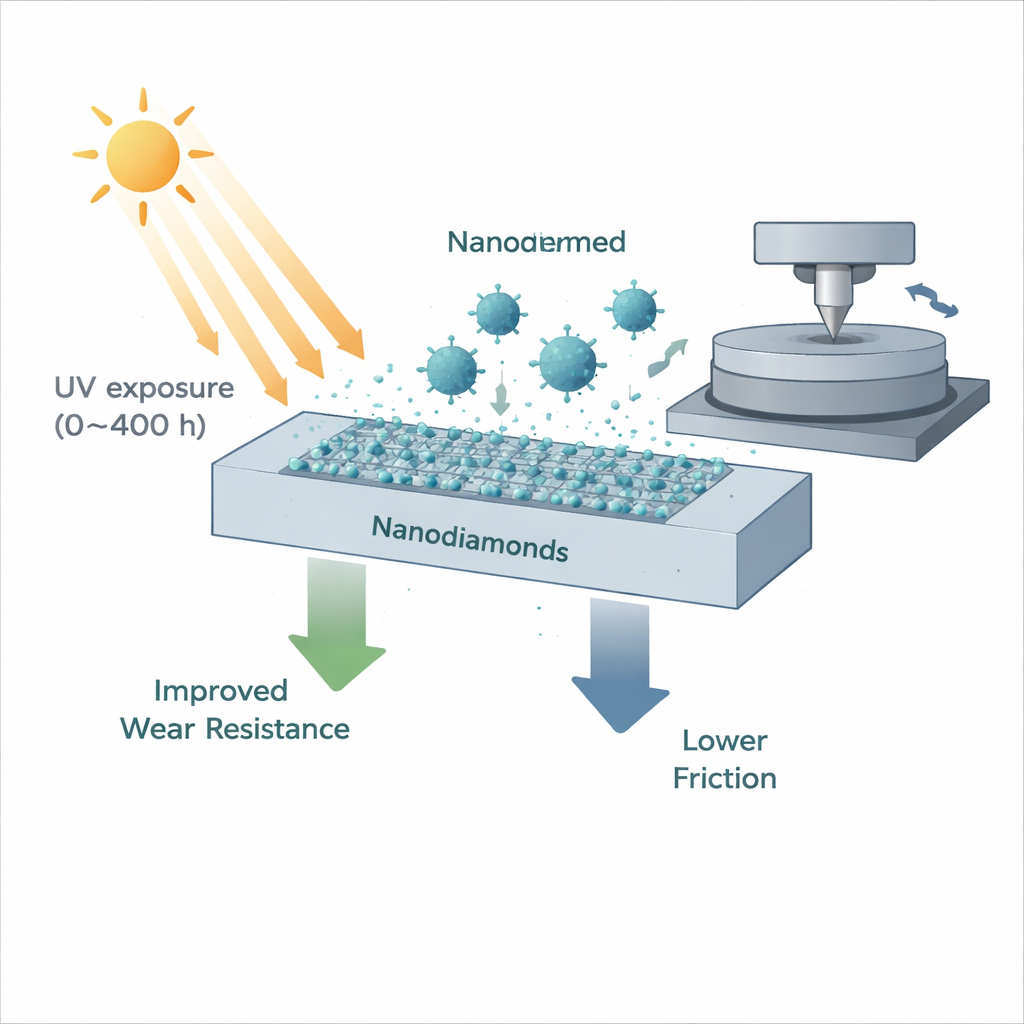
From car bushings and conveyor belts to aircraft seals, many moving parts rely on polyurethane, a tough, rubbery plastic. But sunlight and constant rubbing slowly grind these parts down, leading to failures, higher maintenance costs, and wasted materials. This study explores whether sprinkling in ultra-hard nanodiamonds—carbon particles only billionths of a meter wide—and carefully tuning test conditions can make polyurethane last much longer, even when exposed to harsh ultraviolet (UV) light.
Tiny Diamonds in Everyday Plastics
The researchers started with thermoplastic polyurethane, a versatile plastic valued for its strength and abrasion resistance. To toughen it further, they added nanodiamonds at very low levels (0.2 and 0.5 percent by weight). Before mixing, the nanodiamonds were chemically treated so they would bond more effectively with the plastic. The treated particles were then dispersed in an alcohol-based liquid and combined with polyurethane pellets, which were dried and injection molded into test pieces. The idea is that nanodiamonds, with their extraordinary hardness and large surface area, can act like tiny armor plates, sharing the load and resisting wear where the plastic meets a sliding surface.
Simulating Sunlight and Sliding Wear
To mimic real-world conditions, the team exposed both pure polyurethane and the nanodiamond-filled versions to controlled UV radiation for up to 400 hours, roughly representing long-term outdoor aging. They then measured two key tribological properties—how materials behave when they slide against each other—using a pin-on-disc machine. In these tests, a pinned sample is pressed against a rotating metal disc under different speeds, loads, and distances. By systematically varying five factors—sliding distance, speed, applied load, nanodiamond content, and UV exposure time—the researchers could see which combinations led to the lowest wear rate (how fast material is lost) and the lowest coefficient of friction (how “slippery” or “grippy” the contact is).
Finding the Sweet Spot with Smart Statistics
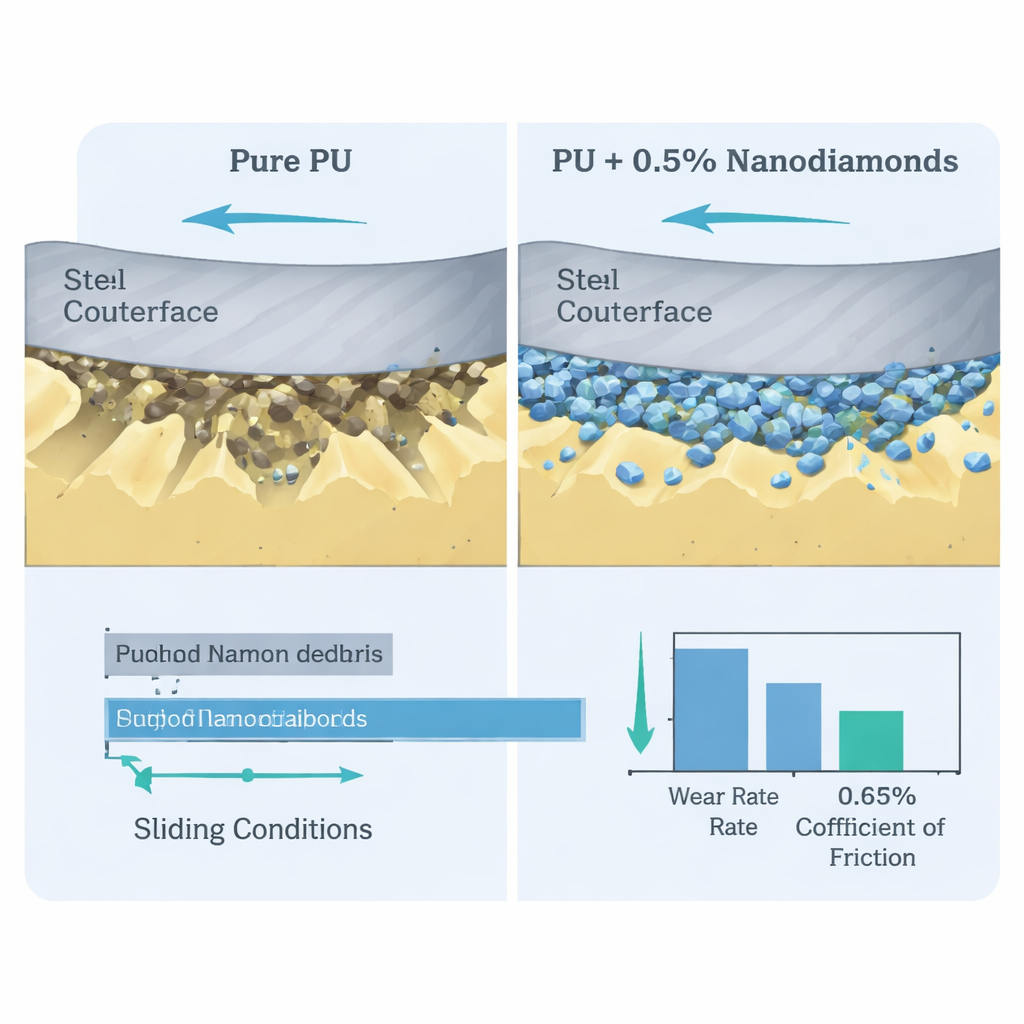
Rather than testing every possible combination—which would be time-consuming and expensive—the team used a statistical design method called Taguchi to select 27 representative test conditions. They then applied analysis of variance (ANOVA) to determine which factors mattered most. The results were clear: the composition of the material and the length of UV exposure dominated its behavior. Adding just 0.5 percent nanodiamonds gave the best performance, cutting wear to about a fifth of the worst case and reducing friction to around 0.25 under optimal conditions. In contrast, prolonged UV exposure made the material more brittle and increased both wear and friction. Microscopic images of worn surfaces confirmed this story: pure polyurethane showed deep grooves, craters, and plastic flow, while nanodiamond-reinforced samples had smoother tracks with shallower damage, especially before long UV aging.
Letting Machines Learn the Patterns
Because the interplay between load, speed, UV aging, and filler content is complex, the researchers also turned to machine learning. They trained three prediction models—linear regression, support vector regression, and a more advanced technique called XGBoost—on their experimental data. These models learned to estimate wear rate and friction from the input conditions. XGBoost performed best, matching measured values with very high accuracy. A further analysis tool, SHAP, helped explain the models’ decisions, again highlighting nanodiamond content and UV exposure time as the most influential factors. This means engineers could eventually use such models to quickly predict how a new polyurethane part will behave without having to run every test in the lab.
What This Means for Real-World Parts
For non-specialists, the takeaway is straightforward: adding a tiny amount of nanodiamonds to polyurethane can make sliding components both tougher and smoother, especially before heavy UV aging sets in. While long-term sunlight still harms the plastic, the reinforced material wears less and maintains a lower friction than ordinary polyurethane. By combining careful experiments, smart statistics, and machine learning, this work points toward longer-lasting, more reliable components in cars, aircraft, and industrial machines—helping reduce breakdowns, maintenance costs, and material waste.
Citation: Prasad, M.B., Louhichi, B., Rama Sreekanth, P.S. et al. Tribological performance of UV treated nanodiamond reinforced polyurethane nanocomposites through Taguchi and machine learning technique. Sci Rep 16, 7368 (2026). https://doi.org/10.1038/s41598-026-38403-z
Keywords: polyurethane composites, nanodiamonds, wear and friction, UV aging, machine learning materials