Clear Sky Science · en
Consolidation behaviour of AZ80 magnesium chips: influence of compaction pressure and holding time on porosity, interfaces and mechanical response
Turning Scrap into Stronger Metal
Modern cars and airplanes rely on lightweight metals to cut fuel use and emissions, but making those parts produces a surprising amount of metallic "sawdust" in the form of curled chips. This study explores a cleaner way to turn magnesium chips back into useful solid pieces without melting them, saving energy and preserving valuable material. By showing how to squeeze these chips into tough, stable blocks, the work points toward more sustainable manufacturing.
Why Magnesium Waste Matters
Magnesium alloys such as AZ80 are prized because they are light yet strong, making them ideal for vehicles that need to burn less fuel or extend battery range. However, shaping magnesium parts by machining inevitably produces scrap: even efficient casting routes can lose several percent of the original metal, while aerospace components may waste up to a fifth of the starting material as chips. Traditional recycling melts this scrap back down, but that takes a lot of energy and exposes the large surface area of chips to oxygen and leftover cutting fluids. The result is oxide-laden metal that can lose strength and quality.
Recycling Without Melting
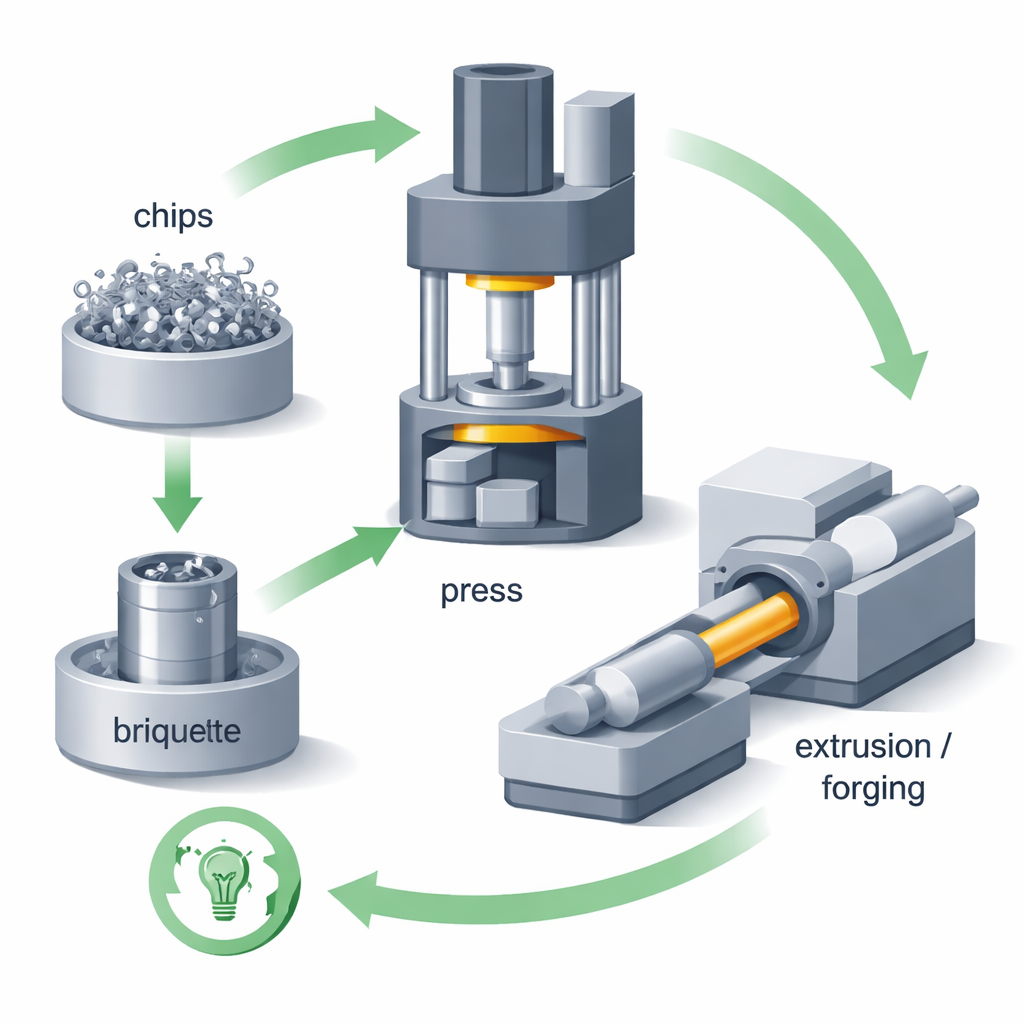
Instead of remelting, solid-state recycling presses metal chips together so forcefully that they deform, lock together, and can later be hot-worked into new parts. In this study, the researchers started with AZ80 magnesium chips produced using a water-based cutting fluid and did not clean them before pressing. They carefully measured chip size, surface roughness, and internal structure, then compacted fixed amounts of chips in a cylindrical steel die using a hydraulic press. Four pressing routes were compared, varying how high the pressure went, how long it was held, and whether the load was kept constant or allowed to relax during the hold.
How Time Under Pressure Closes the Gaps
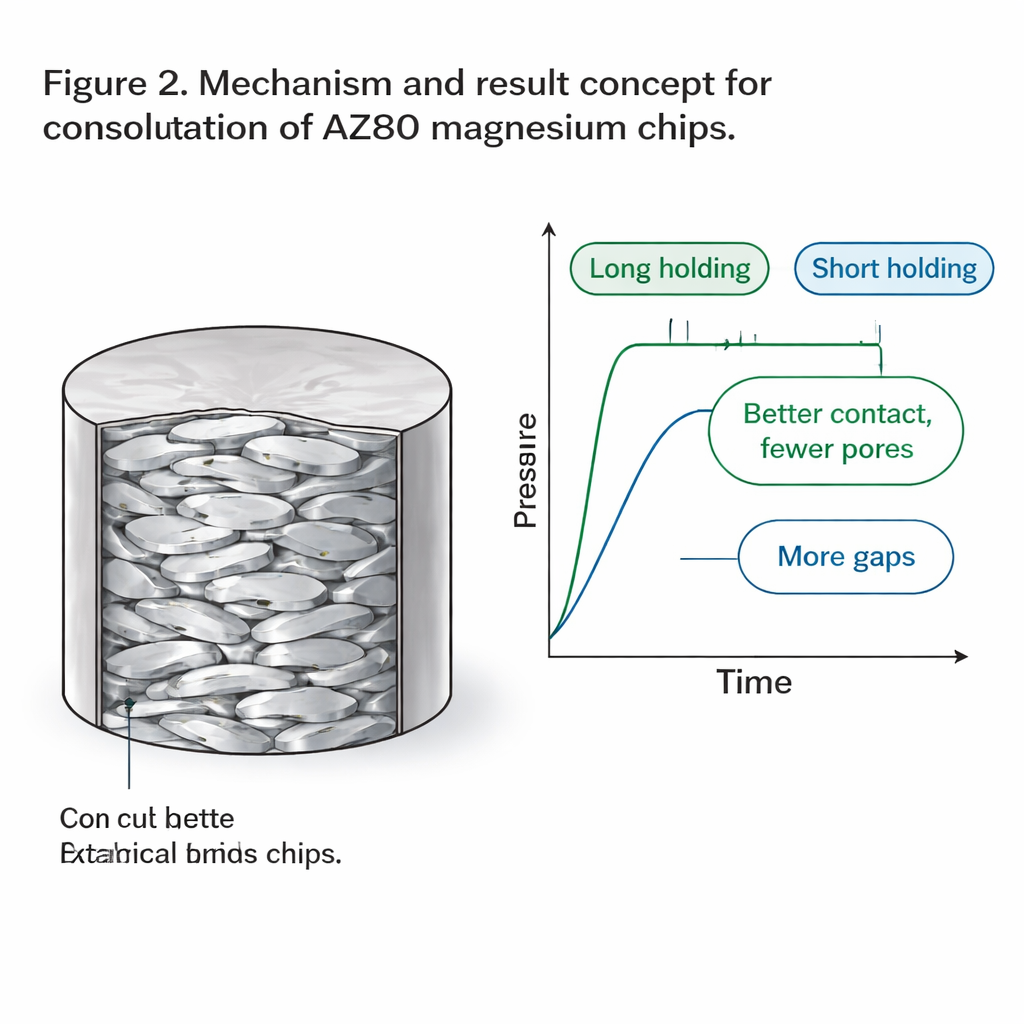
From the outside, all compacted cylinders looked sound, but detailed imaging told a more nuanced story. When pressure was applied and then held for a longer period, the chips had more time to rearrange and deform, allowing internal pores to shrink and spread more evenly. These routes reached overall solid fractions of about 91–92 percent of full density, with porosity distributed fairly uniformly from top to bottom. When the same or similar pressure was applied only briefly, more voids remained, especially near the bottom of the briquettes, and the overall density fell to about 87 percent. This showed that how long the material spends under load is more important than simply how high the peak pressure is.
Invisible Films, Visible Effects
Under the microscope, the compacted chips looked like overlapping platelets with thin gaps at their boundaries. Chemical maps revealed that these boundaries were lined with a very thin layer rich in oxygen: a stubborn native oxide that survives machining and pressing. Longer holding times squeezed the chips into closer geometric contact, shrinking these gaps to sub-micrometer scales and improving mechanical interlocking, but the oxide film itself did not break enough to allow true metal-to-metal bonding. The leftover cutting fluid, by contrast, did not show a strong effect within the range of pressures and times used, suggesting that simple pre-cleaning may be less critical than previously assumed for this type of cold compaction.
Strength Depends on Contact Quality, Not Just Packing
Mechanical tests under compression highlighted how the internal architecture controls performance. All samples first showed a non-linear stage where pores and gaps closed, followed by an almost straight-line segment where the solid network carried load. Interestingly, the briquette that was not the densest overall but had the best-locked interfaces—thanks to a long, sustained hold at high pressure—was the stiffest, resisting deformation much like a more continuous metal. By contrast, a slightly denser sample with more open micro-gaps was less stiff. Hardness measurements around each briquette showed that short holding times left regions highly work-hardened but uneven, while longer holding allowed stresses to redistribute, leading to more moderate and balanced hardness values.
What This Means for Greener Metal Use
For non-specialists, the key message is that time under pressure can be as important as pressure itself when compacting metal chips for recycling. Simply pushing harder is not enough; the chips must be held long enough to bend, flow, and lock together, even though an ultra-thin oxide skin still keeps them from fully fusing as if they had been melted. By tuning pressing schedules to favor better contact rather than just higher density, manufacturers could transform dirty-looking magnesium chips into reliable feedstock for further forming steps, cutting waste and energy use while keeping lightweight design on a more sustainable footing.
Citation: Murillo-Marrodán, A., García, E. & Nakata, T. Consolidation behaviour of AZ80 magnesium chips: influence of compaction pressure and holding time on porosity, interfaces and mechanical response. Sci Rep 16, 7321 (2026). https://doi.org/10.1038/s41598-026-38401-1
Keywords: magnesium recycling, solid-state processing, metal machining chips, lightweight alloys, sustainable manufacturing